
Curved Stairlifts
A curved stairlift is built around a rail made to measure for one staircase, which is why it costs two to three times what a straight lift costs and takes weeks, not days. Expect £4,000 to £7,000 installed for a single bend, and £7,000 to £10,000 once the stairs turn more than once.
How much does a curved stairlift cost? The median published price of a new curved stairlift in the UK is £4,395, from 28 prices published by 19 UK sellers and captured 20 August 2026 for our UK Stairlift Price Tracker. Published prices ran from £2,695 to £10,000 — the widest spread of any stairlift type — with 24 of the 28 between £3,500 and £6,000. As a budget guide: £4,000 to £7,000 installed for a single bend, £7,000 to £10,000 for multiple bends or a half landing, and £9,000 to £12,000 for a spiral or three storeys. Reconditioned curved lifts: median £3,342 from 14 published prices. See how we count.
What is a curved stairlift?
A curved stairlift is a powered chair running on a rail formed to follow the exact shape of your staircase, round quarter turns, winders, half landings and full 180 degree bends. The chair is close to a commodity: seat, motor, batteries, seatbelt and controls are much the same parts a straight lift uses, and several brands fit an identical carriage to both. What you pay for is the rail, a one-off made for one house.
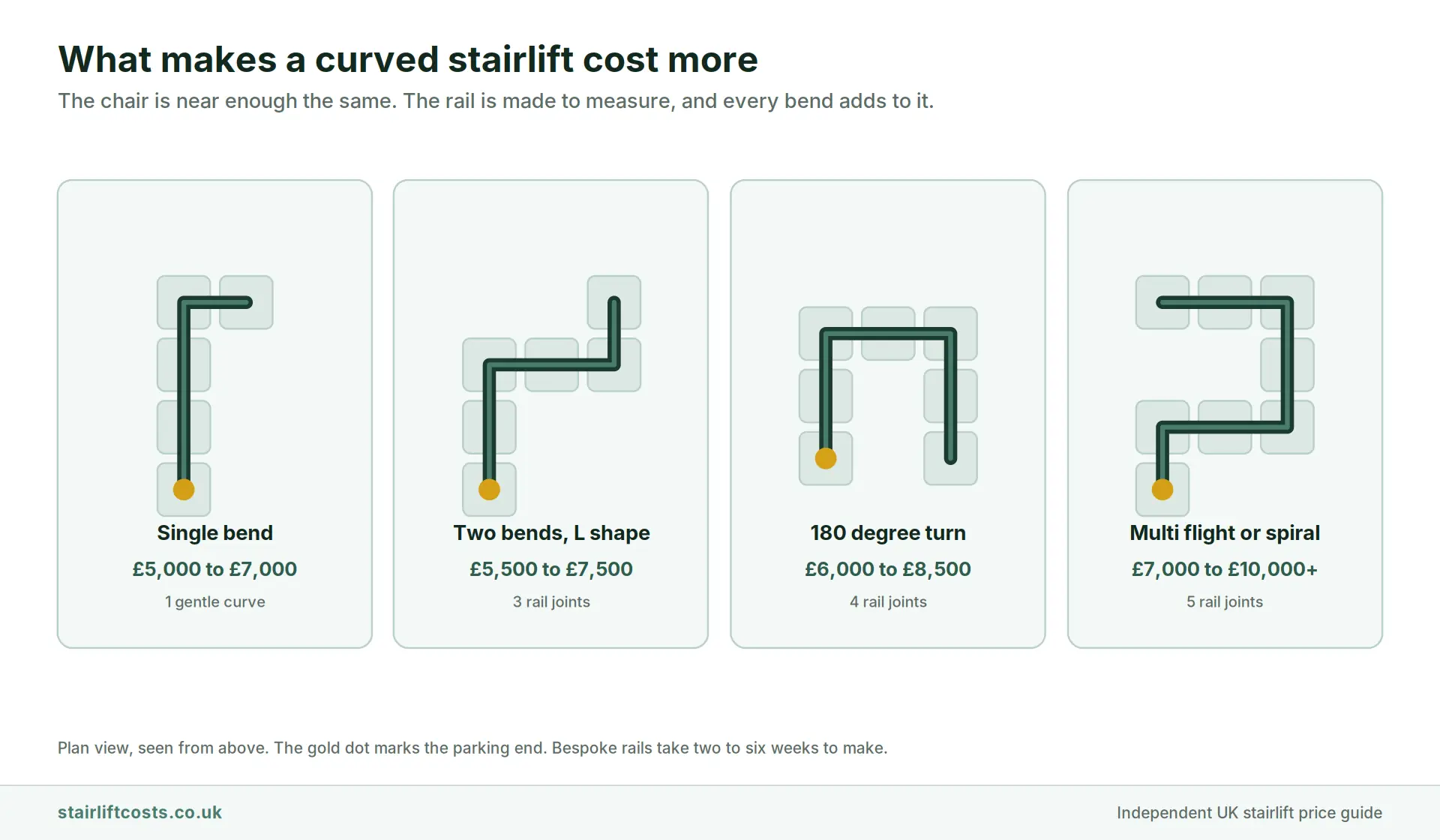
That single fact explains the rest. The rail is 50 to 70 percent of the price, so every extra bend adds cost. Nothing can be fitted until the rail exists, so the wait is manufacturing time. And because a rail formed for your stairs fits nobody else’s, a curved lift has almost no resale value and cannot sensibly be rented. It still bolts to the treads and strings, never the wall, so nothing structural is touched.
Is a curved stairlift right for your staircase?
A curved stairlift usually works if
- Your stairs turn at any point, by a quarter turn, winders or a half landing
- The user can transfer onto a seat unaided or with light help
- The narrowest point measures about 75cm, or from about 61cm for a slimline rail
- You expect to stay in the house for seven years or more
- There is a socket within reach of a park position at the top or bottom
Look at something else if
- The user cannot leave a wheelchair. A stairlift cannot help here at any price, whereas a through-floor lift carries chair and user together
- The stairs break at a half landing and the user can stand and transfer. Two straight lifts are usually thousands cheaper
- The condition is progressive and a wheelchair is likely within a few years
- The stairs are too tight even for a slimline rail. See the narrow stairs guide
- Bending the hips or knees is painful. A standing or perch lift can be curved, but needs balance
Ask for the rail specification, not just the price. Curved quotes are hard to compare on the headline figure, because you cannot see what each firm has priced. Ask every company for the rail length in metres and the number of formed bends, then compare cost per metre. That turns three unlike quotes into three comparable ones.
How much does a curved stairlift cost in 2026?
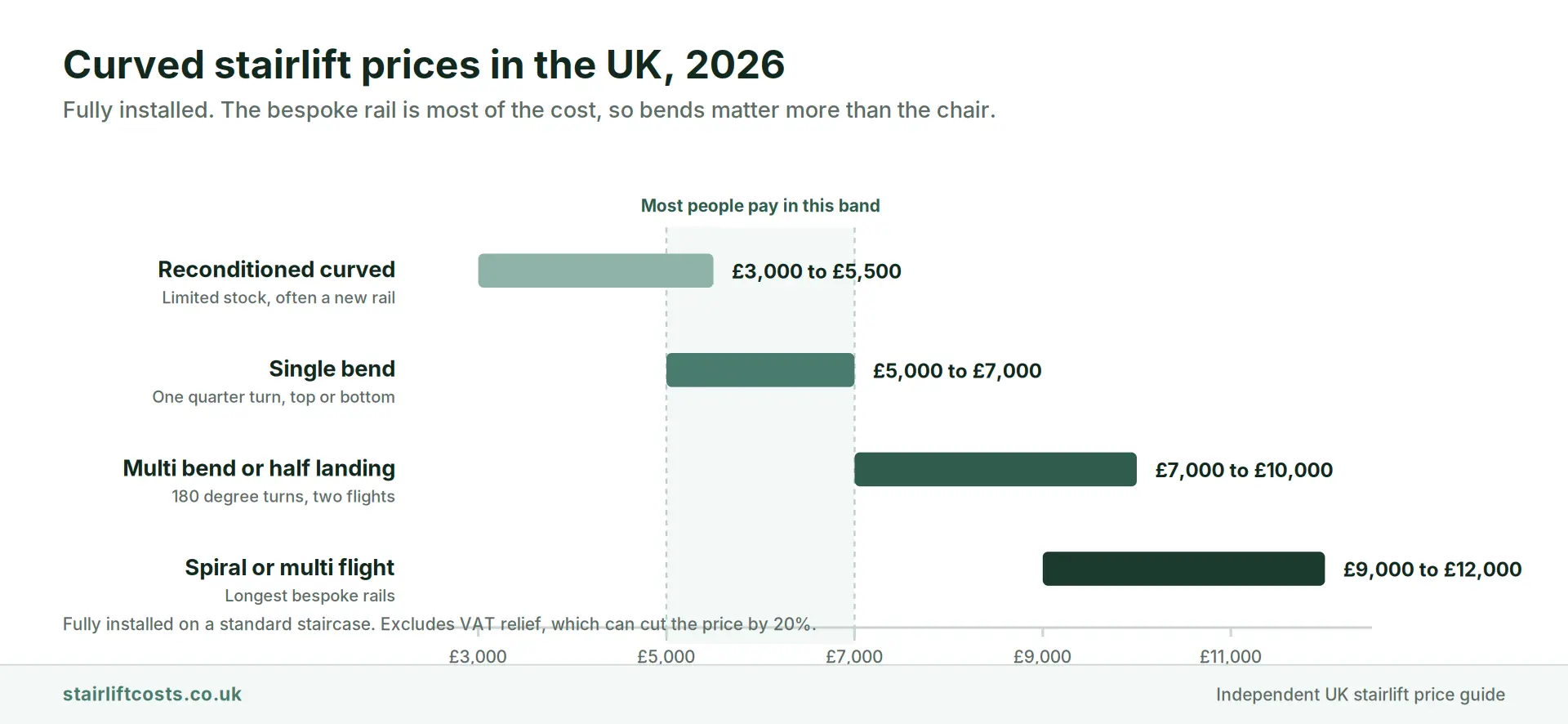
Most households pay £4,000 to £7,000 for a new curved stairlift on a staircase with one bend, and £7,000 to £10,000 where the stairs turn more than once or break at a half landing. Spiral staircases and three-storey runs reach £9,000 to £12,000. The gap between those bands is almost entirely rail: more metres, more curves and more joints.
What sellers actually publish: for our UK Stairlift Price Tracker we captured 28 published prices for new curved stairlifts from 19 UK sellers on 20 August 2026. The median was £4,395 — 2.2 times the £1,995 median for a new straight lift — and prices ran from £2,695 to £10,000, the widest spread of any stairlift type. That spread is the rail: 13 of the 28 were open-ended “from” prices, one seller lists a £300 premium for the 180-degree version of the same model, and single-flight installs are advertised from £3,500.
| Staircase | Installed price | Why it costs that |
|---|---|---|
| Single bend, one quarter turn | £4,000 to £7,000 | Shortest bespoke rail, one formed curve |
| Two or more bends, L-shape or half landing | £7,000 to £10,000 | Longer rail, more curves, more joints |
| Spiral, helical or three storeys | £9,000 to £12,000 | Continuously curving rail, the most metres |
| Reconditioned curved | £2,200 to £4,700 | Refurbished carriage on a brand new bespoke rail |
Last verified: August 2026
Why the rail is the product
On a straight lift the rail is a stock extrusion cut to length and the chair is where the money goes. Curved reverses that. Your staircase is measured in detail: the pitch of each flight, the rise and going of every tread, the newel posts, handrails, radiators and doorways, and the geometry of any landing. That becomes a CAD design, and the rail is formed, jointed and powder coated to it. Inside the bands, price moves with rail length, the number and tightness of the bends, an over-run at the top, a hinged section to clear a doorway, powered swivel and footrest, and whether you buy from a manufacturer or a dealer. Some makers assemble rails from pre-formed segments, others form them continuously, and almost none publish which, so ask what it means at your tightest bend. See also our straight vs curved comparison.
What a quoted price usually includes, and what it does not
| Usually included | Usually extra |
|---|---|
| Free home survey and measure | Servicing once the warranty ends |
| Design and manufacture of the bespoke rail | Removing an existing stairlift |
| Delivery, rail assembly and commissioning | Adding a socket if there is not one in reach |
| Connection to a nearby 13 amp socket | Extra remote call stations beyond the two supplied |
| Two remote call stations, one per floor | Powered swivel, powered footrest, hinged rail |
| 12 to 24 months parts, labour and call-outs | Batteries, even under some cover plans |
Two straight stairlifts instead of one curved lift
Where a staircase breaks at a half landing, two straight lifts with a short walk between them is a real alternative, and at roughly £4,000 to £7,000 for the pair it is often several thousand pounds cheaper than one curved rail. Both use stock rails, so the job is fitted in days. Every curved installer can price this, and many will not mention it unless asked.
The trade-off is the transfer. The user must stand at the half landing, walk a few steps and sit again, usually with a drop on one side. For someone with reasonable balance that is a sensible saving. For a wheelchair user, or anyone who fatigues quickly, it is the whole risk of the installation. Ask each surveyor for both quotes in writing, and get a free council occupational therapy assessment if unsure.
How to pay less for a curved stairlift
VAT relief is the biggest single saving
On a curved lift, VAT is worth £1,000 or more. There are two reliefs and most buyers qualify for one, so settle the VAT question before you negotiate on price.
- Zero rate, 0% VAT. Available where the lift is supplied and installed for a chronically sick or disabled person in their own home. HMRC defines that as an impairment with a long-term, substantial adverse effect on everyday activities, or a condition treated as a chronic sickness. Being elderly or frail on its own does not qualify.
- Reduced rate, 5% VAT. Available on age alone where the customer is 60 or over and the lift is supplied and installed in their own home. It does not cover goods without installation, care homes, or repairs after installation.
What most guides get wrong. You do not reclaim VAT relief from HMRC and you do not need a doctor’s letter or proof of benefits. You sign a short eligibility declaration, separate from the order form, and the supplier simply does not charge the VAT. If you qualify on disability grounds the zero rate also covers later servicing and repairs, which almost nobody is told at the point of sale.
Grants and council help
A Disabled Facilities Grant can cover all or part of a curved stairlift after an occupational therapy assessment. Curved lifts are a mainstream adaptation and sit inside every national cap.
| Nation | Maximum | Means tested? |
|---|---|---|
| England | £30,000 | Yes, on the disabled person and partner. Not means tested for a disabled child. Adaptations costing £1,000 or less must be provided free |
| Wales | £36,000 | Yes, with small adaptations usually fitted free regardless of means |
| Scotland | No DFG. Scheme of Assistance instead | Councils fund at least 80% of approved costs, and up to 100% on qualifying benefits |
| Northern Ireland | £35,000 | Yes, administered by the Housing Executive. Confirm the current cap with NIHE before you rely on it |
Last verified: August 2026 against the grant legislation. GOV.UK still shows the superseded £25,000 figure for Northern Ireland.
A grant cannot pay for work already done, so apply before you order, and remember the rail takes weeks to build on top of however long approval takes. Council and housing association tenants should ask the landlord first. Our grants guide covers each nation.
Reconditioned, rental and finance
- Reconditioned. Sold at £2,200 to £4,700, but only the carriage is second-hand. The old rail is scrapped and a new bespoke rail is built for your staircase, which is why the saving is nothing like the 60 percent a reconditioned straight lift delivers. Which? says made-to-measure curved lifts are not usually available second-hand. That is half right: they are, but the expensive half is new every time.
- Rental. Rarely offered and rarely good value, because the provider still builds a one-off rail it can never re-let and front-loads that cost into a large upfront fee. Get the end-of-rental removal fee in writing.
- Finance. Compare the total repayable, not the monthly figure, and check the agreement is regulated.
- Charities. Independence at Home, the ACT Foundation, SSAFA, the Royal British Legion and trusts listed on Turn2us make small grants towards adaptations.
What a curved stairlift costs to run
Running costs are modest and only slightly higher than a straight lift. The difference is servicing: more rail joints, more bend transitions where the levelling gear works hardest and usually powered mechanisms, so a visit takes longer. Ignore anyone selling a legally required LOLER inspection: the Health and Safety Executive is clear that stairlifts in private dwellings fall outside LOLER and PUWER, and a paid carer using one does not change that.
| Running cost | Typical UK figure | How often |
|---|---|---|
| Electricity | About £12 a year | Continuous, driven by the charger, not the journeys |
| Annual service | £100 to £200, curved at the top | Yearly, once the warranty ends |
| Out of warranty repair | Call-out £75 to £200, plus parts | As needed. Curved carriages are model-specific |
| Battery replacement | £50 to £120 fitted | Every 3 to 5 years |
| Cover plan | £150 to £300 a year | Optional, and batteries are usually excluded |
| Removal at end of life | £150 to £300, curved at the top | Once. Free removal is rare, because there is no resaleable rail |
Last verified: August 2026
Curved stairlift models sold in the UK
A curved rail is built for your staircase, so choosing a model is really choosing a rail system: a single tube, twin rails, or modular bend sections joined on site. One thing rarely mentioned at the survey is that the same chair usually carries less on a curve than it does on a straight run, by as much as 40kg in Stannah’s case.
| Model | Rail | Max user weight | Other published figures |
|---|---|---|---|
| Acorn 180 | Modular bend sections | 120kg | 620mm wide, 335mm folded, 0 to 58 degrees, rail to 30m |
| Stannah Siena, stairs with turns | Twin rail | 120 to 135kg | 679mm minimum in use, 405mm folded |
| Stannah Starla, stairs with turns | Twin rail | 120 to 135kg | 679mm minimum in use, 405mm folded |
| Stannah Sadler | Twin rail | 135kg | Staircase from 650mm, 400mm overrun at the top |
| Handicare and Companion Freecurve | Single rail | 125kg | Not published |
| Handicare and Companion 4000 | Twin rail | 160kg | Not published |
| Halton Ultimate | Not published | 120kg or 160kg | Up to 75 degrees, 0.12 m/s, seat 510mm from the floor |
| Halton Dual Rail | Twin rail | 160kg | 589mm wide, minimum bend radius 200mm |
| Halton Infinity | Not published | 125kg | 607mm wide, 407mm folded depth |
| Otolift Modul-Air Smart | Single rail, 60mm tube | 125kg | Staircases from 70cm |
| Access BDD Flow X | Single rail | 125kg | Staircase from 610mm, up to 72 degrees, from £4,500 |
| Platinum ergo Curve | Twin rail | 160kg | Not published |
| Platinum ergo Ultimate | Single tube | 160kg | Not published |
The steepest staircase any UK maker commits to in writing is 75 degrees, on the Halton Ultimate, with the Flow X close behind at 72. Everyone else leaves the angle out, which is why a survey is the only way to settle it. We hold a dated source page for every one of these figures in our UK stairlift model specifications table.
Will a curved stairlift fit? What to measure
A surveyor does this properly and for free, and on a turning staircase the survey is detailed and never a formality. These are the figures that decide whether you are in ordinary territory.
| Specification | Typical curved stairlift |
|---|---|
| Stair width needed | About 75cm at the narrowest point, from 61cm for a slimline rail |
| Weight capacity | 120 to 140kg, 19 to 22 stone. Heavy-duty curved models reach 160kg |
| Capacity on the bends | Often lower than the straight-rail rating. Ask for the figure on the curve |
| Travel speed | Up to 0.15 metres a second, slower through bends |
| Rail fixing | Bolted to the treads and strings, not the wall |
| Power | Battery driven, trickle charged from a 13 amp socket, so it works in a power cut |
| Charging | At the park positions only |
Width is not the only constraint on a turning staircase. Winders narrow sharply at the inside of a bend, a newel post can sit exactly where the rail wants to run, and a low window or radiator can push the rail out from the wall and cost clearance. Knee and shoulder room at the tightest bend matters more than width at the bottom step.
Installation, step by step
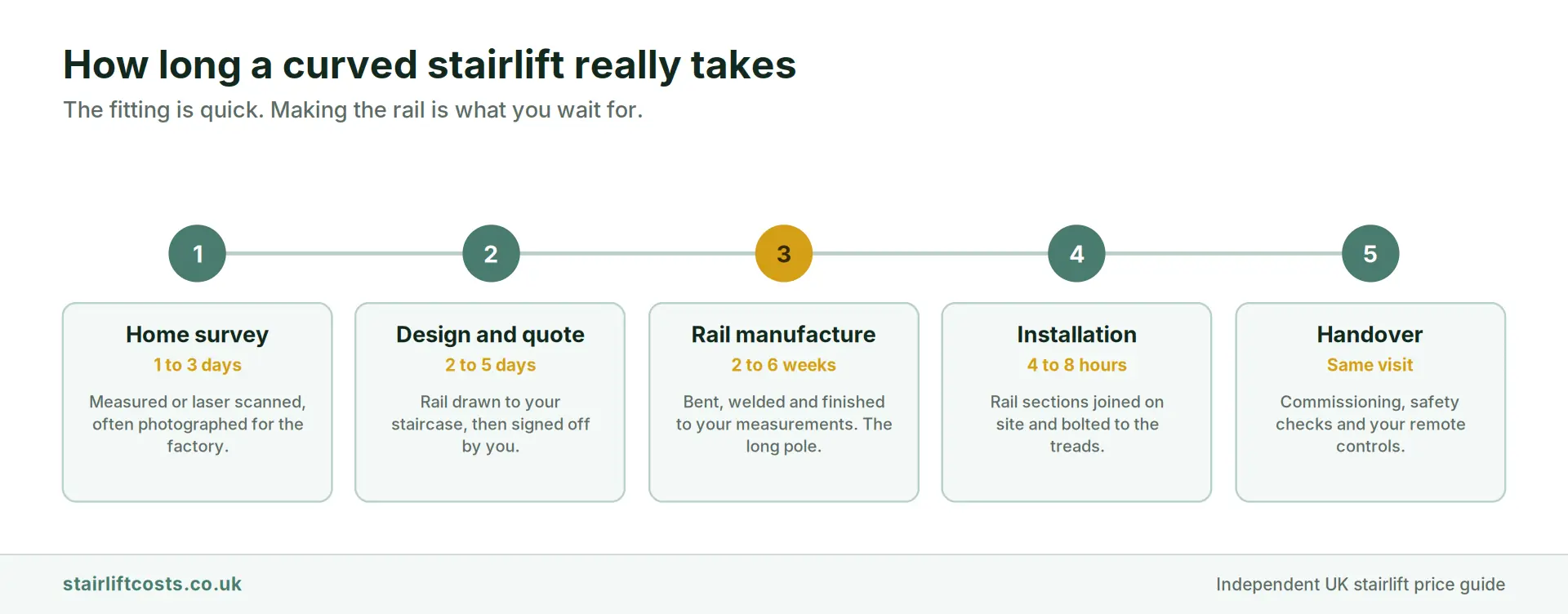
Reckon on 2 to 6 weeks from survey to fitting. The survey and quote take days; the rail takes weeks. Fitting takes 4 to 8 hours depending on the bends and rail sections. The engineer joins the sections, bolts the brackets to the treads and strings, aligns the carriage, connects to a socket, then commissions the lift by running it through every bend and testing the safety edges, seatbelt, limit stops and emergency stop. Carpets stay down, and only screw holes remain afterwards.
Permissions
- Planning permission is never required for an internal stairlift. Works affecting only the interior are not development at all, so this holds for flats as well as houses.
- Building regulations approval is not normally required, because bolting a rail to the treads is not a material alteration. Only a new dedicated circuit, bringing in Part P, is likely to change that.
- There is no legal minimum stair width. No Approved Document sets one for a private stair, and none mention stairlifts, so any figure quoted as a regulation is not one. A building control officer can still take a view on escape routes in a loft-converted house.
- Listed buildings need listed building consent, including for internal work, and applying is free. Historic England regards a rail on a principal staircase as intrusive and a last resort.
- Rented homes need the landlord’s written permission, as consent to a relevant improvement, which must not be unreasonably withheld. Expect to agree reinstatement, and photograph the stairs first.
Safety features and standards
UK stairlifts are built to BS EN 81-40:2020, and are regulated as machinery rather than as lifts because they travel at no more than 0.15 metres a second. Ask for the Declaration of Conformity and check the standard it cites, because the withdrawn 2008 edition is still quoted on some dealer pages. CE and UKCA marking are both lawful in Great Britain, though UKCA alone is not valid in Northern Ireland. Every mainstream curved model includes:
- Obstruction sensors on the carriage, footrest and both ends of the rail, which stop it on contact
- A retractable seatbelt, with a full harness available where needed
- A swivel seat that locks at the landing, so you step off onto the floor and not onto a step
- Constant-pressure controls, so the lift stops the moment you let go
- A key switch to isolate the lift, useful with children or dementia at home
- An overspeed governor and dual braking, plus manual lowering if power and battery fail
Warranty, lifespan and resale
New curved stairlifts come with 12 months of parts, labour and call-outs as standard, 24 from some brands, and longer only as a paid extension. Reconditioned units carry 6 to 12 months. Servicing by a non-approved engineer voids most warranties and batteries are excluded from almost every cover plan. A well maintained curved lift gives 7 to 12 years, a little less than a straight lift, because rail joints, bend transitions and powered mechanisms are what wear.
Resale is where curved lifts differ sharply. A straight rail can be shortened and reused. A curved rail fits one staircase, so the trade wants the carriage alone. Realistic buy-back is £0 to £400: £200 to £400 under four years old, £100 to £250 at four to seven years, and nothing beyond that. Charities almost always decline used stairlifts. By roughly year eight the lift is worth less than it costs to take out. Our guide to selling a stairlift covers the options.
The repair calculation runs the other way. Because replacing a curved lift means paying for a new bespoke rail all over again, even reconditioned, repairing an ageing one stays sensible far longer than on a straight lift. A £400 gearbox repair on a nine year old curved lift is usually the right call. The same repair on a straight lift often is not.
Curved stairlift compared with the alternatives
| Option | Installed cost | Best for |
|---|---|---|
| New curved stairlift | £5,000 to £12,000 | Any turning staircase where the user can transfer onto a seat |
| Reconditioned curved | £2,200 to £4,700 | Tighter budgets, shorter warranty |
| Two straight lifts with a transfer | About £4,000 to £7,000 | A half landing, and a user who can stand and transfer safely |
| Straight stairlift | £1,500 to £3,500 | A single straight flight with no bend at all |
| Through-floor lift | £13,000 to £17,000 | Wheelchair users who cannot transfer |
| Downstairs living | Varies, often grant funded | Where there is room for a bed and wet room |
Last verified: August 2026
The usual mistake is treating curved stairlift against through-floor lift as a price contest. It is not. It is a question of whether the user can safely transfer onto a seat. If they can, a curved stairlift is nearly always right, at a third of the cost. If they cannot, it is the wrong product.
What to ask before you sign
Get three quotes and say you are comparing. Take these to each survey and write down the answers, because the difference between two curved quotes is rarely the price.
- How many metres of rail is this, and how many formed bends, so I can compare cost per metre?
- Is the rail modular or formed to my staircase, and what does that mean at the tightest bend?
- Is this price at 0%, 5% or 20% VAT, and will you supply the declaration form?
- What is the weight capacity going around the bends, not just on the straight sections?
- Where will the carriage park, and does it fold clear of the doorway and any loft stair?
- Are the swivel and footrest powered or manual, and is an over-run at the top included?
- How long is the warranty, does it cover parts, labour and call-outs, and are batteries included?
- What will an annual service cost from year three, and what is the call-out fee?
- Are you the manufacturer or a dealer, and what happens if you cease trading?
- What is your engineer response time, including evenings, weekends and bank holidays?
- What will removal cost at end of life, and what buy-back, if any, would you offer in writing?
- Are you a member of the British Healthcare Trades Association, which offers binding dispute resolution?
Your rights, and the red flags
Stairlifts are usually sold in your home, making the sale an off-premises contract with a 14 day right to cancel under the Consumer Contracts Regulations 2013. Goods made to your specification are excluded, and on a curved lift that exemption is far harder to argue with than on a straight one: the rail genuinely is made for your staircase and can be sold to nobody else. Expect it to bite the moment the rail goes into production, so ask exactly when that is. If you were never given the cancellation information in writing, the period extends by twelve months.
Walk away from: a price that only holds if you sign today, the cancelled curved order going cheap that happens to fit your stairs, a refusal to put the rail length and bend count in writing, or pressure to decide during the survey. The BHTA code of practice bans price-dropping and pressurised selling by its members, and it is a Chartered Trading Standards Institute approved code.
Frequently asked questions
How much does a curved stairlift cost in the UK?
The median published price of a new curved stairlift in the UK is £4,395, from 28 prices published by 19 UK sellers and captured 20 August 2026 for our UK Stairlift Price Tracker. As a budget guide, expect £4,000 to £7,000 fully installed for a single-bend staircase, and £7,000 to £10,000 where the stairs turn more than once or break at a half landing. Spiral and three-storey installations run £9,000 to £12,000, and reconditioned curved lifts £2,200 to £4,700.
Why are curved stairlifts so much more expensive than straight ones?
Because the rail is made to measure for one staircase and is roughly 50 to 70 percent of the price. A straight rail is a stock length cut to size, while a curved rail is surveyed, designed in CAD, formed and finished for your stairs alone. The chair on top is much the same part.
How long does a curved stairlift take to install?
Allow 2 to 6 weeks from survey to fitting. Almost all of that is rail manufacture, which cannot start until the staircase is surveyed and the design signed off. The fitting itself takes 4 to 8 hours in a single visit, depending on the number of bends.
Is it cheaper to fit two straight stairlifts than one curved stairlift?
Usually yes. Two straight lifts on a staircase with a half landing cost roughly £4,000 to £7,000 for the pair against £7,000 to £10,000 for one curved rail, and can be fitted in days. The trade-off is that the user must stand, walk a few steps and transfer at the landing.
Can you buy a reconditioned curved stairlift?
Yes, at £2,200 to £4,700 installed, but only the carriage is second-hand. The old rail is scrapped and a new bespoke rail is built for your staircase, so the saving is around a quarter to a third rather than the 60 percent a reconditioned straight lift delivers. Warranties are 6 to 12 months.
Will a curved stairlift fit narrow stairs?
Standard curved models need about 75cm of clear width at the narrowest point, and slimline curved rails fit staircases from about 61cm. Width at the tightest bend matters more than width at the bottom step, because winders narrow sharply inside a turn.
Do I need planning permission for a curved stairlift?
No. Works affecting only the interior of a building are not development, so no internal stairlift needs planning permission, in a house or a flat. Building regulations approval is not normally needed either. Listed buildings are the exception: internal work needs listed building consent, and applying is free.
What is a curved stairlift worth second-hand?
Very little. Realistic buy-back is £0 to £400: £200 to £400 under four years old and £100 to £250 at four to seven years, with almost nothing beyond that. The rail fits one staircase and is scrapped, so only the carriage has value. Charities generally decline used stairlifts.
How long does a curved stairlift last?
Around 7 to 12 years with annual servicing, slightly less than a straight lift, because rail joints, bend transitions and powered swivel and footrest mechanisms are what wear. Repairing an ageing curved lift stays sensible for longer than on a straight lift, because replacing it means paying for a new bespoke rail.
Does a curved stairlift work in a power cut?
Yes. Curved stairlifts run on batteries that trickle charge from a normal 13 amp socket at the parking positions, so a power cut leaves enough charge for several return trips. Charging happens at the park points, not along the whole rail, so return the chair to park instead of leaving it mid-flight.