
Standing Stairlift
A standing stairlift, usually called a perch lift, carries the user in a semi-upright position on a small ledge seat rather than a chair. It exists for two reasons: hips or knees that will not bend enough to sit, and staircases too narrow for a seated lift. Expect £2,000 to £3,500 installed on a straight staircase, against £1,500 to £3,500 for a seated lift on the same stairs.
How much does a standing stairlift cost? A standing or perch stairlift costs £2,000 to £3,500 fully installed on a straight staircase in the UK in 2026, and £4,000 to £10,000 on a curved rail. A slimline rail for a narrow flight runs £2,000 to £3,500. It costs more than a seated stairlift on the same stairs, which is £1,500 to £3,500. Every figure here comes from our Pricing Index, reviewed quarterly against published UK prices.
What is a standing stairlift?
A standing stairlift runs on exactly the same rail and carriage as an ordinary stairlift. What changes is the seat. Instead of a chair you get a small padded ledge, roughly 320mm deep, set high above the footplate and adjustable between about 675mm and 875mm on the one model that publishes a full dimension sheet. The user stands on the footplate, leans back against a padded backrest, takes some weight through the ledge and rides semi-upright, facing sideways across the flight instead of forwards down it. A lap belt fastens across the pelvis and there is a guard rail to hold.
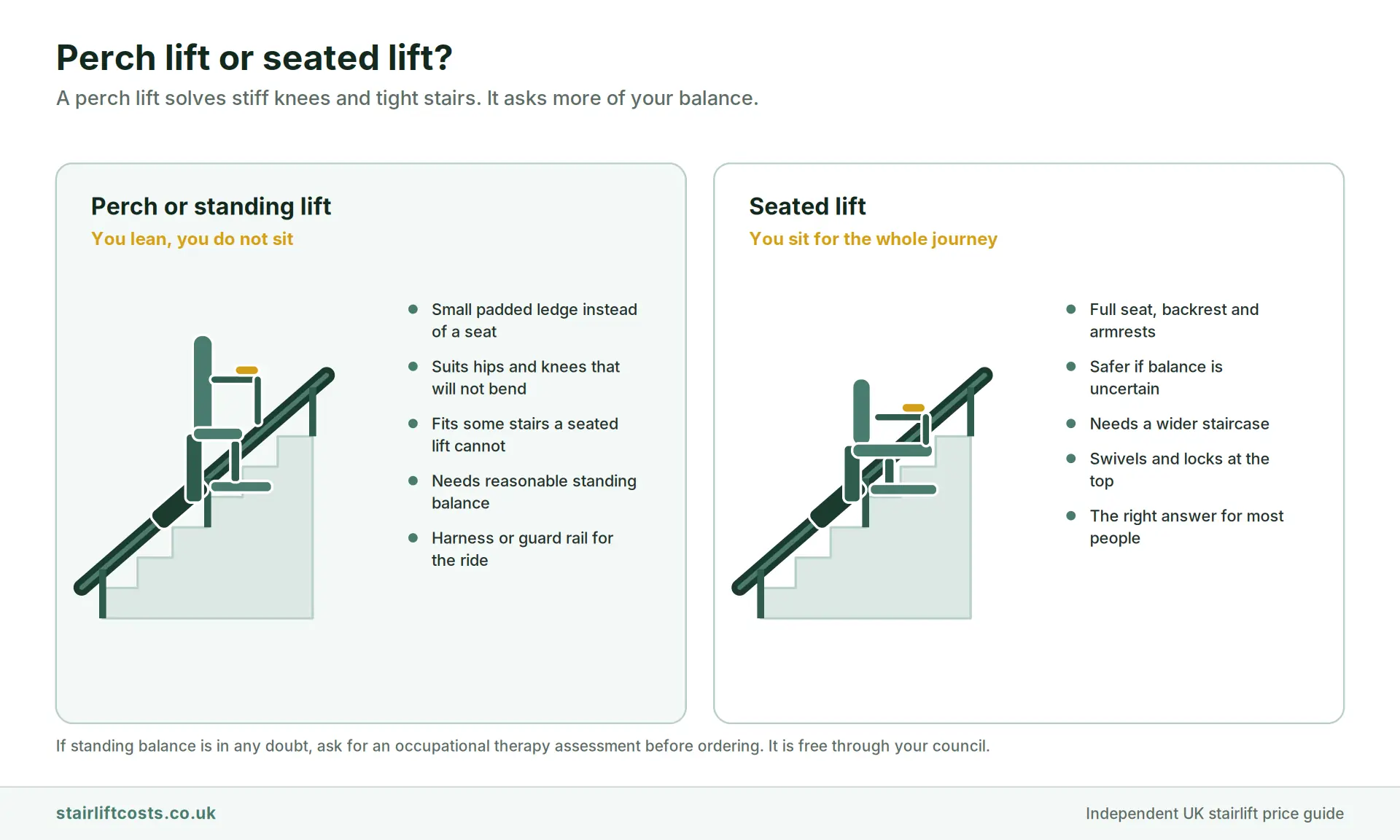
Two details follow from that design and they drive everything else on this page. First, the perch seat is fixed. There is no 90 degree swivel, so the user does not turn to face the landing at the top, they step off directly. That is what frees up the space: a seated lift needs a swivel radius of roughly 645mm at the landings, and the perch does not. Second, the seating point sits far higher than the 430mm to 520mm of a seated lift, which puts the body above the handrail line rather than projecting across the treads, and makes headroom, not stair width, the constraint people trip over.
Is a standing stairlift right for you?
A perch stairlift usually works if
- Hips or knees will not bend far enough to sit properly, because of a stiff or fused joint, a recent replacement with movement restrictions, or a fixed contracture
- The user can stand and take full weight on both legs for the whole journey, not just for a moment at each end
- There is enough headroom for the user standing on the footplate, measured at the tightest point of the flight
- The staircase is too narrow for a seated lift, at roughly 60cm to 68cm of clear width
- The user has the upper body strength and grip to hold the guard rail throughout, and the balance to stay steady while the lift is moving
- An occupational therapist has seen the user on the stairs and supports the choice
Look at something else if
- The user can sit comfortably. A seated straight stairlift is cheaper, has a wider model choice and gives more support
- Standing tolerance is limited or the user tires quickly. A journey takes 30 to 60 seconds and the user is on their feet for all of it
- Dizziness, vertigo or blackouts are part of the picture, or balance is unreliable
- Memory or understanding make it likely someone would try to step off part way up
- Legs are weak or paralysed, or full weight bearing is not possible. That points to a seated lift or a through-floor lift
- The user cannot leave a wheelchair at all, in which case no stairlift of any kind is the answer
Get the assessment before the quotation. Your council’s adult social care service provides an occupational therapy assessment free of charge, and for a perch lift that is not a formality. Guidance used by councils treats stairlifts as something a trusted assessor can sign off only where the situation is simple and straightforward, and a perch lift is by definition not that: the transfer is non-standard, the restraint is lighter, and standing tolerance has to be judged on a bad day, never a good one. Book it before you take a quotation, not after.
How much does a standing stairlift cost in 2026?
A perch stairlift costs £2,000 to £3,500 fully installed on a straight staircase. The perch is a seat option on a standard rail rather than a different machine, so what moves the price is the rail, not the seat. A straight rail is a stock extrusion cut to length. A curved rail is bent to your staircase after survey, which is why the same lift costs £4,000 to £10,000 once the stairs turn.
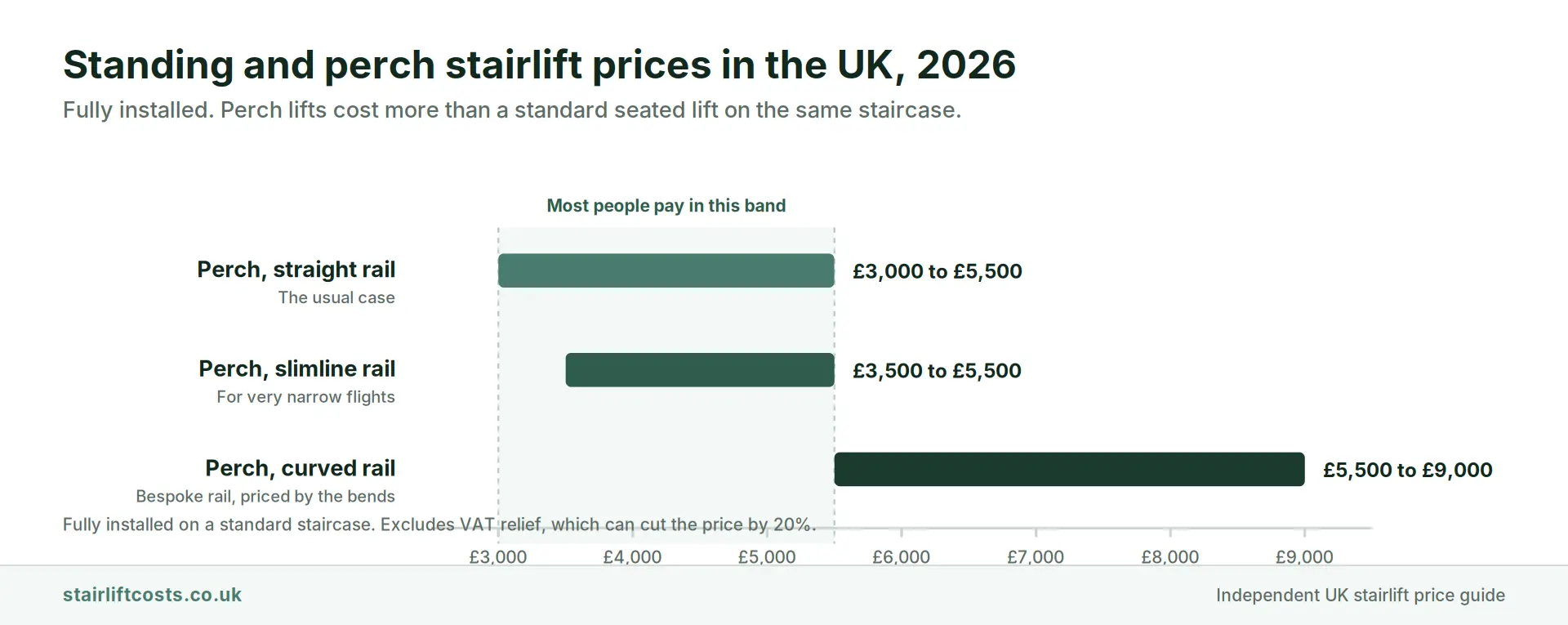
| Option | Installed price | What you get |
|---|---|---|
| Perch, straight rail | £2,000 to £3,500 | Stock rail cut to length, fixed ledge seat with adjustable height, backrest, lap belt and guard rail |
| Perch, slimline rail | £2,000 to £3,500 | Narrow-profile rail and carriage for tight staircases, usually a shorter model list to choose from |
| Perch, curved rail | £4,000 to £10,000 | Rail bent to your staircase, measured and manufactured after survey, longer lead time |
| Seated straight stairlift | £1,500 to £3,500 | The comparison that matters. A full chair with a 90 degree swivel on the same staircase, for less money |
| Reconditioned perch | Limited stock, ask locally | Some perch models are now refurbished stock only. Check the age of the carriage and what warranty comes with it |
| Rental | Rarely offered | Hire fleets carry seated straight and curved lifts. The perch seat is generally a purchase option, not a rental one |
Last verified: August 2026. Prices updated 16 September 2026. Few UK sellers publish perch prices: new straight perch and sit-stand lifts are listed at £1,950 (Brooks, Unicorn Stairlifts), £2,395 (My Mobility UK) and £3,195 (Handicare 1000 Perch, Multicare), and the Stannah Sadler from £5,000 (The Local Stairlift People). We found too few curved perch prices to give a separate range, so the curved figure is the ordinary curved-lift band.
A perch lift costs more than a seated lift on the same staircase, and it is worth being clear why. It is a lower volume option, it needs a more careful survey because headroom and ledge height have to be set for one person, and fewer manufacturers offer it, so there is less competition on any given quotation. If the reason you are looking at a perch is stair width rather than joint movement, price a narrow seated lift alongside it before deciding. See our guide to minimum stair width for the figures, and the curved stairlift guide if your staircase turns.
What a quoted price usually includes, and what it does not
| Usually included | Usually extra |
|---|---|
| Free home survey, no obligation | Annual servicing once the warranty ends |
| Delivery, rail assembly and fitting to the treads | Removing an existing stairlift |
| Connection to a nearby 13 amp socket | Adding a socket if there is not one within reach |
| Ledge height set and adjusted for the user | A five point harness in place of the standard lap belt |
| Lap belt and guard rail as standard | A powered footrest or additional remote call stations |
| 12 to 24 months parts, labour and call-outs | Battery replacement, even under some cover plans |
| Handover and a safety demonstration | Removal and making good at end of life |
How to pay less for a standing stairlift
VAT relief is the biggest single saving
There are two separate reliefs and most buyers qualify for one. Settle the VAT question before you negotiate on price, because it is worth more than any discount an installer will offer.
- Zero rate, 0% VAT. Available where the lift is supplied and installed for a chronically sick or disabled person in their own private home. HMRC treats that as a physical or mental impairment with a long-term and substantial adverse effect on everyday activities, or a condition the medical profession treats as chronic sickness. Being elderly on its own does not qualify. Most people buying a perch lift will meet this test comfortably.
- Reduced rate, 5% VAT. Available on age alone where the customer is 60 or over and the lift is supplied and installed in their own home. It does not apply to goods without installation, to care homes, or to repairs after installation.
The bit that gets missed. You do not claim VAT relief back from HMRC and you do not need a doctor’s letter or proof of benefits. You sign a short eligibility declaration, which must be separate from the order form, and the supplier simply does not charge the VAT. Where the zero rate applies it also covers installation and, less well known, the repair and maintenance of the lift afterwards. That is worth £20 to £40 on every service visit for the life of the lift.
Grants and council help
A Disabled Facilities Grant can cover all or part of a stairlift after an occupational therapy assessment, and a perch lift sits comfortably inside council funding policy: where a seated lift will not fit or the user cannot use one, the perch is normally the least expensive adaptation that meets the need. The obstacle is rarely the cost. It is the risk assessment.
| Nation | Maximum | Means tested? |
|---|---|---|
| England | £30,000 | Yes, on the disabled person and partner. Not means tested for a disabled child. Adaptations costing £1,000 or less must be provided free |
| Wales | £36,000 | Yes, with small adaptations usually fitted free regardless of means |
| Scotland | No DFG. Scheme of Assistance instead | Councils fund at least 80% of approved costs, and up to 100% on qualifying benefits |
| Northern Ireland | £35,000 | Yes, administered by the Housing Executive. Confirm the current cap with NIHE before you rely on it |
Last verified: August 2026 against the grant legislation. GOV.UK still shows the superseded £25,000 figure for Northern Ireland.
A grant cannot pay for work already done, so apply before you order. Councils have six months to decide, and once the works are approved they must normally be completed within twelve months. Servicing and repairs after the warranty are the householder’s responsibility under most council schemes, so factor that in from the start. Council and housing association tenants should ask the landlord first, because they often fund and fit directly. The full detail is in our stairlift grants guide.
Reconditioned, rental and finance
- Reconditioned. Some perch models are only available refurbished now, because manufacturers have discontinued them. That cuts both ways: the price is lower, but spare parts availability becomes a real question. Ask how old the carriage is, how long parts will be supported and what warranty is included, which is usually shorter than on a new lift.
- Rental. Effectively unavailable with a perch seat. The largest UK rental programmes list a straight and a curved seated lift, with the perch offered as a purchase option only. If the need is genuinely short term, ask whether a seated rental would work in the interim.
- Finance. Most installers offer instalments. Compare the total repayable, not the monthly figure, and check whether the agreement is regulated.
- Charities. Independence at Home, the ACT Foundation, SSAFA, the Royal British Legion and condition-specific charities make small grants towards adaptations, usually in the hundreds, not the thousands. Several require a referral from a professional instead of a direct application, so ask the occupational therapist to make it.
What a standing stairlift costs to run
Running costs are the same as any indoor stairlift, because a perch lift is the same machine with a different seat. Electricity is negligible. Servicing is the number that matters over ten years.
| Running cost | Typical UK figure | How often |
|---|---|---|
| Electricity | About £12 a year | Continuous, on typical daily use |
| Annual service | £100 to £200 | Yearly, once the warranty ends |
| Out of warranty call-out | £75 to £200, plus parts | As needed. A failed motor or control board is the expensive case |
| Battery replacement | £50 to £120 fitted | Every 3 to 5 years |
| Extended warranty or cover plan | £150 to £300 a year | Optional. Ask whether batteries are included, because they often are not |
| Removal at end of life | £150 to £300 | Once. Assume little or no buy-back on a perch configuration |
Last verified: August 2026
Two things worth knowing. If the user qualifies for zero-rated VAT on the lift, servicing and repairs on it should be zero-rated too, so check the rate on every invoice and not just the first one. And never switch the lift off at the socket to save electricity. The batteries drain, a flat pair shortens their life, and on a perch lift a stranded carriage means somebody standing on a footplate part way up the stairs.
Standing and perch models sold in the UK
This corner of the market is smaller than the advertising suggests. When we read every UK maker’s range on 8 September 2026, one true perch model was published, one maker offered a tilted seat instead, and one offered the perch as a seat option that lowers the weight limit.
| Model | What it actually is | Published user weight | Other published figures |
|---|---|---|---|
| Halton Sit and Stand | A perch model for straight stairs | 127kg, 280 lb | 605mm in use, folds to 210mm, seat 435 by 440mm, 120 mm/s |
| Stannah Sadler | A tilted seat rather than a perch platform, listed under stairs with turns | 135kg, 21 stone | Staircase from 650mm with the shorter footrest, 400mm overrun at the top |
| Handicare and Companion 1000 with the perch seat | A seat option on the standard 1000, not a model of its own | 300 lb, about 136kg | The seated 1000 is published at 350 lb, so the perch costs you about 23kg of capacity |
| Acorn | No perch or standing model published | Not published | Acorn publishes two models, the 130 and the 180, and neither is a perch |
The Halton figure is the one to hold on to if space is the reason you are looking at a perch lift, because 210mm folded is the narrowest published figure in the whole UK market. Be careful with the wording on quotes, though: perch, sit and stand, and tilted seat are used loosely by sellers and they are not the same product. Our UK stairlift model specifications table carries the source page and reading date behind each figure above.
Will a standing stairlift fit? What to measure
A surveyor measures this properly and for free. Four things decide the answer, and the order matters, because the constraint people forget is headroom rather than width.
| Specification | Typical perch stairlift |
|---|---|
| Stair width needed | From roughly 60cm to 68cm of clear width, against 70 to 75cm for a standard seated lift. Treat this as installer guidance, because no manufacturer publishes a perch-specific figure |
| Headroom | Enough clear height for the user standing on the footplate, measured at the tightest point. Bulkheads, sloping ceilings and the stair opening bite first |
| Ledge height above the footplate | About 675mm to 875mm, adjustable, on the model with a published dimension sheet. It is set once, for one user |
| Ledge depth | Around 320mm, against about 390mm of seat depth on a seated lift from the same manufacturer |
| Swivel | None. The seat is fixed and the user steps off directly, which is why the 645mm swivel envelope of a seated lift is not needed |
| Weight limit | Commonly quoted at 136kg to 160kg, and sources conflict even within a single manufacturer’s own material. Get the figure for the perch seat in writing |
| Width folded | About 385mm when parked, so people can still pass on the stairs |
| Power | Battery driven, trickle charged from a standard 13 amp socket, so it works in a power cut |
Height matters twice over. A tall user needs the headroom, and the same user standing on a raised footplate is taller still. Ask the surveyor to measure with the user actually standing on the lift, and not from a drawing, and to check the ceiling above the middle of the flight as well as the top.
Who should assess before you order
A perch lift is a clinical decision as much as a purchase. The published functional requirements are consistent across manufacturers and consumer-clinical sources: the user must be able to walk to the lift, stand while it travels, and take full weight throughout the journey. A perch gives a small amount of support under the buttocks. It does not hold anybody up.
That makes two screening questions decisive. Is there enough headroom for the user’s standing height, and can the user stand steadily for several minutes, on a tired day as well as a good one? Neither is something a salesperson at a survey is qualified to judge. Ask your council’s adult social care service for an occupational therapy assessment, which is free, and which is also the route to grant funding. National falls guidance recommends a home hazard assessment carried out by an occupational therapist or an appropriately trained professional, and adaptation guidance used by councils reserves the simpler trusted-assessor route for straightforward cases. A perch lift is not one.
What manufacturers do not publish. Manufacturers describe who a perch lift suits, using phrases like restricted movement in the knee or hip joints. None of them publishes exclusion criteria, a hip or knee flexion angle, or a required grip strength, so any guide quoting degrees has invented them. The whole screening burden falls on the buyer and the assessing therapist, which is exactly why the free assessment is worth waiting for.
Safety features and standards
UK stairlifts, perch models included, are built to BS EN 81-40:2020, the standard for stairlifts and inclined lifting platforms. A brochure still citing the 2008 version tells you how current the rest of the document is. Domestic stairlifts in private homes are outside LOLER and PUWER, so there is no legal thorough-examination duty at home, whatever an installer implies. A perch lift in a care home or workplace is a different matter and does need thorough examination.
- The restraint is a retractable lap belt. Across the mainstream perch models this is the standard fitting, usually with a guard rail to grip, and on sideways-facing designs a support either side. A five point harness is available on request across stairlifts generally, at extra cost. Any supplier describing a harness as standard on a perch lift is mistaken.
- Ask about a seat belt interlock. At least one manufacturer will not let the lift travel until the belt is fastened, and on a perch lift that is a meaningful feature and not a gimmick. It is not universal.
- Constant-pressure controls, so the lift stops the moment the user lets go, plus obstruction sensors on the carriage, footplate and both ends of the rail.
- An overspeed governor and dual braking, with manual lowering if power and battery both fail.
- A key switch so the lift can be isolated, which matters where there are children in the house or where someone might use it unsupervised.
Be clear-eyed about the trade-off without being alarmed by it. Standing takes more balance and muscle control than sitting, and an upright user restrained by a lap belt has less support in an emergency stop than a seated user with a backrest and armrests. That is not a reason to rule out a perch lift, which is the right answer for a real group of people. It is the reason the assessment comes first, and the reason a narrow seated lift should be priced alongside it whenever the driver is stair width rather than joint movement.
Warranty, lifespan and resale
New perch lifts commonly come with two years of parts, labour and call-outs from the larger manufacturers, and one year on reconditioned units, though 12 months is the general market standard and some brands offer more. Some suppliers bundle an annual service plan inside the warranty period, which is worth more than a small discount on the purchase price.
A well serviced indoor lift should give ten to fifteen years. Resale is where the perch differs from a seated straight lift. Buy-back firms will collect a working straight seated lift because the rail shortens and the chair suits the next buyer. A perch seat is a niche option and the pool of buyers who need one is small, so treat a perch lift as having little or no exit value and budget £150 to £300 for removal instead. On a curved rail, resale is close to non-existent because the rail was made for one staircase.
Standing stairlift compared with the alternatives
| Option | Installed cost | Best for |
|---|---|---|
| Perch or standing stairlift | £2,000 to £3,500 straight | Users who cannot bend hips or knees to sit, and staircases too narrow for a seated lift |
| Perch on a curved rail | £4,000 to £10,000 | The same user on a staircase with a bend, winder or half landing |
| Seated straight stairlift | £1,500 to £3,500 | Anyone who can sit. Cheaper, more support, more models, better resale |
| Narrow or slimline seated lift | £1,500 to £3,500 upwards depending on model | Tight staircases where the user can still sit. Often safer and cheaper than a perch at the same width |
| Sit-stand model | Priced with the perch band | Households where one user sits and another perches, or where a condition varies day to day |
| Through-floor lift | Substantially more | Users who cannot stand at all, wheelchair users and progressive conditions |
| Downstairs living | Varies, often grant funded | Where upstairs access is only occasionally needed. Councils will assess for it |
Last verified: August 2026
Sit-stand models, which do both
Several manufacturers offer a sit-stand configuration: a seat that can be used as a low chair or perched on in a semi-standing position, sometimes with a seat that raises and lowers to assist the transfer. These suit two situations. The first is a household where two people share the lift and only one of them can sit. The second is a condition where movement varies, so a joint that bends on a good day is stiff on a bad one. They are priced in the same band as a perch lift rather than a seated one, and the compromise is real: the seat is smaller than a proper chair and the perching height is a compromise between the two uses. If only one person will use the lift, and their situation is stable, a dedicated seat of the right type is usually the better buy.
Installation, step by step
Fitting is quick. A straight perch lift takes two to four hours, usually two to five working days from order, because the rail is a stock length cut to size. A curved rail has to be measured, manufactured and delivered, which normally takes weeks, not days, so ask for the lead time in writing before you pay a deposit. The engineer marks out the rail, bolts the brackets to the treads, joins and levels the sections, mounts the carriage and perch seat, sets the ledge height for the user, connects to a socket and commissions the lift by running it and testing the safety edges, belt and limit stops. Nothing structural is touched, carpets are not lifted and the electrics run off a standard 13 amp socket, so no new circuit is normally needed. The stairlift installation guide covers the day in more detail.
Permissions
- Planning permission is not required for an internal stairlift, and building regulations approval is not required for the lift itself. The product must meet BS EN 81-40.
- Listed buildings do need listed building consent for significant work, and a rail bolted into a historic staircase is an alteration. This catches people out precisely because planning permission is not needed. Consent is free to apply for and unauthorised work is a criminal offence.
- Rented homes need the landlord’s written permission. Under the Equality Act 2010 a landlord should not unreasonably refuse a disability-related adaptation, although the Act will not compel a landlord to install a lift for you. Agree reinstatement terms and photograph the stairs before fitting.
- Leasehold flats need the freeholder’s consent where the lease restricts alterations, and consent should not be unreasonably withheld. On communal stairs, escape routes have to be kept clear, and a parked perch carriage sits higher than a folded seat, which makes refusal more likely.
What to ask before you sign
Get three quotes and say you are comparing. Take these questions to each survey and write the answers down, because on a perch lift the important differences are about fit and restraint rather than price.
- What is the exact model, and is the perch a seat option on a standard rail or a different product?
- What is the rated weight limit for the perch seat specifically, in writing, not the figure for the seated version?
- What is the ledge depth, and what is the adjustable range from footplate to ledge on this model?
- What headroom did you measure at the tightest point, with the user standing on the footplate?
- What restraint is fitted as standard, is a five point harness available, and what does it cost?
- Does this lift have a seat belt interlock that prevents it moving until the belt is fastened?
- Is the seat fixed or does it swivel, and how exactly does the user get off at the top landing?
- What is the minimum stair width for this model, and what did you measure at the narrowest point?
- Has a registered occupational therapist assessed standing tolerance, weight bearing and balance, rather than a trusted assessor?
- Straight or curved rail, and what is the manufacturing lead time in writing?
- How long is the warranty on new and on reconditioned, and is an annual service plan bundled in?
- Is this price at 0%, 5% or 20% VAT, does the zero rate carry through to servicing, and what is the removal cost at the end?
Your rights, and the red flags
Stairlifts are usually sold in your home, which makes them an off-premises contract with a 14 day right to cancel under the Consumer Contracts Regulations 2013. Goods personalised or made to measure for you are excluded, and suppliers apply that to stairlifts routinely. The claim is far stronger for a bespoke curved rail than for a straight stock rail cut to length, so push back if you are told a straight perch lift cannot be cancelled. Where the trader did not give you the cancellation information in writing, the cancellation period extends by twelve months.
Walk away from: a salesperson who tells you a perch lift is suitable without an occupational therapy assessment, a price that only holds if you sign today, a refusal to put the weight limit or the warranty terms in writing, or any pressure to decide during the survey. The British Healthcare Trades Association code of practice bans price-dropping and pressurised selling by its members, offers binding dispute resolution, and is approved by the Chartered Trading Standards Institute.
Frequently asked questions
How much does a standing stairlift cost in the UK?
A standing or perch stairlift costs £2,000 to £3,500 fully installed on a straight staircase in 2026. A slimline rail for a narrow flight runs £2,000 to £3,500, and a curved rail bent to a staircase with a turn costs £4,000 to £10,000. A seated straight stairlift on the same stairs costs £1,500 to £3,500.
Why does a perch stairlift cost more than a seated one?
The perch is a lower volume option offered by fewer manufacturers, so there is less competition on any given quotation. It also needs a more careful survey, because the ledge height and the headroom have to be set for one specific person. The rail itself, which is the largest part of the cost, is the same as on a seated lift.
Who is a standing stairlift for?
Perch lifts are made for people whose hips or knees will not bend enough to sit comfortably, because of a stiff or fused joint, a recent replacement with movement restrictions or a fixed contracture. They also suit staircases too narrow for a seated lift. The user must be able to walk to the lift, stand and take full weight for the whole journey.
Is a standing stairlift safe?
Perch lifts are built to BS EN 81-40:2020 with obstruction sensors, constant-pressure controls, an overspeed governor, dual braking and a lap belt. Standing does demand more balance and muscle control than sitting, and the restraint is lighter than on a seated lift, which is why an occupational therapy assessment of standing tolerance and balance should come before ordering, never after.
Do standing stairlifts come with a harness?
No. The standard restraint across UK perch models is a retractable lap belt, usually combined with a guard rail to hold and side supports. A five point harness can be specified on request at extra cost, but it is not fitted as standard and it is not perch-specific. Ask which restraint is included in your quotation and whether the lift has a belt interlock.
How narrow a staircase will a perch stairlift fit?
Installers commonly quote from roughly 60cm to 68cm of clear width, against 70 to 75cm for a standard seated lift. No manufacturer publishes a perch-specific minimum, so treat those figures as guidance and get a measured answer for the actual model from the surveyor. A narrow seated lift may fit the same staircase and is often cheaper.
Why does a perch stairlift fit narrower stairs than a seated one?
Because the perch seat is fixed rather than swivelling. A seated lift needs a swivel radius of around 645mm at the landings so the user can turn to step off, and the perch does not. The ledge is also shallower, roughly 320mm against 390mm, and the seating point is higher, which puts the body above the handrail line rather than across the treads.
Do I need an occupational therapy assessment before buying a perch stairlift?
It is strongly advisable, and it is free through your council’s adult social care service. A perch lift requires standing tolerance, full weight bearing and reliable balance for the whole journey, which is not something a salesperson at a survey can judge. The assessment is also the route to Disabled Facilities Grant funding, which cannot pay for work already done.
How much weight can a standing stairlift take?
Weight limits are commonly quoted between 136kg and 160kg, roughly 21 to 25 stone, but published figures conflict across sources and even within a single manufacturer’s own material. Get the rated limit for the perch seat specifically, in writing, on the quotation. Do not rely on the figure published for the seated version of the same lift.
What is the difference between a perch lift and a true standing lift?
A perch lift has a small ledge seat, a backrest, a lap belt and a guard rail, so the user rides semi-upright with support. A true standing lift may have no seat, no backrest and no belt, which puts far more demand on balance. The two terms are used interchangeably in the UK, so check which one you are actually being quoted for.
Are sit-stand stairlifts worth it?
They suit two situations: a household where two people share the lift and only one can sit, or a condition where joint movement varies from day to day. Some models raise and lower the seat to help the transfer. They cost the same as a perch lift, and the seat is a compromise between both uses, so a dedicated seat is usually better for a single stable user.
Can I rent a standing stairlift?
Rarely. The main UK rental programmes offer a seated straight lift and a seated curved lift, with the perch seat available as a purchase option only. If the need is short term, ask whether a seated rental would serve in the interim, and whether the supplier will offset the rental against a later purchase.