Straight Stairlifts
Costs, suitability, and what to expect in the UKA straight stairlift runs on a single rail bolted to your stair treads, with no bends or turns. It is the cheapest and quickest stairlift to fit: £1,500 to £3,500 fully installed for most UK homes, surveyed and installed inside a week, with no structural work and no planning permission.
How much does a straight stairlift cost? A straight stairlift costs £1,500 to £3,500 fully installed in the UK in 2026, with reconditioned units at £1,000 to £2,000 and premium models up to £5,500. The rail is a stock length cut to fit, so most homes are surveyed and installed inside a week. Every figure on this page comes from our Pricing Index, which we review quarterly against published UK prices.
What is a straight stairlift?
A straight stairlift is a powered chair that travels on a single straight rail bolted to your stair treads. Because the staircase runs in one line with no bend, turn or half landing, the rail is a stock extrusion cut to length, not a bespoke made-to-measure part. That one fact explains almost everything about this type of lift: it is the cheapest stairlift you can buy, the fastest to install, the easiest to service and the only type with meaningful resale value.
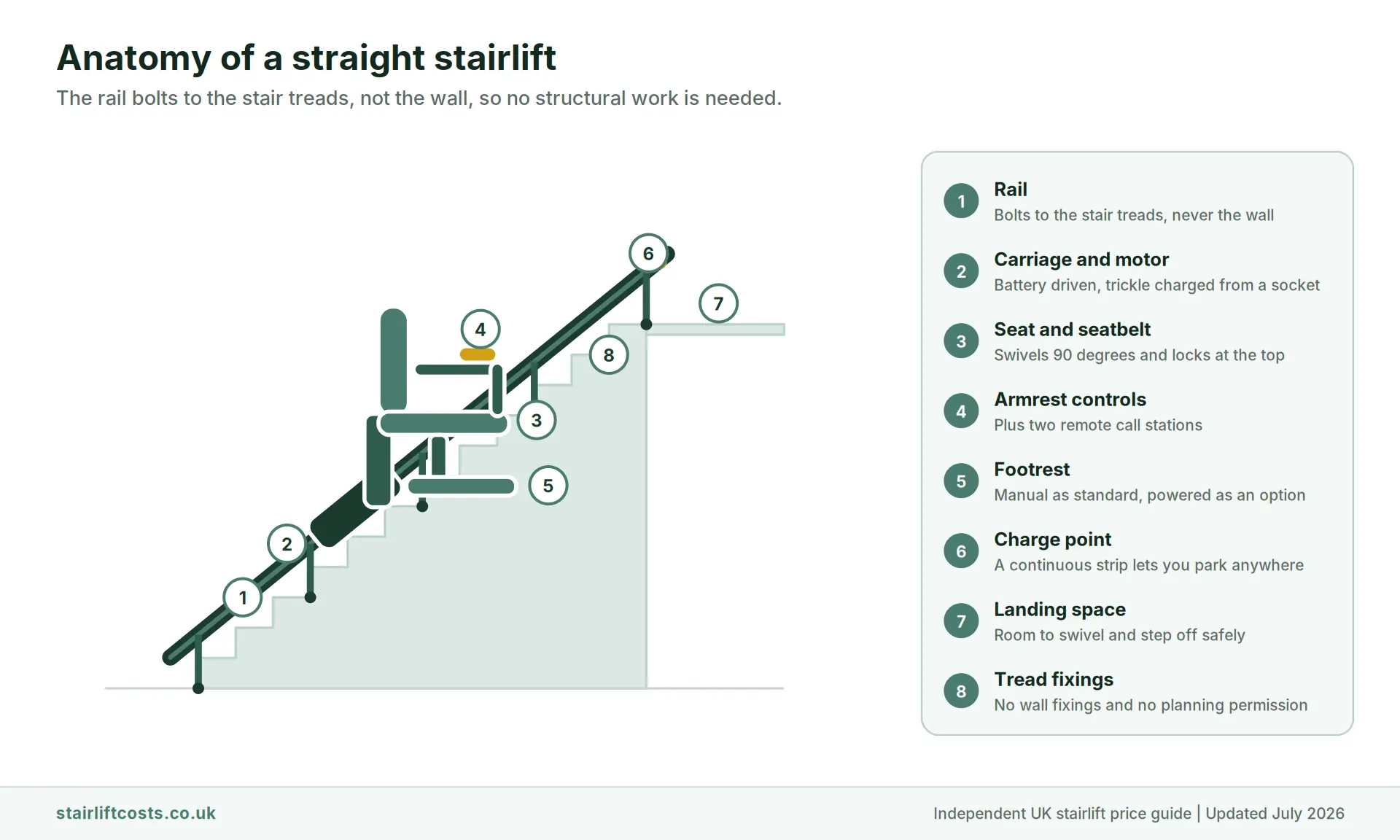
The rail fixes to the treads, not to the wall, so nothing structural is touched and party walls and plaster are left alone. The carriage runs on batteries that trickle charge from an ordinary 13 amp socket, which means the lift keeps working in a power cut. The seat swivels 90 degrees and locks at the top so you step off onto the landing rather than onto the stairs.
Is a straight stairlift right for your staircase?
A straight stairlift usually works if
- Your staircase runs in one line from bottom to top with no bend, winder or half landing
- The narrowest point measures about 70cm or more, or 61cm for a slimline model
- The user can transfer onto a seat and sit for the ride
- There is space at the top to swivel and step off without reaching
- There is a socket within reach of the top or bottom of the stairs
Look at something else if
- The stairs turn, even by a few degrees. You need a curved stairlift, or two straight lifts with a transfer at the half landing
- The user cannot leave a wheelchair. A through-floor lift carries the chair and the person together
- Bending the knees or hips is painful. A standing or perch stairlift may suit better, though it needs reasonable balance
- Balance, grip or cognition make operating the controls a concern. Ask your council for a free occupational therapy assessment first
- Upstairs access is only occasionally needed. A downstairs bedroom and wet room is often cheaper, and councils will assess for it
The half landing question. If your stairs break at a half landing, ask installers to price two straight lifts as well as one curved lift. Two straight rails are often several thousand pounds cheaper and can be fitted in days instead of weeks, but the user has to stand, walk a few steps and transfer at the landing, so it only works for some people.
How much does a straight stairlift cost in 2026?
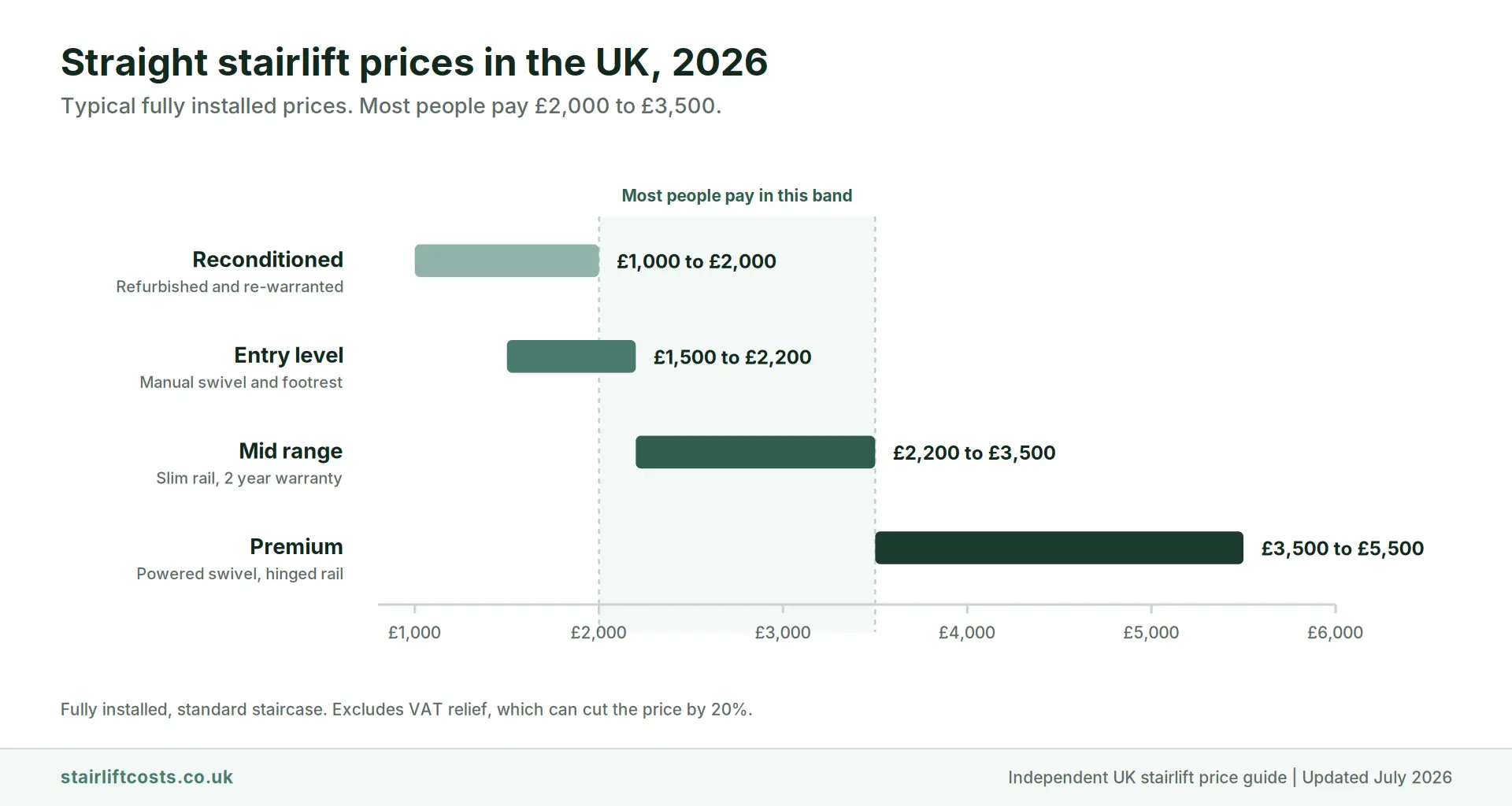
Most UK households pay £1,500 to £3,500 for a new straight stairlift supplied and installed. Below that band you are buying an entry-level model with a manual swivel, a manual footrest and a 12 month warranty. Above it you are paying for a powered swivel, a powered footrest, a hinged rail or a brand with its own engineer network rather than a dealer.
| Option | Installed price | What you get |
|---|---|---|
| Reconditioned | £1,000 to £2,000 | Refurbished carriage on a new rail, safety tested, typically 6 to 12 months warranty |
| Entry level, new | £1,500 to £2,200 | Standard rail, manual swivel and footrest, 12 month warranty |
| Mid range, new | £2,200 to £3,500 | Slim rail, 2 year parts and labour, often a powered swivel |
| Premium, new | £3,500 to £5,600 | Powered swivel and footrest, hinged rail, wider seat, manufacturer engineer network |
| Rental | About £40 to £80 a month plus an installation fee | Servicing and call-outs included, removal at the end. Worth it under about 18 months |
Last verified: August 2026. Premium row updated 16 September 2026: Stannah’s own straight stairlifts start from £3,585, and the TK Home Solutions S200 straight from £5,561, both on the makers’ own price pages. Which?’s buying guide (updated 24 August 2026) puts standard straight lifts at £2,000 to £4,000.
What moves the number inside those bands: rail length beyond the standard 4.5 metres, a hinged or folding rail to clear a door at the bottom, powered swivel and footrest, a wide or heavy-duty seat, extra remote controls, and whether you buy from the manufacturer or a local dealer. Distance from the nearest engineer matters too. See the straight stairlift prices page for model-by-model figures, or straight vs curved if you are not sure which you need.
What a quoted price usually includes, and what it does not
| Usually included | Usually extra |
|---|---|
| Free home survey, no obligation | Annual servicing once the warranty ends |
| Delivery, rail assembly and fitting | Removing an existing old stairlift |
| Connection to a nearby socket | Adding a socket if there is not one in reach |
| Two remote call stations | Extra remotes, at roughly £30 to £80 each |
| 12 to 24 months parts, labour and call-outs | Powered swivel, powered footrest, hinged rail |
| Handover and safety demonstration | Battery replacement, even under some cover plans |
| First service, if inside the warranty | Removal and making good at end of life |
Last verified: August 2026
How to pay less for a straight stairlift
VAT relief is the biggest single saving
There are two separate reliefs and most buyers qualify for one of them. They are worth far more than any discount an installer will offer, so settle the VAT question before you negotiate on price.
- Zero rate, 0% VAT. Available where the lift is supplied and installed for a chronically sick or disabled person in their own private home. HMRC defines that as a physical or mental impairment with a long-term and substantial adverse effect on everyday activities, or a condition the medical profession treats as a chronic sickness. Being frail or elderly on its own does not qualify.
- Reduced rate, 5% VAT. Available on age alone, where the customer is 60 or over and the lift is supplied and installed in their own home. It does not apply to goods without installation, to care homes, or to repairs and replacements after installation.
What most guides get wrong. You do not claim VAT relief back from HMRC and you do not need a doctor’s letter or proof of benefits. You sign a short written eligibility declaration, which must be separate from the order form or invoice, and the supplier simply does not charge the VAT. If you qualify on disability grounds, servicing and repairs on the lift can also be zero-rated, which almost nobody tells you.
Grants and council help
A Disabled Facilities Grant can cover all or part of a stairlift after an occupational therapy assessment. The maximum and the means test depend on where you live.
| Nation | Maximum | Means tested? |
|---|---|---|
| England | £30,000 | Yes, on the disabled person and partner. Not means tested for a disabled child. Adaptations costing £1,000 or less must be provided free |
| Wales | £36,000 | Yes, with small adaptations usually fitted free regardless of means |
| Scotland | No DFG. Scheme of Assistance instead | Councils fund at least 80% of approved costs, and up to 100% on qualifying benefits |
| Northern Ireland | £35,000 | Yes, administered by the Housing Executive. Confirm the current cap with NIHE before you rely on it |
Last verified: August 2026 against the grant legislation. GOV.UK still shows the superseded £25,000 figure for Northern Ireland.
A grant cannot pay for work already done, so apply before you order. Councils have six months to decide. If you are a council or housing association tenant, ask the landlord first: they often fund and fit the lift directly. See the full stairlift grants guide.
Reconditioned, rental and finance
- Reconditioned. Straight lifts refurbish well because the rail is reusable. Expect £1,000 to £2,000 installed, and check the age of the carriage: anything past five or six years is close to the end of a typical ten year service life. Compare reconditioned against new before deciding.
- Rental. Sensible for a temporary need such as recovery from surgery. Beyond about 18 months the cumulative cost overtakes buying a budget unit outright.
- Finance. Most installers offer instalments. Compare the total repayable, not the monthly figure, and check whether the agreement is regulated.
- Charities. Independence at Home, the ACT Foundation, Turn2us listed trusts, SSAFA and the Royal British Legion all make small grants towards adaptations. Condition-specific charities such as the MS Society and Parkinson’s UK are worth asking.
- Every published straight stairlift price in the UK, tracked monthly
What a straight stairlift costs to run
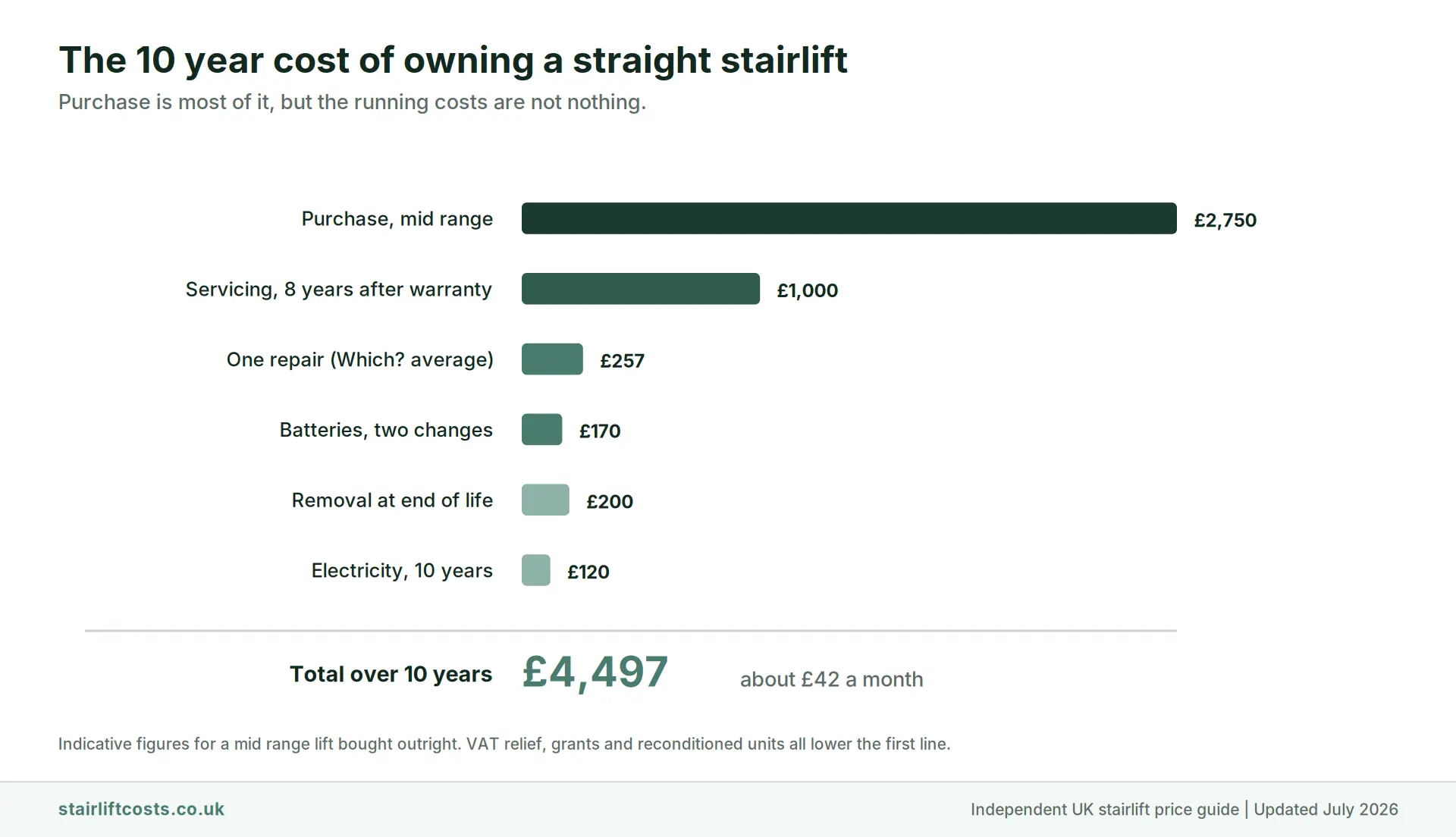
The purchase price is not the whole cost, but the running costs are modest and predictable. Electricity is trivial: a straight lift uses roughly 35 kWh a year at four journeys a day, about a pound a month.
| Running cost | Typical UK figure | How often |
|---|---|---|
| Electricity | About £12 a year | Continuous |
| Annual service | £100 to £200 | Yearly, once the warranty ends |
| Out of warranty repair | Call-out £75 to £200, plus parts | Which? found 37% of owners needed one repair over ten years, averaging £257 |
| Battery replacement | £50 to £120 fitted | Every 3 to 5 years |
| Extended warranty or cover plan | £150 to £300 a year | Optional |
| Removal at end of life | £150 to £300 | Once, or free if the unit has buy-back value |
Last verified: August 2026
Two things worth knowing. Batteries are the most common exclusion from extended cover plans, so ask before you buy one. And never unplug the lift to save power: the batteries drain, and a flat pair shortens their life and can leave the chair stranded mid-rail.
Straight stairlift models sold in the UK
Nine brands sell a straight lift in Britain, and what each one publishes about it varies enormously. The figures below were read on the maker’s own site on 8 September 2026. The widths are the numbers that decide whether the chair clears your banister and your skirting, and only about half the market prints them.
| Model | Max user weight | Width in use | Folded width |
|---|---|---|---|
| Halton Synergy | 125kg | 575mm | 395mm depth |
| Acorn 130 | 127kg, 159kg heavy duty | 605mm | 310mm |
| Halton Sit and Stand | 127kg | 605mm | 210mm |
| Halton Slimline 130 T700 | Up to 20 stone | 620mm | 280mm |
| Stannah Starla, straight | 120 to 160kg | 654mm minimum | 339mm minimum |
| Stannah Siena, straight | 160kg | 659mm minimum | 344mm minimum |
| Handicare and Companion 1000 | 137 to 160kg | Not published | Not published |
| Handicare and Companion 1100 | 140kg | Not published | Not published |
| Handicare 1000XXL | 440 lb, about 200kg | Not published | Not published |
| Access BDD HomeGlide | 136 to 160kg depending on the angle | Staircase from 740mm | Not published |
| Platinum ergo Straight | 160kg | Not published | Not published |
| Brooks Stairlift | Not published | Not published | Not published |
Two of these are worth a second look. The Halton Synergy is the slimmest straight lift anyone in Britain puts a number to, at 575mm in use, and the Halton Sit and Stand folds back to 210mm, narrower than anything else we found. The source page and reading date behind each of these numbers sits in our UK stairlift model specifications table.
Will a straight stairlift fit? What to measure
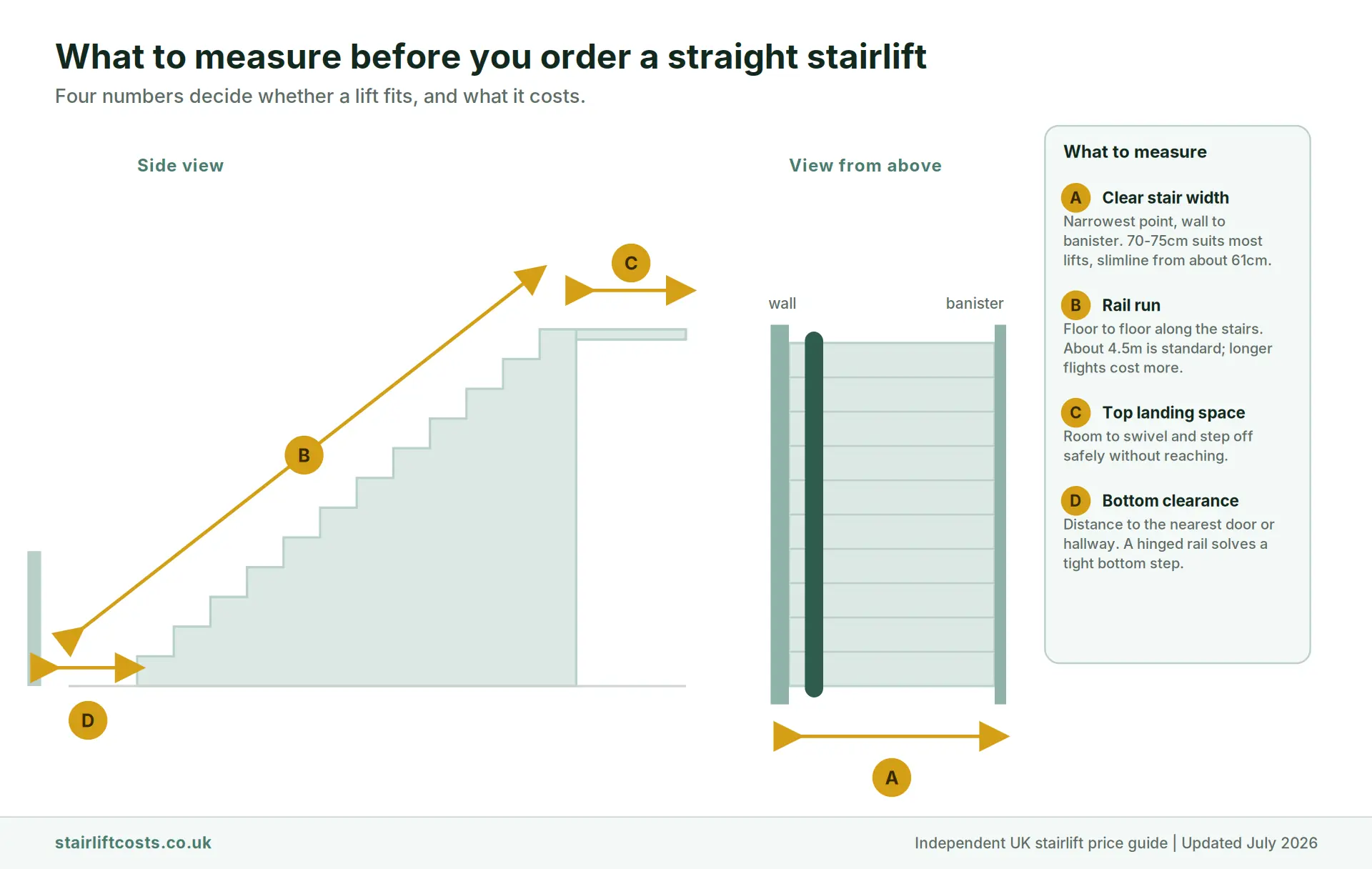
A surveyor will do this properly and for free, but four measurements tell you in advance whether you are in normal territory or a special case.
| Specification | Typical straight stairlift |
|---|---|
| Stair width needed | 70 to 75cm for a standard model, from about 61cm for slimline |
| Folded width when parked | 28 to 30cm, so people can still pass on the stairs |
| Weight capacity | 120 to 140kg, roughly 19 to 22 stone. Heavy-duty models carry 25 stone or more |
| Seat width | About 43 to 45cm standard, 49 to 50cm on a wide seat |
| Standard rail length | About 4.5m, charged per extra half metre beyond that |
| Travel speed | Around 0.15 metres a second, so a 13 step flight takes 30 to 45 seconds |
| Power | Battery driven, trickle charged from a 13 amp socket, works in a power cut |
Width is not the only constraint. Knee clearance on a steep flight, shoulder room past a radiator, a newel post at the bottom and a low window sill can all rule out a particular model even where the tape measure says yes. If your stairs are tight, read the narrow stairs guide and the detail on minimum stair width. If the top landing is small, see straight stairlifts with a small landing.
Options that are worth paying for
Most upsells on a stairlift quote are optional. These four are the ones that decide whether the user can operate the lift independently, which is the whole point of buying one.
| Option | Typical extra | Worth it when |
|---|---|---|
| Powered swivel seat | £150 to £500 | Grip, shoulder or trunk rotation is limited. A manual swivel needs a firm pull and a deliberate lock |
| Powered footrest | £200 to £400 | Bending down to fold the footrest is painful or unsafe. It rises and lowers with the seat |
| Hinged or folding rail | £250 to £500 | The rail would otherwise block a doorway, hall or fire escape route at the bottom of the stairs |
| Continuous charge rail | Usually built in, or not available | Always ask. A continuous charge strip lets you park anywhere on the rail. Fixed charge points at the ends only mean the batteries flatten if the chair is left mid-rail |
Last verified: August 2026
Installation, step by step
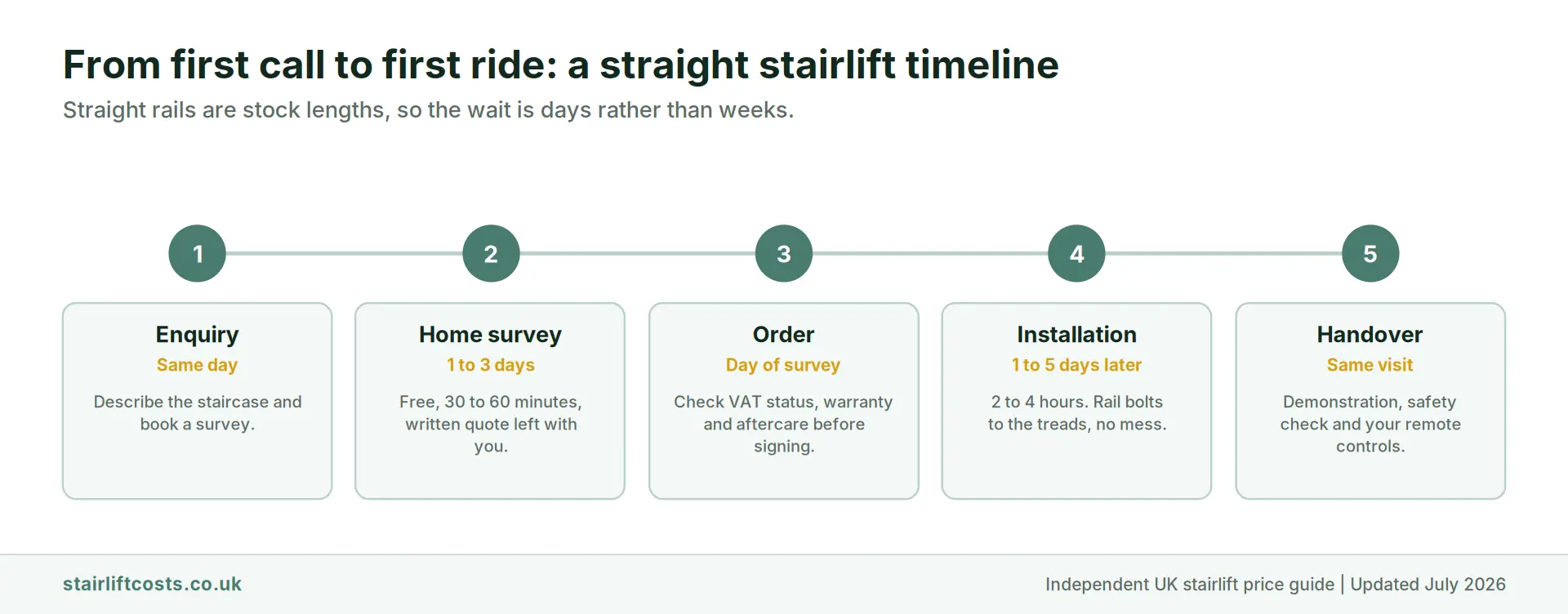
Fitting a straight stairlift takes two to four hours. The engineer marks out the rail, joins and levels the sections, bolts the brackets to the treads, mounts the carriage and seat, connects to a socket, then commissions the lift by running it repeatedly and testing the safety edges, seatbelt, limit stops and emergency stop. Carpets are not lifted and nothing is made good beyond small screw holes when the lift is eventually removed. See the full stairlift installation guide.
Permissions
- Planning permission is not required for an internal stairlift, and building regulations approval is not required for the lift itself. The product must meet BS EN 81-40.
- Listed buildings do need listed building consent for significant work. This catches people out precisely because planning permission is not needed.
- Rented homes need the landlord’s written permission. Under the Equality Act 2010 a landlord should not unreasonably refuse a disability-related adaptation. Expect to agree reinstatement when you leave, and photograph the stairs before fitting.
- Leasehold flats need the freeholder’s consent where the lease restricts alterations. If the stairs are communal, means of escape rules usually make it impossible.
Safety features and standards
UK stairlifts are built to BS EN 81-40:2020, the European standard for stairlifts and inclined lifting platforms. Every mainstream straight model includes the following as standard, not as options:
- Obstruction sensors on the carriage, footrest and both ends of the rail, which stop the lift on contact
- A retractable seatbelt, with a full harness available where needed
- A lockable 90 degree swivel seat so you step off onto the landing, never onto a step
- A key switch so the lift can be isolated, useful with young children or dementia in the house
- Constant-pressure controls, so the lift stops the moment you let go
- An overspeed governor and dual braking, plus manual lowering if power and battery both fail
Warranty, lifespan and what it is worth later
New straight stairlifts come with 12 to 24 months of parts, labour and call-outs depending on brand. Reconditioned units usually carry 6 to 12 months. A well serviced lift should give around ten years, which is the window Which? uses when it surveys owners, and it is also why buying a used unit already five or six years old is poor value.
Straight lifts are the only type with real second-hand value, because the rail can be shortened and reused. Even so, set expectations low. A straight lift under four years old typically fetches £300 to £500 on buy-back, four to seven years £150 to £300, and beyond ten years the realistic outcome is free removal instead of a cheque. Which? found a third of owners who got a buy-back quote were unhappy with it. Our guide to selling a stairlift covers the options.
Straight stairlift compared with the alternatives
| Option | Installed cost | Best for |
|---|---|---|
| New straight stairlift | £1,500 to £3,500 | A single straight flight. Fastest to fit, cheapest to run, best resale |
| Reconditioned straight | £1,000 to £2,000 | Tight budgets and short-to-medium term needs |
| Rented straight | About £40 to £80 a month plus install fee | Recovery from surgery, or a need under about 18 months |
| Curved stairlift | £4,000 to £10,000 | Any staircase with a bend, winder or half landing |
| Standing or perch | £2,000 to £3,500 | Users who cannot bend the knees, and very narrow stairs |
| Through-floor lift | £13,000 upwards | Wheelchair users and progressive conditions |
| Downstairs living | Varies, often grant funded | Where upstairs access is only occasionally needed |
Last verified: August 2026
What to ask before you sign
Get three quotes and say you are comparing. Take these questions to each survey and write down the answers, because the difference between two quotes is rarely the headline price.
- Is this price at 0%, 5% or 20% VAT, and will you supply the eligibility declaration form?
- How long is the warranty, and does it cover parts, labour and call-outs? Are batteries included?
- What will an annual service cost from year three, and what is the call-out fee and hourly rate?
- What is your engineer response time, including evenings, weekends and bank holidays?
- Are you the manufacturer or a dealer, who services the lift, and what happens if you cease trading?
- Are the swivel and footrest manual or powered at this price?
- Does the rail have a continuous charge strip, or fixed charge points at the ends only?
- Is a hinged rail needed to clear the doorway at the bottom, and is it in this price?
- Does the quote include adding a socket if there is not one within reach?
- Does it include removing the existing stairlift, if there is one?
- What is the buy-back or removal position at end of life, in writing?
- Are you a member of the British Healthcare Trades Association, which offers binding dispute resolution?
Your rights, and the red flags
Stairlifts are usually sold in your home, which makes them an off-premises contract with a 14 day right to cancel under the Consumer Contracts Regulations 2013. There is an important exception: goods personalised or made to measure for you are excluded, and suppliers routinely apply that to stairlifts. The claim is far weaker for a straight lift with a stock rail cut to length than for a bespoke curved rail, so push back if you are told otherwise. If the trader did not give you the cancellation information in writing, the cancellation period extends by twelve months.
Walk away from: a price that only holds if you sign today, the “cancelled order going cheap” pitch, a refusal to put aftercare costs in writing, or any pressure to decide during the survey visit. The BHTA code of practice bans price-dropping and pressurised selling by its members, and it is a Chartered Trading Standards Institute approved code.
Frequently asked questions
How much does a straight stairlift cost in the UK?
A new straight stairlift costs £1,500 to £3,500 fully installed for most UK homes. Entry-level models start around £1,500 and premium models with a powered swivel and hinged rail reach £5,500. Reconditioned straight lifts run £1,000 to £2,000 installed.
How long does it take to install a straight stairlift?
The fitting takes two to four hours. Because straight rails are stock lengths, most installers can survey and install within one to five working days, and some offer next-day fitting. A curved lift takes two to six weeks because the rail is made to measure.
Do I need planning permission for a stairlift?
No. Planning permission is not required for an internal stairlift and neither is building regulations approval for the lift itself. Listed buildings are the exception: significant work needs listed building consent.
Will a stairlift fit my narrow stairs?
Most standard straight stairlifts need 70 to 75cm of clear width at the narrowest point, measured between the wall and the banister. Slimline models fit from about 61cm, and fold to 28 to 30cm when parked so people can still pass.
Does a straight stairlift work in a power cut?
Yes. Straight stairlifts run on batteries that trickle charge from a normal socket, so a power cut leaves you enough charge for at least ten to twenty return trips.
Can I get a stairlift VAT free?
If the lift is supplied and installed for a chronically sick or disabled person in their own home, it is zero-rated at 0% VAT. If nobody in the household qualifies on those grounds but the customer is 60 or over, the reduced 5% rate applies instead. You sign a short eligibility declaration; there is nothing to claim back from HMRC and no doctor’s letter is needed.
How much does it cost to run a straight stairlift?
About £12 a year in electricity, plus £100 to £200 for an annual service once the warranty ends and £50 to £120 for new batteries every three to five years. Over ten years a mid-range lift costs roughly £4,500 all in, about £42 a month.
Is a reconditioned straight stairlift a good idea?
Often yes, because the straight rail is reusable and refurbished units cost half to two thirds less than new. Check the age of the carriage, ask what warranty is included, and confirm spare parts are still available for that model. Avoid a carriage already five or six years old.
Can a straight stairlift be fitted to stairs with a small landing at the top?
Usually yes. The seat swivels 90 degrees and locks so you step onto the landing rather than a step. Where the landing is genuinely tight, options include a shorter parking rail, an over-run at the top or a powered swivel so you do not have to twist yourself.
What weight can a straight stairlift take?
Standard models carry 120 to 140kg, roughly 19 to 22 stone. Heavy-duty straight lifts carry 25 stone or more with a reinforced rail and wider seat, at £2,500 to £4,500 at published prices.
Can I put a stairlift in a rented house?
Yes, with the landlord’s written permission. Under the Equality Act 2010 a landlord should not unreasonably refuse a disability-related adaptation. Nothing structural is altered, removal takes under an hour, and only small screw holes remain, so agree reinstatement terms in writing and photograph the stairs first.
Is it cheaper to fit two straight stairlifts than one curved stairlift?
Frequently, yes. Where a staircase breaks at a half landing, two straight rails can cost several thousand pounds less than one custom curved rail and can be fitted in days. The trade-off is that the user must stand and transfer at the half landing, so it only suits people who can manage a few steps.