Affordable Stairlifts to Rent: Costs, Options, and Benefits
Renting a stairlift costs a median £50 a month after a median £475 upfront fee, going by the 18 UK sellers that publish a straight rental price. The first year comes to a median £1,050, and servicing, breakdown cover and removal are normally included. It is built for a temporary need: by month 19 the same money would have bought a reconditioned lift outright.
How much does it cost to rent a stairlift? Eighteen UK sellers publish a straight stairlift rental price, and the median first year costs £1,050: a median £475 upfront, then a median £50 a month. On those terms renting passes the median price of a reconditioned straight stairlift in month 19 and a new one in month 31. Six of the 48 sellers we checked also rent curved lifts, at £1,910 to £3,200 for the first year where the terms allow a full year to be worked out. Every price below was read on the seller’s own website on 12 October 2026, with a link to each one.
What is stairlift rental, and what do you actually get?
Stairlift rental is a hire agreement, not a purchase and not a finance deal. You pay an upfront installation fee, then a fixed monthly amount for as long as you keep the lift. The installer owns it throughout, maintains it, repairs it and takes it away at the end. Nothing is ever yours, and nothing is ever your responsibility either. You swap ownership and resale value for a low entry cost and a support contract with no extra bills.
Almost all rental stock is straight, and much of it refurbished rather than new, because a straight rail is a stock extrusion that can be cut down, cleaned up and refitted in the next house. That reusability is the commercial basis of the model, and why the honest answer on curved rental is usually no.
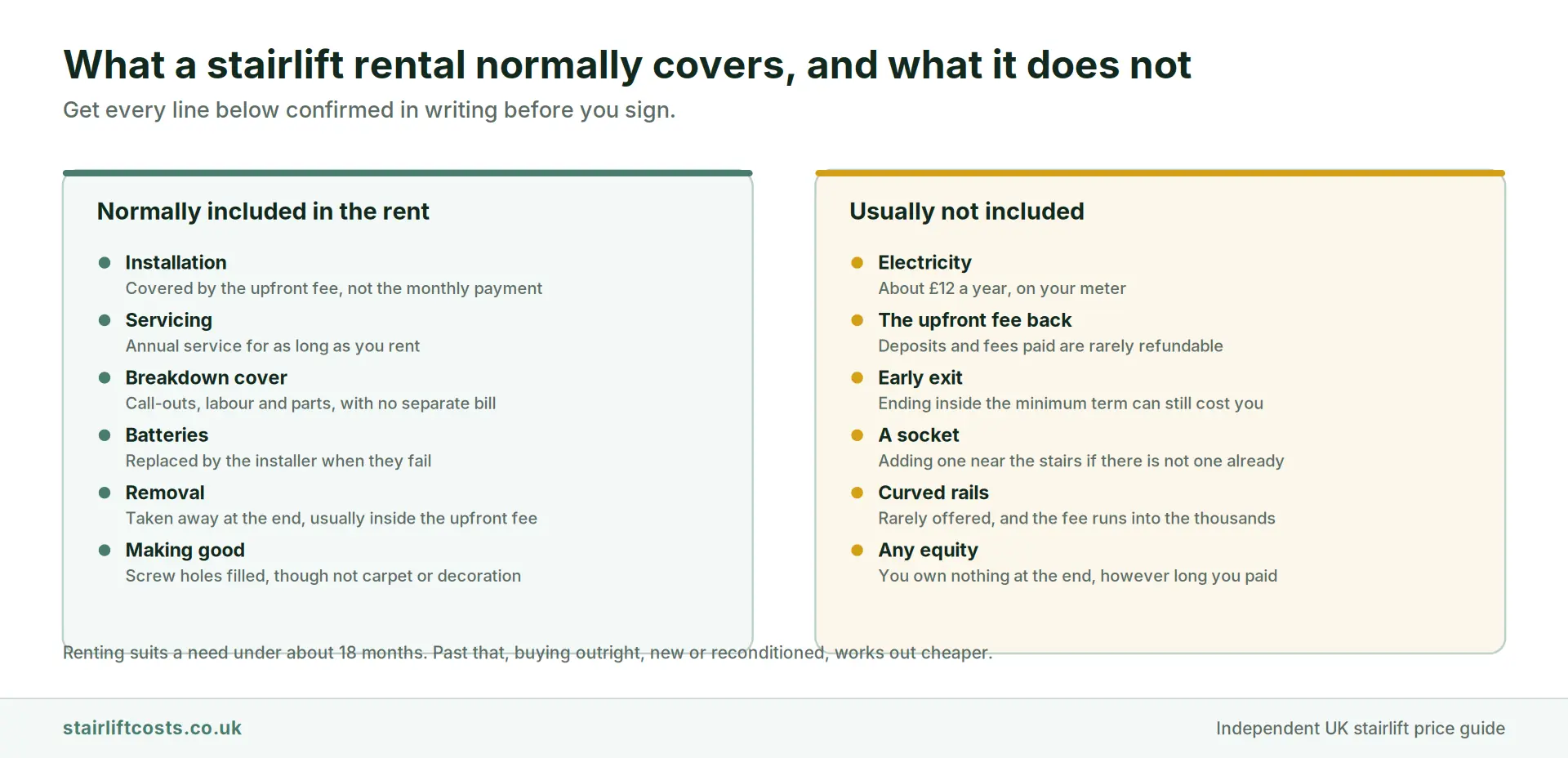
| Normally included in the rent | Normally not included |
|---|---|
| Free home survey and delivery | Ownership. The lift never becomes yours |
| Installation, commissioning and handover | Any refund of the upfront fee, which is a charge not a deposit |
| Annual servicing for the whole period | Electricity, at about £12 a year |
| Breakdown call-outs, parts and labour | Adding a socket if there is not one in reach |
| Battery replacement while on hire | Damage beyond fair wear and tear |
| Removal, and making good screw holes | Curved staircases, in most cases |
Last verified: August 2026
Is renting a stairlift right for you?
Renting usually works if
- The need is temporary, such as recovery from a hip or knee replacement, and the lift goes back inside a year
- You are providing palliative or end of life care and need a lift fitted this week
- You are waiting on a Disabled Facilities Grant assessment and need stairs access meanwhile
- The house is on the market, or a move to a bungalow is planned
- You want to test whether the user will genuinely use a stairlift before committing thousands
- You cannot raise the capital and finance has been declined or is not wanted
Look at something else if
- The need is permanent or progressive. Buy, and look at reconditioned if the budget is tight
- Your stairs turn. Only six of the 48 sellers we checked publish curved rental terms, and over two years a reconditioned curved lift usually costs less, so price a curved stairlift purchase alongside
- You expect to keep the lift for more than about a year and a half. The median seller’s rent passes a reconditioned purchase in month 19
- The user cannot leave a wheelchair. A through-floor lift is the right question
- You want an asset with resale or buy-back value at the end. A rented lift has none
The fee is not a deposit. The fee paid at the start, a median £475 across 18 sellers, is a charge for fitting and later removing the lift. It is not returned when the lift goes, and it is not credited against a purchase unless the installer puts that in writing. Query any quote that calls it a deposit, because the word implies a refund that will not happen.
How much does stairlift rental cost in 2026?
We read the websites of 48 UK stairlift sellers on 12 October 2026. Eighteen publish rental terms for a straight stairlift that can be compared like for like, two more publish rental prices that cannot (see the note under the table), eight say they rent but give no figure, and the rest either do not rent or would not load. Across the eighteen, the median upfront fee is £475 and the median monthly rent is £50. Upfront fees run from £245 to £1,300, and monthly rents from £40 to £100.
Those two numbers mislead when read apart, because sellers bundle them differently. Some fees pay for the fitting alone, some include the first month, and Age UK Mobility’s £1,300 covers six months of hire. The fair comparison is what each set of terms adds up to after a year. That median is £1,050, and the middle half of sellers land between £925 and £1,100.
| Seller | Upfront | What the upfront fee includes | Then, a month | Total after 12 months | Link |
|---|---|---|---|---|---|
| Dolphin Lifts | £700 | Fitting and the first 12 months’ rental | £50 from month 13 | £700 | source |
| Rental Stairlifts | £245 | Not stated (page undated) | £10.38 a week, about £45 | £785 | source |
| Unicorn Stairlifts | £385 | Installation and removal | £40 | £865 | source |
| GN Stairlifts | £395 | Preparation, installation and removal | £40 | £875 | source |
| Midland Stairlifts | £385 | Admin, installation and removal | £45 | £925 | source |
| Aline Mobility | £350 | Installation | £50 every 4 weeks, about £54 | £1,000 | source |
| Essex Stairlifts | £400 | Installation and removal | £50 | £1,000 | source |
| Mobility First | £595 | Installation, maintenance, removal and the first 6 months | £69 from month 7 | £1,009 | source |
| 1st Choice Stairlifts | £450 | Installation (prices shown without VAT) | £50 | £1,050 | source |
| Central Mobility | £450 | Installation | £50 | £1,050 | source |
| Manchester Stairlifts | £500 | Survey, fitting, removal and the first month | £50 from month 2 | £1,050 | source |
| Somerset Stairlifts | £650 | Installation, removal and the first 3 months | £45 from month 4 | £1,055 | source |
| Carelift Services | £499 | Administration, installation and removal | £50 | £1,099 | source |
| My Mobility Solutions | £500 | Installation | £49.95 | £1,099 | source |
| Top Flight Stairlifts | £600 | Supply, installation and the first 3 months | £60 from month 4 | £1,140 | source |
| My Mobility UK | £695 | Fitting and the first 3 months | £50 from month 4 | £1,145 | source |
| Millercare | £450 | Installation and removal; 3 month minimum | £100 | £1,650 | source |
| Age UK Mobility | around 1,300 | Installation and the first 6 months | from £80 from month 7 | £1,780 | source |
Cheapest first year at the top. The 12-month total is the upfront fee plus each month not already covered by it, using only the seller’s published terms. Prestige Stairlifts publishes a different kind of deal, £950 for the first six months and another £950 for six more, after which the lift is yours; that is closer to buying in two instalments, so it is left out of the medians. In August it advertised £850 upfront and £25 a week. My Mobility UK and Reconditioned Stairlift Prices publish identical Acorn 130 terms and count once. A £295 plus £35 a month offer from Stairlifts Wales appears only on a directory listing, not its own site, so it is not counted. Only 1st Choice (without VAT) and GN Stairlifts (with VAT) say how VAT is treated.
Last verified: 12 October 2026
The full capture, with the wording each price was read from and the sellers that publish nothing, is available as a CSV download. Purchase prices on this page come from our UK Stairlift Price Tracker.
Curved stairlift rental
Six of the 48 sellers publish curved rental terms. A curved rail is bent to fit one staircase and cannot be reused, so the upfront fees start at £950 and the monthly rents run from £70 to £100. Where the terms allow a full year to be worked out, the first year costs £1,910 to £3,200, against a median £3,342 to buy a reconditioned curved lift and £4,395 for a new one. At those four sellers renting passes the reconditioned price between month 14 and month 30.
| Seller | Upfront | What the upfront fee includes | Then, a month | Total after 12 months | Link |
|---|---|---|---|---|---|
| Unicorn Stairlifts | £950 | Installation and removal; 6 month minimum | £80 | £1,910 | source |
| Mobility First | £1,695 | Installation, maintenance, removal and the first 6 months | £99 from month 7 | £2,289 | source |
| Manchester Stairlifts | from £2,000 | Custom rail and the first 6 months | £80 from month 7 | £2,480 | source |
| 1st Choice Stairlifts | from £2,000 | Installation (prices shown without VAT) | £100 | £3,200 | source |
| Age UK Mobility | around £3,000 | Installation and the first 6 months | Not published separately for curved | Cannot be worked out | source |
| Rental Stairlifts | Not stated | Not stated (page undated) | £70 | Cannot be worked out | source |
Last verified: 12 October 2026
What the upfront fee actually buys
The fee covers two engineer visits, not one: the fitting, and the removal months or years later, including unbolting the rail, taking the parts away and filling the screw holes. Because that second visit is already paid for, a well written agreement lets the lift leave without a further invoice. A low fee with removal charged separately at the end is usually the worse deal. On curved stairs the bespoke rail cannot be refitted elsewhere, so the few installers offering curved rental recover thousands upfront and the monthly rate is no lower.
The break-even point, plainly
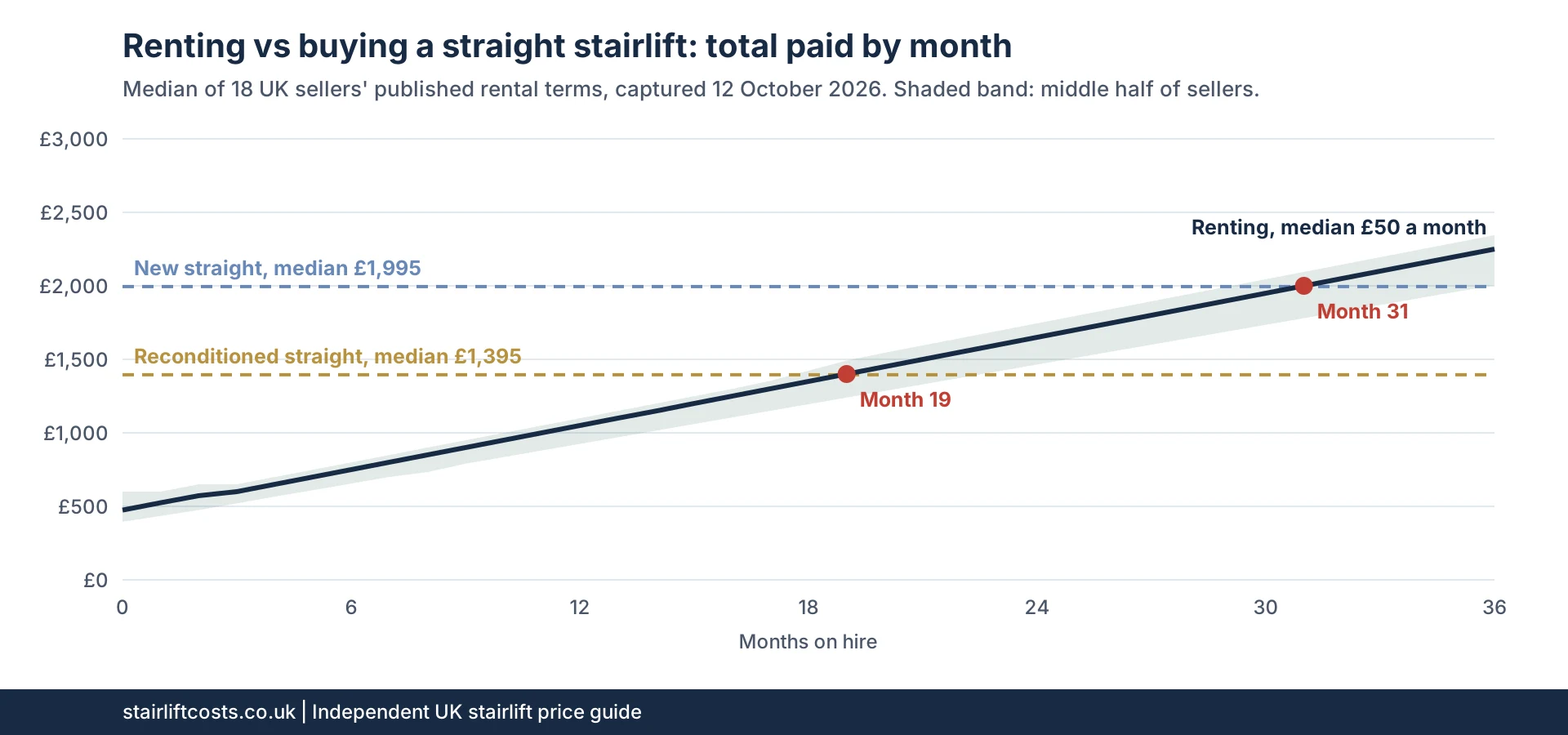
Set each seller’s terms against the tracker’s median purchase prices, £1,395 for a reconditioned straight stairlift and £1,995 for a new one. For the median seller, renting passes the reconditioned price in month 19 and the new price in month 31. The spread between sellers is wide. On Age UK Mobility’s terms renting overtakes a reconditioned purchase in month 8; at Dolphin Lifts, GN Stairlifts, Rental Stairlifts and Unicorn Stairlifts it takes until month 26.
| Time on hire | Median total paid, 18 sellers | Against buying |
|---|---|---|
| 6 months | £750 | About half the price of a reconditioned lift |
| 12 months | £1,050 | £345 short of a reconditioned lift |
| 18 months | £1,350 | Just under a reconditioned lift |
| 24 months | £1,650 | Past a reconditioned lift, still short of a new one |
| 36 months | £2,250 | More than a new straight lift, with nothing owned |
Last verified: 12 October 2026
These crossovers use purchase price alone. An owner also pays for servicing once the warranty ends, about £100 to £200 a year, which a rental already includes. Counting that pushes both crossovers back by roughly two months.
Do the arithmetic on the real term, not the hoped-for term. Most people who rent for a temporary reason keep the lift longer than planned, because recovery drags or a house move slips. Work out what the agreement costs at 18 and 24 months before you sign. If you probably will not give it back, buying reconditioned is the cheaper route overall.
Get stairlift rental quotes from local installers
Answer a few quick questions and up to 3 installers who cover your area will quote. Free, with no obligation.
Stairlift rental compared with buying
Compare these on total cost over the period you will genuinely use the lift, not on the monthly figure, which flatters rental.
| Option | Cost | Cost at 12 months | Best for |
|---|---|---|---|
| Rental, straight | Median £475 upfront, then £50 a month (18 sellers) | Median £1,050 | Needs under about 18 months. Everything covered, no asset |
| Reconditioned straight, bought | £1,000 to £2,000 installed | Purchase price | Medium to long term needs on a tight budget. You own it |
| New straight, bought | £1,500 to £3,500 installed | Purchase price | Permanent needs. Longest life, best warranty, some resale value |
| New straight on finance | Instalments, interest may apply | Depends on the agreement | Ownership without the capital. Compare total repayable |
| Curved rental | 6 of 48 sellers publish terms: £950 to £3,000 upfront, £70 to £100 a month | £1,910 to £3,200 | A short, certain need on a curved stair. Price a reconditioned curved lift alongside |
Last verified: 12 October 2026
Our comparison of reconditioned against new sets out warranty, lifespan and parts availability side by side.
Who renting actually suits
Post-operative recovery. The clearest case. After a hip or knee replacement, a fracture or a stroke, stairs may be unmanageable for three to nine months and then fine again. A rental fitted in days gets someone home from hospital and goes back when it is no longer needed. Ask the discharge team or community occupational therapist first, because some areas lend equipment free.
Palliative and end of life care. Speed matters more than price, and nobody wants to arrange a sale afterwards. Rental fits both, but this is where the bereavement terms need reading first. A 12 month minimum signed for someone with a prognosis of weeks can leave a family paying for a lift no longer in the house.
Waiting for a council adaptation or a house move. Grant assessments and works take months, and a rental bridges the gap then comes out when the permanent lift goes in. The same applies if the house is on the market.
Trialling before buying. A few installers let rental payments count towards a later purchase. It is not standard, so treat it as a bonus rather than a plan, and get the figure in writing when you order.
Renting suits almost nobody with a permanent or progressive need. Multiple sclerosis, Parkinson’s, advanced arthritis and general frailty all point to buying, because the lift will still be needed in three years and rental will by then cost more.
What it costs to run while you are renting
Very little, and that is the genuine attraction. A stairlift draws roughly 35 kWh a year at four journeys a day, or about £12 a year. Everything else below is the installer’s responsibility while the lift is on hire.
| Cost | Who pays while you rent | What it would cost if you owned the lift |
|---|---|---|
| Electricity | You | About £12 a year either way |
| Annual service | Installer | £100 to £200 once the warranty ends |
| Breakdown call-out | Installer | £75 to £200 plus parts |
| Batteries | Installer | £50 to £120 every three to five years |
| Extended cover plan | Not needed | £150 to £300 a year |
| Removal at the end | Covered by the fee | £150 to £300 |
Last verified: August 2026
Two practical points. Tell your home insurer a lift has been fitted, even a rented one, because it belongs to somebody else. And never unplug it to save electricity: the batteries drain, a flat pair shortens their life, and avoidable damage is chargeable to you.
How to pay less, and where rental sits with VAT and grants
VAT on a rental agreement
Two reliefs exist and most households qualify for one. The zero rate at 0% VAT applies where the lift is supplied and installed for a chronically sick or disabled person in their own home. HMRC defines that as an impairment with a long-term and substantial adverse effect on everyday activities, or a condition the medical profession treats as chronic sickness. Being elderly alone does not qualify. The reduced rate at 5% applies on age where the customer is 60 or over, and is also written around supply and installation.
Get the VAT basis of a rental in writing before you sign. Both reliefs are drafted around supplying and installing a lift, and a rental is legally a hire rather than a sale, so the position is less obvious than on a purchase. HMRC’s guidance does allow a supply on hire or lease to an eligible customer to be zero-rated, but installers apply it inconsistently. Ask the quotation to state which rate applies to the fee and which to the monthly payments. The eligibility declaration is a form you sign, not a claim back from HMRC.
Grants rarely fund rental
A Disabled Facilities Grant funds a permanent adaptation. A rented lift is neither permanent nor owned by the householder, so councils rarely pay for one, and temporary help usually comes through community equipment or a discretionary assistance policy instead. Apply for the grant for the permanent lift and treat rental as the bridge while the application runs.
| Nation | Maximum grant | How it works |
|---|---|---|
| England | £30,000 | Means tested, but not for a disabled child. Adaptations of £1,000 or less must be free |
| Wales | £36,000 | Means tested, with small adaptations usually fitted free |
| Scotland | No DFG. Scheme of Assistance instead | Councils fund at least 80% of approved costs, up to 100% on qualifying benefits |
| Northern Ireland | £35,000 | Means tested, via the Housing Executive. Confirm the current cap with NIHE |
Last verified: August 2026 against the grant legislation. GOV.UK still shows the superseded £25,000 figure for Northern Ireland.
A grant cannot pay for work already done, so apply before you order, and council or housing association tenants should ask the landlord first because they often fund and fit the lift directly. The full stairlift grants guide covers the assessment. Charities including Independence at Home, the ACT Foundation and SSAFA make small awards, and some consider short-term hire.
What would your stairs cost?
The price depends on your staircase. Compare real quotes for your home from up to 3 local installers.
Installation and permissions
Rental fitting is fast because the rail is stock: most installers survey and fit inside one to five working days, several offer next-day fitting for hospital discharges, and the visit takes two to four hours. Brackets bolt to the treads rather than the wall, so nothing structural is touched. Our stairlift installation guide has the detail.
- Planning permission is not required for an internal stairlift, rented or owned, and nor is building regulations approval. The lift must meet BS EN 81-40:2020, the stairlift standard covering obstruction sensors, constant-pressure controls, seatbelts and manual lowering.
- Listed buildings need listed building consent for significant work, which catches people out precisely because planning permission is not needed.
- Rented homes need the landlord’s written permission. Under the Equality Act 2010 a landlord should not unreasonably refuse a disability-related adaptation, and rental is often easier to get agreed because the lift comes out again.
- Battery drive means the lift works in a power cut, which matters when there is no alternative route upstairs.
Ending the agreement: notice, death and early exit
This is where rental agreements differ most, and where the cheapest headline rate turns into the most expensive outcome. Read the exit clauses before the price.
Notice. Expect to give 28 days or one calendar month in writing once you are past the minimum term. Payments normally run until the lift is physically removed rather than until the date you gave notice, so ask how quickly removal is scheduled. A week or two of drift can add another month’s rent.
Death of the user. The agreement does not simply stop. The contract normally ends on notice from the estate, the installer collects the lift, and money already paid is not refunded. If the death falls inside the minimum term, some installers waive the remaining months on production of a death certificate and others invoice the balance in full. Nothing in consumer law obliges a waiver, so the outcome depends on the wording you signed. Where the reason for renting is palliative care, make a bereavement clause a condition of the order.
Moving into care. Treated the same way as a death by most installers, and again there is no statutory right to exit early because circumstances changed. A move into residential care is often sudden, so a six or 12 month commitment is a real risk to budget for.
Early exit charges. Three models are common: the remaining months charged in full, a fixed termination fee, or the monthly payments waived but removal charged separately on the basis that the fee only covered removal after a completed term. Find out which one you are signing, in pounds, with a worked example at month three and month nine.
Removal. Confirm in writing that removal is covered by the upfront fee, how many working days it takes from notice, that the screw holes will be filled, and that no collection charge applies. A rented lift belongs to the installer, so an executor cannot sell it and there is no buy-back value at the end.
The question almost nobody asks at the survey. “If the user dies next month, what exactly do we owe you?” Ask it in those words, write down the answer and the name of the person who gave it. Families are routinely surprised to find the upfront fee is gone and the balance of a 12 month term may still be due.
What to ask before you sign
Rental agreements vary far more than purchase quotes, so get three and take these questions to every survey.
- What is the monthly rate, and is it fixed for the whole term or can it rise?
- What is the upfront fee, what does it cover, and does it include removal at the end?
- What is the minimum term, and what does early exit cost at month three and month nine, in pounds?
- What happens if the user dies or moves into care inside the minimum term, and is that clause in the written agreement?
- How much notice do I give, and do payments stop on the notice date or the removal date?
- Are servicing, call-outs, parts, labour and batteries all included for the whole period?
- What are your call-out hours, and your response time at weekends and bank holidays?
- Is the lift new or refurbished, and how old is the carriage?
- Is this zero-rated, 5% or 20% VAT, and does that apply to the fee, the monthly payments or both?
- Who is responsible for damage, and what counts as fair wear and tear?
- Can rental payments be offset against buying the lift later, and at what figure?
- Are you a member of the British Healthcare Trades Association, which offers binding dispute resolution?
Your right to cancel, and the red flags
A rental signed in your home is an off-premises contract, which carries a 14 day right to cancel under the Consumer Contracts Regulations 2013. Suppliers sometimes claim the made-to-measure exemption, which is far weaker for a stock straight rail cut to length than for a bespoke curved rail, so push back if told a straight rental cannot be cancelled. If you asked for installation inside the 14 days you can still cancel, but may owe a proportionate amount for work done. If the trader gave no cancellation information in writing, the period extends by twelve months.
Walk away from: a rate that only holds if you sign today, a refusal to put the death or early exit terms in writing, a fee described as a refundable deposit, or removal quoted as a charge to be confirmed later. The BHTA code bans price-dropping and pressurised selling by its members. Our list of stairlift companies shows who belongs, and you can compare rental quotes first.
Frequently asked questions
How much does it cost to rent a stairlift in the UK?
Eighteen UK sellers publish a straight stairlift rental price, and the median first year costs £1,050: a median £475 upfront fee, then a median £50 a month. Upfront fees run from £245 to £1,300 and monthly rents from £40 to £100. Servicing, call-outs and removal are normally included. Prices captured 12 October 2026.
Is renting a stairlift cheaper than buying one?
Only for short needs. On the median seller’s terms renting passes the median price of a reconditioned straight stairlift, £1,395, in month 19 and a new one, £1,995, in month 31. Below a year renting is clearly cheaper. Beyond about a year and a half you pay more and own nothing.
What does the upfront fee on a stairlift rental cover?
It covers two engineer visits: fitting the lift at the start and removing it at the end, including filling the screw holes. It is a charge, not a refundable deposit, so it is not returned when the lift goes back. Confirm in writing that removal is included, because a few agreements charge for it separately.
What happens to a stairlift rental if the user dies?
The agreement does not end automatically. The estate gives written notice, the installer collects the lift, and money already paid is not refunded. If the death falls inside the minimum term, some installers waive the remaining months on production of a death certificate and others invoice the balance. Nothing in law requires a waiver, so ask for a bereavement clause in writing before ordering.
Can I end a stairlift rental if the user moves into a care home?
Yes, but on the same terms as any other early exit, and there is no statutory right to cancel because circumstances changed. Outside the minimum term you give 28 days or one month written notice. Inside it, expect to pay the remaining months, a termination fee or a removal charge, depending on the wording you signed.
Is there a minimum term on a stairlift rental?
It varies more than any other part of the deal. Most of the 18 sellers that publish rental prices advertise no minimum and run month to month. Millercare asks for three months, while Mobility First and Age UK Mobility build the first six months into the upfront fee. A shorter minimum is worth real money where the need is genuinely temporary, so compare the term alongside the monthly rate, not the headline figure alone.
Can you rent a curved stairlift?
Yes, from six of the 48 UK sellers we checked in October 2026. Where a full year can be worked out it costs £1,910 to £3,200, against a median £3,342 to buy a reconditioned curved lift. A curved rail is bent to fit one staircase and cannot be reused, so upfront fees start at £950 and monthly rents run from £70 to £100. Unless the need is short and certain, price a reconditioned curved purchase alongside.
Is servicing included when you rent a stairlift?
Yes. Annual servicing, breakdown call-outs, parts, labour and battery replacement are normally included for the whole rental period, because the lift remains the installer’s property. Check the call-out hours, since some agreements cover only Monday to Friday. Electricity, at about £12 a year, is the only running cost you pay.
Who removes the stairlift at the end of a rental?
The installer does, and the cost is normally covered by the upfront fee already paid. Removal takes under an hour for a straight lift and leaves only small screw holes in the treads, which should be filled. Ask how many working days it takes after notice, because payments often run until the lift leaves.
Do you pay VAT on a rented stairlift?
It depends on eligibility. The 0% zero rate applies where a lift is supplied and installed for a chronically sick or disabled person in their own home, and the 5% reduced rate where the customer is 60 or over. Both are written around supply and installation, so ask the installer to confirm in writing which rate applies to a rental.
Will a council or a Disabled Facilities Grant pay for a rented stairlift?
Rarely. A Disabled Facilities Grant funds a permanent adaptation, and a rented lift is neither permanent nor owned by the householder. Grants of up to £30,000 in England, £36,000 in Wales and £35,000 in Northern Ireland apply to purchases, while Scotland funds at least 80% through the Scheme of Assistance. Rental bridges the wait for those works.
Related Rental Guides
Ready to compare prices?
Tell us about your stairs and get up to 3 free quotes from installers who cover your area.