
A through-floor lift carries you between two floors through an opening cut in the ceiling. It is the only home access product that takes a wheelchair and its user together, and the only one involving real building work. Expect £13,000 to £17,000 installed, three to eight weeks from survey to fitting, and building regulations approval for the hole in your floor.
Last Updated on September 16, 2026How much does a through-floor lift cost? A through-floor lift starts at about £13,000 to £17,000 installed in 2026. A two person cabin runs £13,000 to £17,000, a wheelchair cabin £16,000 to £26,000, and a shaft or structural build £23,000 to £33,000. Sources, checked 16 September 2026: Stiltz (from £17,000 excluding VAT, including installation and standard building works), 1st Choice Homelifts (compact lifts from £13,000 and wheelchair lifts from £16,000, excluding VAT), Dolphin Mobility (Stiltz Duo Classic from £12,950), My Mobility UK (lifts listed at £14,000 to £16,000, with installation adding £4,000 to £10,000), MyJobQuote (£15,000 to £30,000 installed, from tradespeople’s quotes) and Checkatrade (hydraulic £23,000 to £28,000 and traction £28,000 to £33,000, May 2024 costs). A starting price assumes a straightforward home, so ask for a written, itemised quote.
What is a through-floor lift?
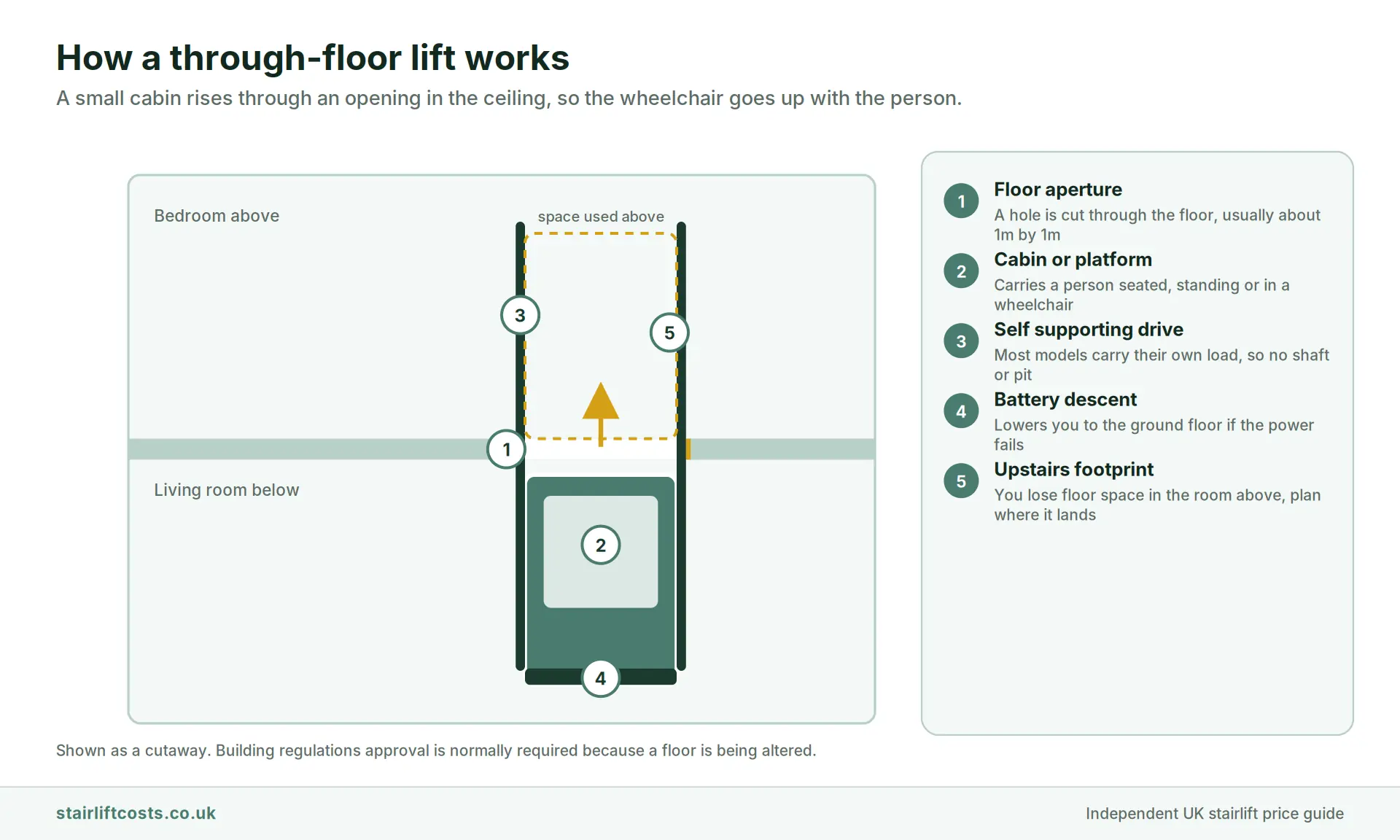
A through-floor lift, also sold as a homelift, is a small platform or cabin travelling between the ground and first floors through an aperture cut in the floor above. Downstairs it stands in the corner of a room. Upstairs it rises through the ceiling and stops level with the bedroom floor, and a powered closure seals the opening once the lift returns. Most models are self-supporting: twin drive rails carry the load, so there is no shaft and no pit.
The difference from a stairlift is what the lift carries. A stairlift moves a person who can sit on a seat. A through-floor lift moves a wheelchair with its user still in it, or a person and a carer together, which is why it answers cases where a transfer is unsafe. The trade-off is cutting joists in a structural floor, notifying building control and losing floor area on both storeys.
Get stairlift quotes from local installers
Answer a few quick questions and up to 3 installers who cover your area will quote. Free, with no obligation.
Is a through-floor lift right for you?
A through-floor lift works if
- The user cannot safely transfer out of a wheelchair onto a stairlift seat
- The condition is progressive and a seated lift would be outgrown within a few years
- The staircase cannot take a rail, or a stairlift would block the only escape route
- You own the home and intend to stay for the long term
- You can permanently give up one to two and a half square metres upstairs
Look at something else if
- The user can transfer onto a seat. A curved stairlift does the same job for a third of the money
- The house is three storeys or loft-converted, where fire rules often rule out an open carriage
- You live in a leasehold flat, where the lease may bar structural alterations outright
- You may move within five years. Resale value is nil and undoing the work costs thousands
- Downstairs living with a bed and wet room would work, which councils often propose first
This is a transfer decision, not a price decision. Guides present a stairlift and a through-floor lift as cheap against expensive. That is the wrong frame. If the user can safely get onto a seat, a stairlift is almost always right. If they cannot, a stairlift simply will not do the job, however little it costs.
How much does a through-floor lift cost in 2026?
Published starting prices run from £13,000 to £17,000 for a through-floor lift supplied and installed, and quotes often come in higher. A standard two person cabin sits at £13,000 to £17,000. A wheelchair-capable car costs £16,000 to £26,000, because a bigger car means a bigger aperture and more floor area lost upstairs. Where a shaft or structural build is needed, the figure rises to £23,000 to £33,000.
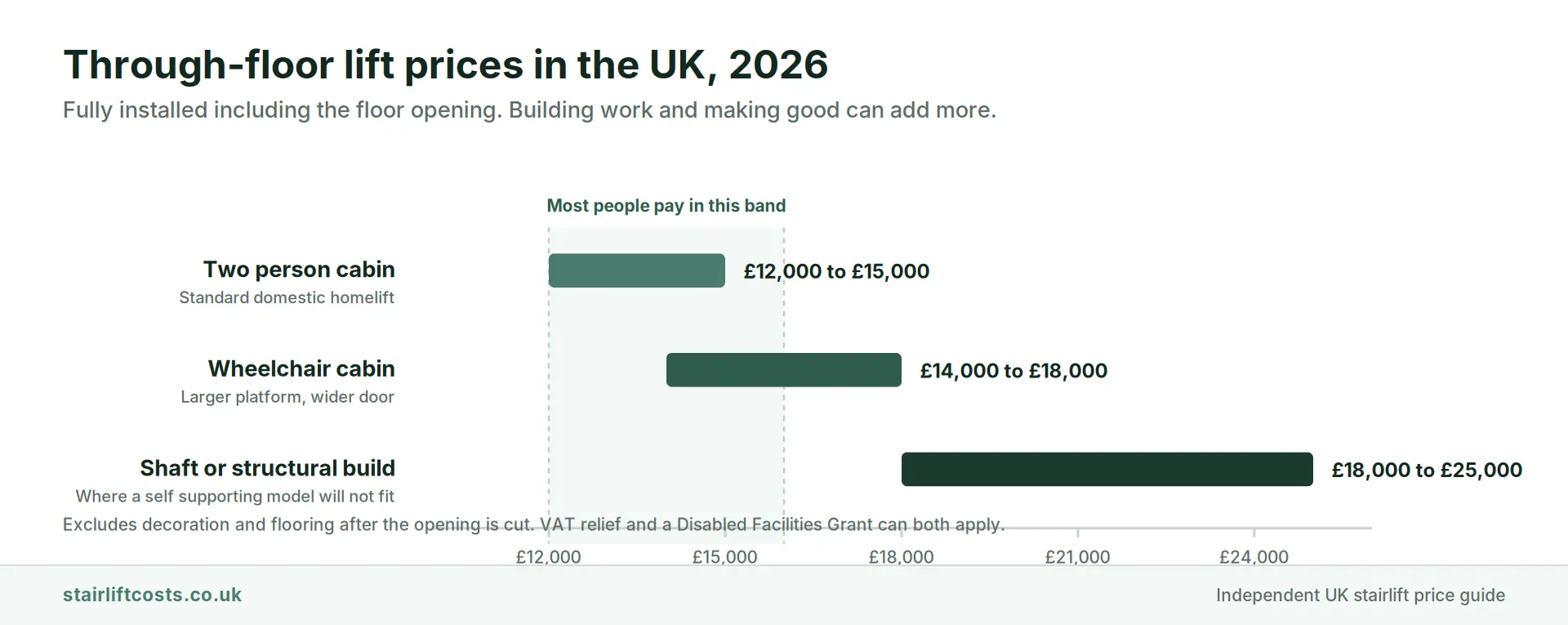
| Type | Installed price | What you get |
|---|---|---|
| Two person cabin or platform | £13,000 to £17,000 | Self-supporting drive rails, no shaft and no pit, battery descent |
| Wheelchair cabin | £16,000 to £26,000 | A larger car taking an occupied wheelchair, or a user and carer, with a larger floor opening |
| Shaft or structural build | £23,000 to £33,000 | An enclosed shaft, steelwork or a pit where a self-supporting lift cannot be used |
Last verified: 16 September 2026
Three things move the price. First, shaft against shaftless: an enclosure adds thousands of pounds of construction on top of a more expensive machine, which is why self-supporting models dominate. Second, wheelchair against seated: a bigger car cascades into a bigger aperture and more structural work. Third, how much preparation the house needs, meaning joist direction, pipework in the way and making good afterwards. Our guide to the types of lift compares the range.
What a quoted price usually includes, and what it does not
| Usually included | Usually extra, or a separate trade |
|---|---|
| Free structural and electrical survey | Moving pipework or a soil stack out of the aperture |
| Manufacture, delivery and installation | Plastering, decorating and flooring afterwards |
| Cutting the aperture and trimming joists | A new consumer unit or circuit way |
| The floor closure and its trim | A fire-rated floor closure, on some models |
| Building notice paperwork | Engineer’s calculations where a steel trimmer is used |
| 12 months parts and labour | Servicing from year two, and extended cover |
| Handover and demonstration | Removal and reinstatement at end of life |
How to pay less for a through-floor lift
VAT relief, and what it covers that people miss
Where the lift is supplied and installed in the private home of a chronically sick or disabled person for their own use, the whole supply is zero-rated at 0% VAT, worth over £2,000 on a £14,000 lift. HMRC treats chronically sick or disabled as an impairment with a long-term, substantial adverse effect on everyday activities. You sign a short eligibility declaration and reclaim nothing. The relief also covers later repair and maintenance, and the making-good building work directly related to the lift where the same contractor does it, which is a strong reason to have one firm handle both.
The 5% reduced rate that applies to stairlifts on age alone is not clearly established for through-floor lifts, because HMRC guidance distinguishes stairlifts from other categories of lift. If a supplier offers 5% on age grounds, ask for the basis in writing.
A Disabled Facilities Grant is often the realistic route
For most households a through-floor lift is not funded out of savings, and the Disabled Facilities Grant is the route that actually gets these lifts installed. A lift at £13,000 to £26,000 sits inside every national cap, but it is a far larger claim than a stairlift and councils scrutinise it accordingly, so the occupational therapy assessment carries real weight.
| Nation | Maximum | Means tested? |
|---|---|---|
| England | £30,000 | Yes, on the disabled person and partner. Not means tested for a disabled child. Adaptations costing £1,000 or less must be provided free |
| Wales | £36,000 | Yes, with small adaptations usually fitted free regardless of means |
| Scotland | No DFG. Scheme of Assistance instead | Councils fund at least 80% of approved costs, and up to 100% on qualifying benefits |
| Northern Ireland | £35,000 | Yes, administered by the Housing Executive. Confirm the current cap with NIHE before you rely on it |
Last verified: August 2026 against the grant legislation. GOV.UK still shows the superseded £25,000 figure for Northern Ireland.
A grant cannot pay for work already done, so never order before approval, and build in the timescale: a grant-funded homelift commonly takes months end to end. Council and housing association tenants should approach the landlord first. See our grants guide.
Reconditioned, rental and finance
- Reconditioned. A thin market with a small saving, for the opposite reason to stairlifts. With a curved stairlift the bespoke part is the rail; with a homelift it is the hole. Apertures are cut to millimetre tolerances and travel height is fixed at manufacture, so a used lift only fits a second house if a new opening is cut to its exact dimensions, and the structural work costs the same as on a new lift.
- Rental. We have found no consumer rental market for these lifts in the UK. The stairlift model does not transfer, because a homelift is not re-deployable and removing it leaves a permanent hole. For a short need, ask your council’s community equipment service.
- Finance. Compare the total repayable, and ask charities such as Independence at Home, the ACT Foundation and trusts listed on Turn2us to close any gap left by a means-tested grant.
What a through-floor lift costs to run
Running costs are higher than a stairlift, and the most important number is not published by anybody. Electricity is small, servicing is a real annual commitment, and out-of-warranty repair pricing is a blank page.
| Running cost | Typical UK position | How often |
|---|---|---|
| Electricity | Roughly £25 to £60 a year, against £12 for a stairlift | Continuous. The controller and charger never switch off |
| Annual service | From about £195 a year | Yearly, and twice yearly on hydraulic models |
| Out of warranty repairs | No UK maker publishes a price for a control board or drive motor | Ask before buying, and treat a refusal as an answer |
| Backup battery pack | Excluded from almost every cover plan | Ask the interval and the fitted price |
| Cover plan | Tiered by lift age, top cover often withdrawn past five years | Check what happens at year eight |
| Removal and floor reinstatement | £850 to £1,100 to remove, £1,100 to £1,350 with new joists and boarding, against £150 to £300 for a stairlift | Once, leaving you ready for plaster and paint |
Last verified: August 2026
The warranty asymmetry nobody mentions. A £15,000 through-floor lift carries the same 12 months parts and labour as a £3,000 stairlift, and few independent engineers work on homelifts, so after year one you buy repairs from a single supplier at whatever price they set. You do not owe anyone a LOLER inspection either: the Health and Safety Executive is clear that equipment owned and used in a private dwelling falls outside LOLER and PUWER.
Will a through-floor lift fit? Room and structural requirements
Stair width is irrelevant here. What decides feasibility is the two rooms, one above the other, and what is inside the floor between them.
| Requirement | What is typical |
|---|---|
| Floor opening | About 1m by 1m for a compact two person lift, larger for a wheelchair car |
| Floor area lost upstairs | Roughly 1 to 1.6 square metres for a two person lift, 1.5 to 2.5 for a wheelchair car |
| Floor area lost downstairs | The same footprint again, usually in a corner of the lounge |
| Joists | Cut and trimmed in every installation, with those either side commonly doubled and bolted |
| Headroom | Self-supporting models need modest headroom. Shaft lifts need more, plus a pit |
| Alignment | Positions must line up exactly, clear of pipes, drains, a chimney breast and any door swing |
| Power | Some models use a 13 amp socket. Others need a dedicated circuit, bringing in Part P |
The number people underestimate is the upstairs footprint. No manufacturer publishes floor area consumed as a single figure, so buyers discover at survey stage that a corner of a bedroom has gone for good. Mark it out with tape before you commit.
What would your stairs cost?
The price depends on your staircase. Compare real quotes for your home from up to 3 local installers.
Installation and building regulations
Allow 3 to 8 weeks from survey to fitting. The survey takes half a day, the specification is then frozen and the lift built to order, which is most of the wait. Once confirmed, the lift is cut to your house and is neither returnable nor transferable. Installation takes 1 to 3 days, of which the aperture is half a day to a day.
Building regulations approval is required
Nothing in the Building Regulations mentions lifts, and that catches people out. The lift is a machine, regulated under product safety law. What is notifiable is the hole. Cutting through a structural floor is a material alteration: it interrupts the load path, engaging Part A, and breaches the fire separation between storeys, engaging Part B. A building notice is normally adequate and work can start two days after submission. The owner is legally responsible even though the installer does the paperwork, so insist the completion certificate is issued in your name. A conveyancer will ask for it.
Building control should be free, and almost nobody tells you. The local authority charges regulations say a council must not charge where the whole of the work in a dwelling occupied by a disabled person is solely to provide access or secure their greater health, safety or convenience. Two catches: the word solely, so do not bundle a kitchen refit into the application, and the fact that the duty binds councils only, not a private approver.
Fire, three-storey houses and loft conversions
This is the check most consumer guides skip, and the one that can stop the project. In an ordinary two-storey house an open-carriage lift is normally fine. Where a storey sits more than 4.5 metres above ground level, meaning a three-storey house or a loft conversion, fire guidance expects a lift serving it to be inside the protected stairway enclosure or in a fire-resisting shaft. An open carriage rising through a bedroom floor is neither, so you are looking at a shaft, sprinklers as a compensating measure, or a different plan. Ask too whether the floor closure is standard: some give 30 minutes of fire and smoke integrity plus isolation on smoke detection, while at least one well-known model treats it as an option.
Other permissions
- Planning permission is not needed for an internal lift, in a house or a flat, because interior works are not development. Only an external shaft or new opening triggers it, and the fee is nil where a disabled person lives there.
- Listed buildings need listed building consent, including for internal work, and it is free to apply for. Cutting an original floor in a Grade I or II* building is serious, so expect a pre-application discussion and a heritage statement.
- Leasehold flats are the hardest case. Many leases carry an absolute bar on structural alterations, and the floor slab is often retained by the freeholder rather than demised to you.
- Rented homes need the landlord’s written consent, far harder to get than for a stairlift because this is permanent.
Safety features and standards
There is no BS EN 81-40 for homelifts. That standard covers stairlifts, and a supplier quoting it here has the wrong document. The UK standard is BS 5900:2012, for powered homelifts with partially enclosed carriers and no liftway enclosure, serving two levels in a private dwelling at no more than 0.15 metres a second. Enclosed platform lifts fall under BS EN 81-41:2024, which superseded the 2010 edition. At that speed these lifts are machinery under the Supply of Machinery (Safety) Regulations 2008, not the Lifts Regulations 2016, which expressly exclude them, so a claim of certification to those regulations is a category error. UKCA alone is not valid in Northern Ireland, but CE marking is lawful throughout.
- A powered floor closure sealing the aperture whenever the car is not at the upper level
- Under-car obstruction sensing that stops the lift if anything is beneath it
- Constant-pressure controls in the car and at both landings
- An emergency stop and an in-car alarm
- A key switch, useful where children or someone with dementia live at home
- Battery backup for descent when mains power fails
What happens in a power cut
Every domestic through-floor lift has a battery backup, but check what it does on your model. Some give a normal controlled descent on battery power. Others provide emergency lowering only, to release someone stuck, and neither will run the lift through a long outage. Ask how many descents the backup gives, and how the lift is lowered manually if the battery is flat too.
Warranty, lifespan and what happens at the end
Twelve months parts and labour is the standard warranty, with three or five year cover available as a purchase from some manufacturers. No UK manufacturer or independent body publishes an expected working life for a through-floor lift, so treat any confident number as an estimate. The one clue the trade gives away is that top-tier service cover is commonly restricted to lifts under five years old.
Assume the resale value is zero. No company publishes a buy-back figure, few will buy a used homelift at all, and removal firms state plainly that they remove and dispose rather than reinstall, because reusing a lift elsewhere would need full refurbishment to meet the current standard. Removing the lift and reinstating the floor runs to roughly £1,100 to £1,350 on published tariffs, which leaves you ready for plaster and paint. Add decorating and flooring on both storeys and undoing it costs thousands.
Through-floor lift compared with the alternatives
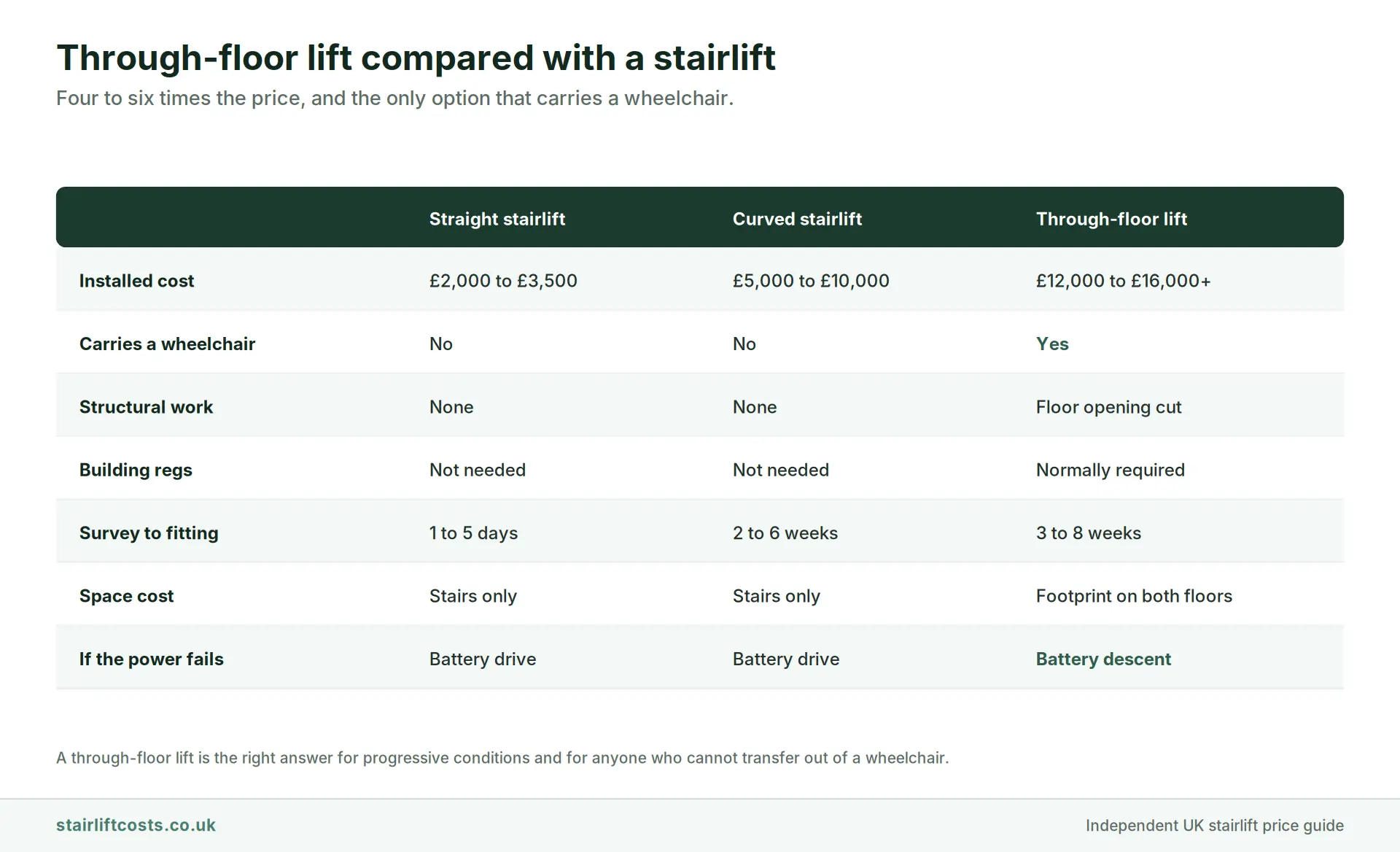
| Option | Installed cost | Best for |
|---|---|---|
| Straight stairlift | £1,500 to £3,500 | A single straight flight, a user who can sit, no building work |
| Curved stairlift | £4,000 to £10,000 | A turning staircase where the user can transfer. See straight vs curved |
| Through-floor lift | £13,000 to £17,000 | Wheelchair users who cannot transfer, and progressive conditions |
| Enclosed shaft or platform lift | £10,000 to £33,000 | Where a self-supporting lift will not fit |
| Downstairs living, bed and wet room | Varies, often grant funded | Where the ground floor has the space |
| Moving to a bungalow | Varies | Where adapting approaches the cost of moving |
Last verified: August 2026
A stairlift and a through-floor lift are not two prices for the same outcome. If the staircase turns and the user can sit, look at a stairlift first, and read our guide to stairlifts for narrow stairs if space is the worry. If the user stays in a wheelchair, the stairlift options come off the table.
What to ask before you sign
Get three quotes and say you are comparing. Several of the questions below are ones the industry is not used to being asked. Our buying guide covers what a good survey includes.
- What are the exact aperture dimensions, and how much room area will I lose upstairs?
- Which way do the joists run, and will you double them or fit a steel trimmer?
- Does this lift need a dedicated circuit or a 13 amp socket, and who self-certifies it?
- Is the fire seal standard or an option, and what integrity does the floor closure achieve?
- My house is loft-converted. How do you satisfy fire guidance on protected stairways?
- Who submits the building notice, and will the completion certificate be in my name?
- Are you using local authority building control, and does the disabled fee exemption apply?
- Is this quote zero-rated for VAT, and does that cover the builder’s work?
- What do out-of-warranty repairs cost, including a control board and a drive motor?
- What does the service contract cost in years two, five and ten?
- What does the battery backup do in a power cut, and how is the lift lowered manually?
- What will removal and floor reinstatement cost, and which trades are included?
Your rights, and the red flags
A lift sold to you at home is an off-premises contract with a 14 day right to cancel under the Consumer Contracts Regulations 2013. The exclusion for goods made to your specification will normally be applied, because car size, travel height and finish are set for your house at order, so establish in writing when manufacture begins. If you were not given the cancellation information in writing, the period extends by twelve months. Start with our quote request page.
Walk away from: a price that only holds if you sign today, a refusal to put out-of-warranty repair or removal costs in writing, a quote silent on plastering and decorating, or anyone citing BS EN 81-40 or the Lifts Regulations 2016 for a homelift. The BHTA code of practice bans price-dropping and pressurised selling by its members and is a Chartered Trading Standards Institute approved code.
Get quotes for a through-floor lift
Compare up to three UK installers. It takes a minute and there is no obligation.
Frequently asked questions
How much does a through-floor lift cost in the UK?
A through-floor lift starts at about £13,000 to £17,000 fully installed for a typical UK home in 2026. A two person cabin runs £13,000 to £17,000 and a wheelchair-capable cabin £16,000 to £26,000. Where a shaft or other structural build is needed because a self-supporting model will not fit, the price rises to £23,000 to £33,000.
Do you need building regulations approval for a through-floor lift?
Yes. The lift is regulated as machinery, but cutting an aperture through a structural floor is a material alteration affecting the load path and the fire separation between storeys, so it must be notified to building control. A building notice is usually adequate, and the completion certificate should be in your name.
How long does a through-floor lift take to install?
Allow 3 to 8 weeks from survey to fitting, most of which is manufacture, because every lift is built to order for one house. The installation takes 1 to 3 days, with half a day to a day spent cutting the aperture and trimming the joists.
How much space does a through-floor lift take up?
The floor opening is about 1 metre by 1 metre for a compact two person lift, larger for a wheelchair car. Counting clearances and the space kept free in front of the car, budget on losing 1 to 1.6 square metres upstairs, or 1.5 to 2.5 for a wheelchair lift.
Can a through-floor lift take a wheelchair?
Yes, and it is the only home access product carrying a wheelchair and its user together. A wheelchair-capable cabin costs £16,000 to £26,000 installed and takes an occupied chair, or a user and a carer. Smaller cars carry one seated or two standing passengers instead.
What happens to a through-floor lift in a power cut?
Every domestic model has a battery backup, but what it does varies. Some give a normal controlled descent on battery power, others provide emergency lowering only, to release someone stuck. Ask how many descents the backup gives, and how the lift is lowered manually if the battery is flat.
Is a through-floor lift better than a stairlift?
It depends on whether the user can transfer onto a seat, not on price. If they can, a stairlift does the same job for a quarter to a third of the cost with no building work. If they cannot leave a wheelchair, a stairlift simply does not do the job.
Can you get a grant for a through-floor lift?
Yes. A Disabled Facilities Grant is the realistic funding route for most households, and a lift at £13,000 to £26,000 sits inside every cap: £30,000 in England, £36,000 in Wales, £35,000 in Northern Ireland, with Scotland funding at least 80%. Get approval before ordering.
Is a through-floor lift VAT free?
Where the lift is supplied and installed in the private home of a chronically sick or disabled person for their own use, the whole supply is zero-rated at 0% VAT. The relief also covers later repair and maintenance, and related making-good building work by the same contractor.
What standard should a through-floor lift meet?
BS 5900:2012 is the UK standard for powered homelifts with partially enclosed carriers and no liftway enclosure. Enclosed vertical platform lifts are covered by BS EN 81-41:2024. BS EN 81-40 applies to stairlifts, not homelifts, and these lifts fall under machinery regulations, not the Lifts Regulations 2016.
A through-floor lift is one option among several. Our comparison of alternatives to a stairlift puts it beside rails, ramps, rental and moving downstairs, with a price against each.
Ready to compare prices?
Tell us about your stairs and get up to 3 free quotes from installers who cover your area.