Independent buying guide. Last updated June 2026 by Claire Ashworth.
Most stairlift “advice” online is really a brochure: it lists features and then asks you to book a survey. This guide does the opposite. It walks you through the same decisions a good surveyor makes in your hallway, in the order they make them, so that by the end you know which type of lift you need, roughly what it should cost, and where you are being steered towards the wrong product. Work through the seven decisions below before you let anyone quote you.
Key takeaways
- Straight stairs need a straight lift (around £1,500 to £3,500 fitted); any bend, turn or landing needs a curved lift (£4,000 to £10,000).
- Most stairs are not too narrow: modern lifts fit a staircase from about 660mm (26 inches) wide.
- Match the seat to the user. If sitting or bending is painful, choose a perch or sit-stand lift.
- Buy reconditioned for a straight staircase; rent only for a short-term need.
- If the user is chronically sick or disabled, the lift should be zero-rated for VAT (saving 20%), and a grant may cover more.
- Never accept a curved quote measured over the phone. The rail must be measured on site.
The seven decisions, in order
- Is your staircase straight or curved? This sets the price band more than anything else.
- How narrow are your stairs, and which side should the rail go?
- Can the user sit normally, or do they need a perch or standing lift?
- What is the user’s weight, and will it change?
- New, reconditioned, or rented?
- National manufacturer or local dealer?
- Are you actually eligible to pay zero VAT or get a grant?
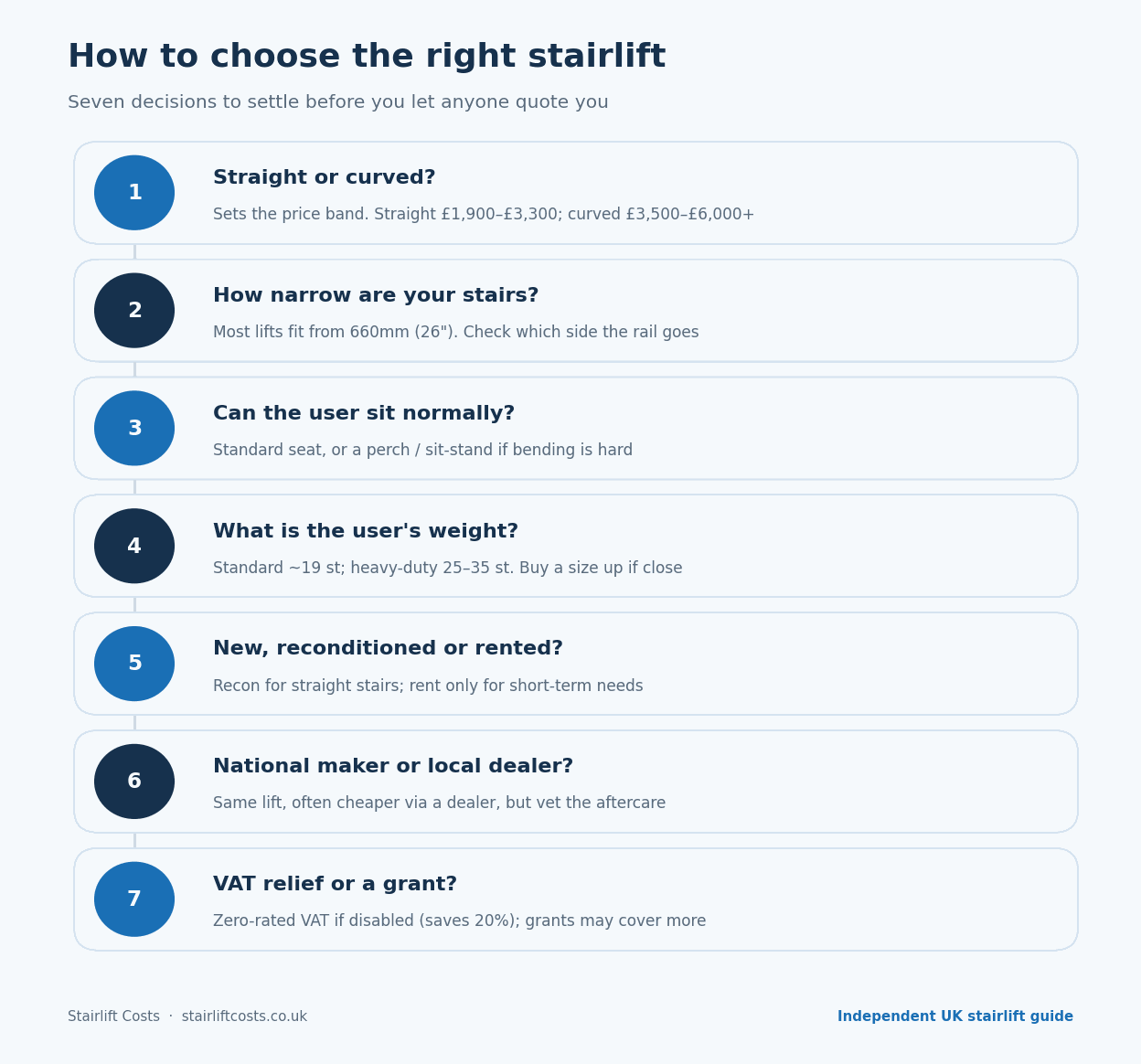
Get the first four right and you have specified the machine. Get the last three right and you have controlled the price.
Get stairlift quotes from local installers
Answer a few quick questions and up to 3 installers who cover your area will quote. Free, with no obligation.
Decision 1: Straight or curved?
This is the single biggest fork in the road, because it roughly trebles the price. A straight stairlift runs on a length of standard rail that is simply cut to fit. A curved stairlift needs a rail bent to the exact shape of your stairs, made to measure in a factory, which is why it costs more and takes longer to install.
| Staircase | Lift you need | Typical 2026 UK price, fitted | Lead time |
|---|---|---|---|
| One straight flight, no bends or landings | Straight stairlift | £1,500 to £3,500 | Often within a week, sometimes next day |
| Any bend, turn, half-landing or spiral | Curved stairlift | £4,000 to £10,000 | 2 to 6 weeks (rail is custom-made) |
Last verified: August 2026
Here is the part the brochures gloss over. If your stairs have a small bend or a couple of steps that turn at the bottom, a salesperson will usually quote you a full curved lift. Sometimes there is a cheaper option: fit a straight lift to the long flight and add a short step or a small platform at the turn, or position the lift so it stops just before the bend. It is not always possible or safe, but it is worth asking, “Can this be done with a straight rail?” before you accept a curved quote, because the difference is often more than two thousand pounds.
One more rule worth knowing: never buy a curved lift on a measurement taken over the phone or from photos. The rail must be measured on site. If a company offers to quote a curved lift without visiting, walk away.
Decision 2: How narrow are your stairs?
People worry their stairs are too narrow for a lift far more often than is justified. Most modern straight lifts fit a staircase from around 660mm (26 inches) wide, against a typical UK staircase of 30 to 32 inches, and the seat, arms and footrest fold flat when the lift is parked so other people can still use the stairs.
Measure the clear width yourself before anyone visits: the distance from the wall to the inside edge of the banister, at stair-tread level, at the narrowest point. Then consider three things a surveyor will check:
- Which side the rail goes. The rail can usually go on either side. The better side is the one that lets the user get on at the bottom and off at the top facing the landing, and that keeps the seat clear of a door at the top of the stairs.
- What is at the bottom. A front door, a radiator or a doorway right at the foot of the stairs can foul the parked seat. A “hinged” or “folding” rail section solves this but adds a few hundred pounds, so factor it in rather than being surprised by it.
- Headroom and overruns. On very short or very steep flights, the seat needs somewhere to sit at each end. This is rarely a dealbreaker but it is worth flagging if your staircase is unusual.
If two people both quote “your stairs are too narrow for the model we sell,” get a third opinion from a company with a slimline model before you accept that no lift will fit.
Decision 3: Can the user sit normally?
The standard stairlift assumes the user can sit, bend their knees and hips to about 90 degrees, and swivel. For many people that is fine. For some it is not, and choosing the wrong seat is the most common reason a lift goes unused after it is fitted. Match the person to the seat honestly:
| If the user… | The right lift is… |
|---|---|
| Can sit and bend normally | Standard seated stairlift |
| Struggles to bend knees or hips, or finds sitting painful | Perch or sit-stand stairlift (they lean rather than fully sit) |
| Uses a wheelchair at both floors and cannot transfer easily | Consider a through-floor home lift instead of a stairlift |
| Has limited grip or arm strength | Standard lift, but check the controls are a paddle or rocker, not a small button, and ask for a powered swivel seat |
Two features are worth paying for and two are usually not. Worth paying for: a powered (automatic) swivel seat, so the user does not have to twist the seat by hand at the top of the stairs, which is exactly the moment a fall is most likely; and a proper seatbelt with a retractable lap belt rather than a flimsy strap. Usually not worth it: remote-control “call and send” handsets (handy, but rarely essential), and upgraded upholstery, which adds cost without adding safety or reliability.
Decision 4: What does the user weigh, now and later?
Standard stairlifts carry around 19 stone (120kg). Heavy-duty or bariatric models raise that to roughly 25 to 35 stone (160 to 220kg), with a wider seat. This matters for two reasons. First, buying a lift that is at the very top of its weight limit shortens its working life and can void the warranty. Second, mobility needs tend to increase, not decrease, so if the user is close to a limit now, specify the next model up. The price difference on a heavy-duty straight lift is usually a few hundred pounds, far less than replacing the whole lift in two years.
Decision 5: New, reconditioned, or rented?
This is where you control the cost, and the right answer depends almost entirely on your staircase and how long you expect to need the lift.
| Option | Best for | Typical 2026 cost | Watch out for |
|---|---|---|---|
| New | Curved stairs; long-term use; anyone wanting the full warranty | £1,500 to £3,500 straight; £4,000 to £10,000 curved | Paying list price without getting two or three quotes |
| Reconditioned | Straight stairs; tighter budgets | From £1,000 to £2,000 fitted | Curved reconditioned lifts barely exist, because the rail is bespoke; insist on a refurbishment record and a real warranty |
| Rented | Short-term need: recovery from surgery, convalescence, palliative care | Install £300 to £500, then around £40 to £80 a month | Minimum terms, where one applies, are usually six months; over a year or two, renting a straight lift usually costs more than buying reconditioned |
Last verified: August 2026
The honest rule of thumb: if you need a straight lift for more than about a year, buying reconditioned almost always beats renting. Rent when the need is genuinely temporary or uncertain. Buy reconditioned when the staircase is straight and the budget is tight. Buy new when the staircase is curved (there is rarely a second-hand option anyway) or when a long warranty and the latest safety features matter most.
What would your stairs cost?
The price depends on your staircase. Compare real quotes for your home from up to 3 local installers.
Decision 6: National manufacturer or local dealer?
The same physical lift is often sold two ways: directly by a national manufacturer, or through an independent local dealer who buys from a manufacturer and resells. The lift and the manufacturer’s warranty can be identical; what differs is price and aftercare.
- National manufacturers (for example Stannah) tend to cost more but give you one company for sales, installation, servicing and breakdowns, with a large engineer network and fast response. Best if reliability and a single point of contact matter most.
- Local dealers usually cost less for the same machine because their margins are leaner, but your aftercare is only as good as that one local firm. A great local dealer can beat the national experience; a poor one cannot.
If you go the dealer route, the decision is really about the dealer, not the lift. Before you sign, ask three questions and write down the answers: who answers a breakdown call and how quickly, what an out-of-warranty callout costs, and how long they have traded under the current name. For more on this trade-off, see our guide to manufacturer versus independent servicing.
Decision 7: Are you paying too much tax, or missing a grant?
Two things knock hundreds or thousands off the real price, and neither is automatic. You often have to ask.
VAT relief. If the lift is for someone who is chronically sick or disabled and it is for their own domestic use, the lift and its installation should be zero-rated for VAT, saving 20%. You do not need to be registered disabled or claiming any benefit; long-term conditions such as arthritis, a heart condition or diabetes can qualify. The supplier provides a short declaration form to sign. If a quote shows VAT added and the user is eligible, query it before you pay.
Grants. Depending on where you live and your circumstances, a Disabled Facilities Grant (England and Wales), or the equivalent schemes in Scotland and Northern Ireland, may cover part or all of the cost, usually means-tested and arranged through your local council’s occupational therapy team. These take time, so start the conversation early. See our regional stairlift grants guide for what applies where you live.
A 60-second self-survey before you call anyone
Have these answers ready and you will get faster, more honest quotes, and you will spot anyone trying to upsell:
- Straight flight, or does it bend or turn anywhere? (Decision 1)
- Clear width at the narrowest point, wall to banister, in inches? (Decision 2)
- Can the user sit and bend normally, or do they struggle? (Decision 3)
- User’s weight, and is it likely to rise? (Decision 4)
- How long will the lift realistically be needed? (Decision 5)
- Does the user have a long-term illness or disability? (Decision 7, for VAT)
Five red flags in a stairlift quote
- A curved lift quoted without a home visit. The rail must be measured on site. No exceptions.
- “Today only” pricing. A genuine price holds for at least a few days. High-pressure, expiring discounts are a sales tactic, not a saving.
- VAT charged to an eligible disabled user. This should be zero-rated; query it.
- A curved quote where a straight lift might fit. Always ask whether a straight rail can do the job before accepting curved pricing.
- No written breakdown of warranty, servicing and callout costs. If the aftercare terms are vague, the price is not really comparable.
So, which stairlift do you need?
For most people the answer is simpler than the sales process makes it feel. A straight staircase, a user who can sit normally, and a long-term need points to a reconditioned or new straight lift for under £3,300, bought from a well-reviewed local dealer, with VAT removed. A curved staircase points to a new curved lift, measured on site, quoted by two or three companies. A short-term need points to rental. Everything else is detail, and now you know which details to insist on.
Next, see typical figures on our stairlift prices guide, or compare options across straight stairlifts, curved stairlifts and reconditioned stairlifts.
Ready to compare prices?
Tell us about your stairs and get up to 3 free quotes from installers who cover your area.
Frequently Asked Questions
How do I know if I need a straight or curved stairlift?
If your staircase is a single straight flight with no bends, turns or landings, you need a straight stairlift, which is the cheaper option at roughly £1,500 to £3,500 fitted. Any bend, turn, half-landing or spiral needs a curved stairlift with a made-to-measure rail, typically £4,000 to £10,000.
Are my stairs too narrow for a stairlift?
Probably not. Most modern straight stairlifts fit a staircase from about 660mm (26 inches) wide, narrower than a typical 30 to 32 inch staircase, and the seat folds flat when parked. Measure from the wall to the inside of the banister at the narrowest point before assuming a lift will not fit.
Is it cheaper to rent or buy a stairlift?
For a short-term need of a few months, renting is usually cheaper, with installation from £350 to £1,000 and monthly fees of around £40 to £150. For a straight staircase needed longer than about a year, buying a reconditioned lift from around £1,000 to £1,500 usually works out cheaper than renting.
Can I get a stairlift without paying VAT?
Yes, if it is for someone who is chronically sick or disabled and for their own domestic use, the stairlift and installation should be zero-rated for VAT, saving 20%. You do not need to be registered disabled. The supplier provides a short declaration to sign.
What weight can a stairlift carry?
A standard stairlift carries around 19 stone (120kg). Heavy-duty and bariatric models carry roughly 25 to 35 stone (160 to 220kg) with a wider seat. If the user is close to the limit, specify the heavier-duty model, as it costs only a few hundred pounds more.
Should I buy from a national company or a local dealer?
The lift is often identical. National manufacturers cost more but give you a single company for service and fast breakdown cover. Local dealers are usually cheaper for the same machine, but your aftercare depends entirely on that firm, so check their breakdown response, callout costs and trading history before buying.
If none of the stairlift types fits the house, the answer may be something else entirely. See alternatives to a stairlift and what they cost.
