

Heavy-Duty Stairlift
Who they are for, weight limits, and cost differences in the UKA heavy-duty stairlift carries 25 stone or more, against 19 to 22 stone on a standard model, using a reinforced rail with extra fixing points, a stronger motor and a wider seat. It costs £3,000 to £6,000 fully installed on a straight staircase and £6,000 to £10,000 for a curved rail. The rated load is a certified figure that the lift was tested to, not a suggestion.
How much does a heavy-duty stairlift cost? A heavy-duty stairlift costs £3,000 to £6,000 fully installed on a straight staircase in 2026, against £2,000 to £3,500 for a standard straight lift, and £6,000 to £10,000 on a curved rail. Reconditioned heavy-duty units run £2,000 to £4,000. Every figure on this page comes from our Pricing Index, which we review quarterly against real installer quotes.
What is a heavy-duty stairlift?
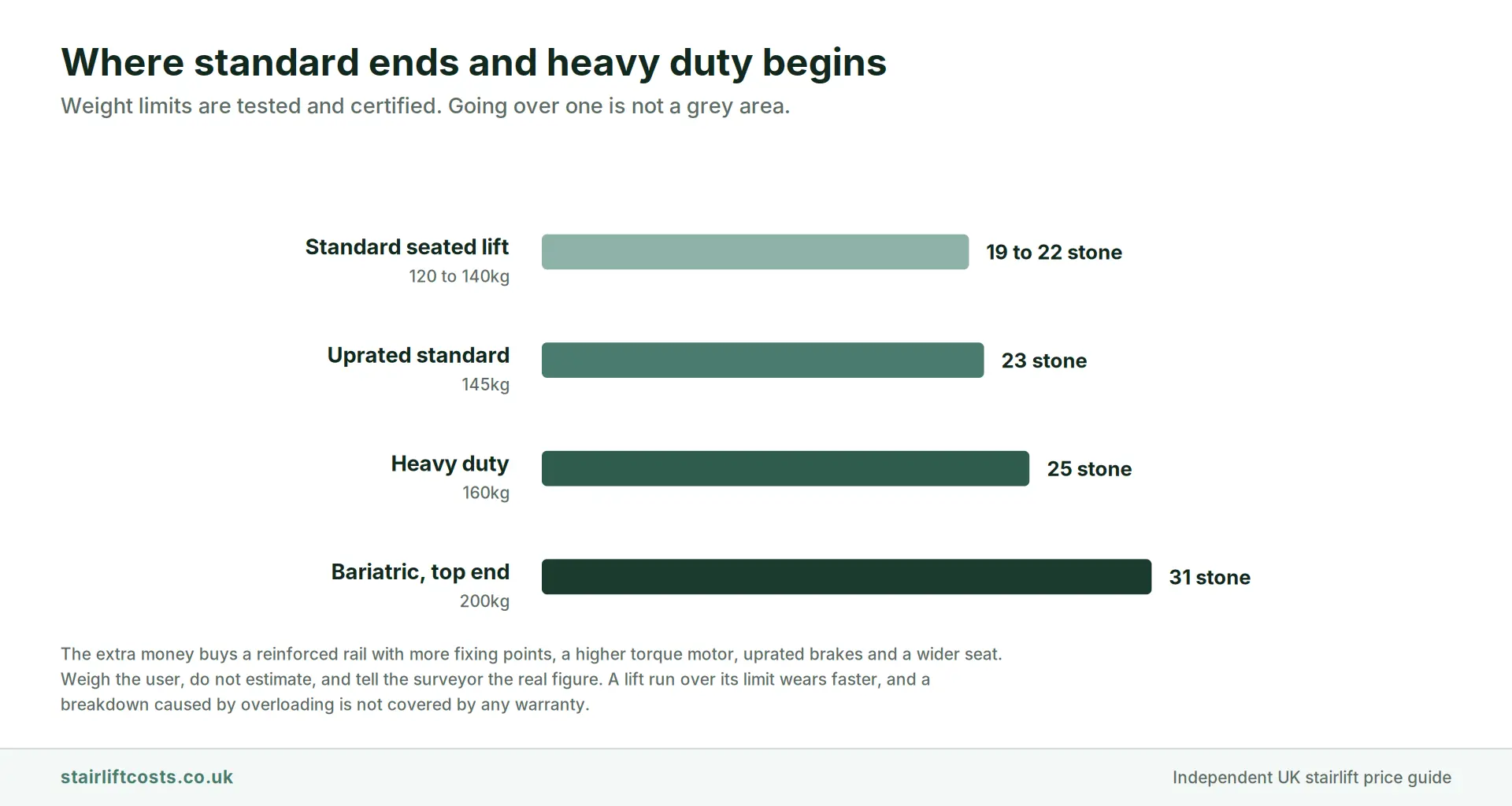
A heavy-duty stairlift is rated to carry roughly 25 stone or more, where a standard seated model is rated at 19 to 22 stone. The rating is the headline, but the whole machine differs: rail, motor, rollers, seat, swivel, footplate, battery and seatbelt are all uprated together. Buying a standard lift and asking for a bigger seat does not produce a heavy-duty lift.
The lower boundary matters as much as the upper one. BS EN 81-40:2020 requires a seated stairlift to be rated at no less than 115kg, about 18 stone, and most standard models sit at 120 to 140kg. The 140 to 160kg zone is marketed inconsistently, and some suppliers call a 145kg lift heavy duty. Treat 140kg as the top of standard, and 160kg with a reinforced rail as genuinely heavy duty.
Is a heavy-duty stairlift right for you?
A heavy-duty stairlift is the right call if
- The user weighs more than about 19 stone, or is within two stone of a standard lift’s rated load
- Hip width is wider than a standard seat allows between the armrests
- The user is tall as well as heavy, so seat depth and footplate height matter
- The staircase is straight, where the choice of high-capacity models is widest
- Weight fluctuates and you want the lift running well inside its rating
Look at something else if
- The user is over about 31 stone. Nothing seated is rated above 200kg, so a platform or through-floor lift is the honest answer
- The user is over about 25 stone and the staircase curves. Options shrink sharply, and two straight lifts may be cheaper
- The staircase is very tight. Heavy-duty carriages are bigger, so narrow stairs and high capacity pull in opposite directions
- The user cannot transfer onto a seat at all, in which case the lift type is the wrong question
- The weight is close to standard and the real problem is seat width, which a standard chassis may solve for less
Build in two stone of headroom. A rated load that matches the user’s weight exactly leaves nothing for winter clothing, shopping, a walking frame on the lap or ordinary fluctuation. The trade rule of thumb is two stone of margin, and moving up a tier at the order stage costs far less than replacing a worn lift in year four.
How much does a heavy-duty stairlift cost in 2026?
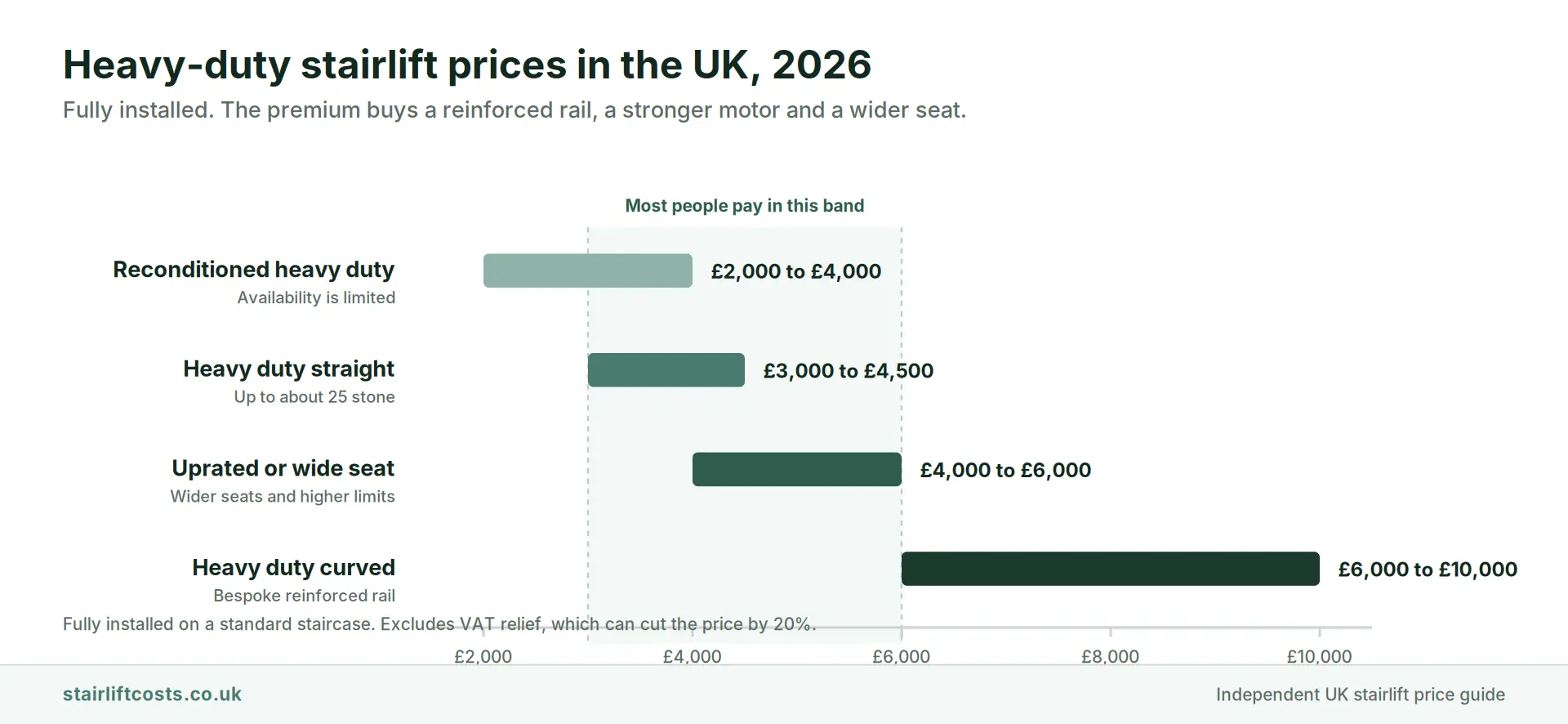
Most UK households pay £3,000 to £6,000 for a heavy-duty stairlift on a straight staircase, against £2,000 to £3,500 for a standard straight lift. The premium is real but smaller than people expect. Curved work is where the money goes, at £6,000 to £10,000, because a bespoke bent rail is expensive before anyone reinforces it.
| Option | Installed price | What you get |
|---|---|---|
| Standard straight, for comparison | £2,000 to £3,500 | 19 to 22 stone rating, standard rail and seat |
| Reconditioned heavy duty | £2,000 to £4,000 | Refurbished carriage on a rail cut for your stairs. Check the plate, because some units are re-rated lower after rebuild |
| Heavy duty straight | £3,000 to £4,500 | 25 stone rating, reinforced rail, wider seat, stronger drive |
| Uprated or wide seat | £4,000 to £6,000 | The top straight tier, to 31 stone, with the widest seats and powered swivel on some models |
| Heavy duty curved | £6,000 to £10,000 | Bespoke bent rail in heavy-duty form, typically to 25 stone, with more brackets through the bends |
Last verified: August 2026
What the premium actually buys
Ask an installer to itemise it. The answer should cover the reinforced rail with its extra support legs and fixing points, which is the largest part of the cost and cannot be retrofitted; a higher-torque motor and hardened rollers; a wider, deeper seat on a stronger frame; an uprated swivel; and an uprated battery. If most of that is missing, you are being sold a standard lift with a wide seat and a heavy-duty label.
What it does not buy. Heavy duty buys no extra warranty in the UK, and several manufacturers give the same 12 months across their range. An uprated gearbox or brake is often claimed in marketing but rarely appears as a different part on a spec sheet, so ask for the part-level difference in writing.
What a quoted price usually includes, and what it does not
| Usually included | Usually extra |
|---|---|
| Free survey, including the user’s seated measurements | Annual servicing once the warranty ends |
| Delivery, reinforced rail assembly and fitting | Powered footplate, worth having at high capacity |
| The wider seat and longer belt | Armrest adjustment beyond the standard range |
| Connection to a nearby 13 amp socket | Adding a socket if there is not one in reach |
| 12 to 24 months parts, labour and call-outs | Removing an existing lift that is being replaced |
| Handover, tuition and a test certificate | Removal and making good at end of life |
How to pay less for a heavy-duty stairlift
VAT relief is the biggest single saving
There are two reliefs and most buyers qualify for one. On a £5,000 job the relief is worth more than any discount an installer will offer, so settle it before you negotiate.
- Zero rate, 0% VAT. Where the lift is supplied and installed for a chronically sick or disabled person in their own private home. HMRC defines that as a physical or mental impairment with a long-term and substantial adverse effect on everyday activities. Weight alone is not the test, the qualifying condition is.
- Reduced rate, 5% VAT. Available on age alone where the customer is 60 or over and the lift is supplied and installed in their own home. It does not apply to goods without installation, nor to later repairs.
You do not claim either relief back from HMRC and you do not need a doctor’s letter. You sign a short eligibility declaration, separate from the order form, and the supplier does not charge the VAT. Where the zero rate applies, servicing, repairs and spare parts are covered too, which matters on a heavy-duty unit because parts are dearer.
Grants and council help
A Disabled Facilities Grant can cover all or part of the cost after an occupational therapy assessment. Be direct with the OT about the user’s weight at the first visit, because a grant approved against a standard specification and then revised upwards causes delay.
| Nation | Maximum | Means tested? |
|---|---|---|
| England | £30,000 | Yes, on the disabled person and partner. Not means tested for a disabled child. Adaptations costing £1,000 or less must be provided free |
| Wales | £36,000 | Yes, with small adaptations usually fitted free regardless of means |
| Scotland | No DFG. Scheme of Assistance instead | Councils fund at least 80% of approved costs, and up to 100% on qualifying benefits |
| Northern Ireland | £25,000 | Yes, administered by the Housing Executive. Confirm the current cap with NIHE before you rely on it |
Last verified: August 2026 against gov.uk
A grant cannot pay for work already done, so apply before you order, and councils have six months to decide. Tenants should ask the landlord first, because councils and housing associations often fund and fit directly. The full stairlift grants guide covers the process.
Reconditioned, rental and finance
- Reconditioned. A refurbished heavy-duty lift runs £2,000 to £4,000 installed. Check the rating on the machine as supplied, not the rating the model carried when new, because refurbished units are sometimes re-rated lower after rebuild.
- Rental. Useful for a temporary need, but confirm the fleet actually holds a heavy-duty unit. Many are standard stock only.
- Finance. Compare the total repayable rather than the monthly figure, and check whether the agreement is regulated.
- Charities. Independence at Home, the ACT Foundation, SSAFA, the Royal British Legion and trusts listed on Turn2us make small grants towards adaptations.
- Published heavy-duty prices from £2,350: the UK Stairlift Price Tracker
What a heavy-duty stairlift costs to run
Running costs are close to a standard lift, with two differences: the motor draws more current on every trip, and parts are lower volume, so a replacement board or motor costs more.
| Running cost | Typical UK figure | How often |
|---|---|---|
| Electricity | About £12 a year | Continuous |
| Annual service | £100 to £200 | Yearly, once the warranty ends |
| Out of warranty repair | Call-out £75 to £200, plus parts | Which? found 37% of owners needed one repair over ten years, averaging £257 |
| Battery replacement | £50 to £120 fitted | Every 3 to 5 years, sooner under heavy loading |
| Extended warranty or cover plan | £150 to £300 a year | Optional |
| Removal at end of life | £150 to £300 | Once |
Last verified: August 2026
Capacity, seat size and what your staircase needs
Three things have to line up and they are independent. The rated load has to exceed the user’s weight with margin, the seat has to fit their hips and thighs, and the staircase has to leave room for knees and shoulders.
Seat width is not the same thing as weight rating
These move independently. One 200kg model has a seat almost 17cm wider between the armrests than a lift rated higher still. A 22 stone user with wide hips may need a wide seat on a standard chassis; a 26 stone user of average build may need the rating without it. Give the installer both numbers.
| Specification | Standard seated lift | Heavy-duty lift |
|---|---|---|
| Rated load | 120 to 140kg, 19 to 22 stone | 160kg and above, to 200kg or 31 stone at the top |
| Seat width between armrests | About 42 to 46cm | About 50 to 64cm depending on model |
| Seat depth | About 36cm | Up to about 42cm |
| Stair width needed | 70 to 75cm typically | Similar. Some heavy-duty curved models fit from 66cm, and knees fail before the rail does |
| Rail fixings | 4 to 6 brackets, every 3 to 4 treads | Extra support legs and more brackets, so load per bracket is similar |
| Travel speed | Up to 0.15 metres a second, the regulated maximum | The same. Heavy duty is not slower by design |
What your staircase has to do
The rail bolts to the stair treads, never to the wall, because walls beside staircases are often plasterboard or lath and plaster and cannot hold the weight of rail, carriage and user. Bracket feet are roughly 50 by 30mm and screws go 25 to 40mm into the tread, deliberately shallow to clear services below. Heavy duty puts little more load through each fixing, because manufacturers add brackets rather than uprating each one.
Two things to raise at the survey. Ask whether the rating is angle-dependent: at least one widely sold model is rated 160kg up to 45 degrees but only 136kg at 53 degrees, so a steep flight can take away 24kg of capacity. And if your stairs are open tread, floating, stone, concrete or built with engineered treads, say so early and ask what the fixing method is, because the standard one assumes solid timber.
Heavy-duty curved stairlifts, and where the ceiling is
Heavy-duty curved lifts exist, but from a much smaller group of suppliers and with a lower ceiling. Most mainstream curved systems stop at 25 stone even in heavy-duty form, one specialist model reaches about 28 stone, and several popular curved lifts have no heavy-duty version at all. The 31 stone tier is straight-rail only.
| User weight | Straight staircase | Curved staircase |
|---|---|---|
| Up to 22 stone | Standard models, £2,000 to £3,500 | Standard curved, widely available |
| 22 to 25 stone | Heavy duty, £3,000 to £4,500 | Heavy-duty rail option on several systems, £6,000 to £10,000 |
| 25 to 31 stone | Uprated models, £4,000 to £6,000 | Almost nothing above 28 stone. Two straight lifts, or a through-floor lift |
| Over 31 stone | No seated stairlift | Platform or through-floor lift, from £12,000 |
Last verified: August 2026
Where a curved heavy-duty lift is not available, price two straight lifts with a transfer at the half landing before accepting anything larger. That only suits a user who can walk a few steps, but it is often thousands cheaper and can be fitted in days.
Installation, lead times and permissions
Heavy-duty straight lifts are stocked by the larger installers, several of whom fit within 24 to 48 hours, and the fit takes two to four hours. Curved rails are bent to a drawing of your staircase, take two to four weeks to make and four to six hours to fit. The engineer levels the rail, bolts the brackets, adds the support legs, mounts the carriage and commissions the lift. Ask for that run to be done with the user in the seat rather than empty. The stairlift installation guide covers the day in full.
- Planning permission is not required for an internal stairlift, and building regulations approval is not required for the lift itself. The product must meet BS EN 81-40.
- Listed buildings need listed building consent for significant work, which catches people out because planning permission is not needed.
- Rented homes need the landlord’s written permission. Under the Equality Act 2010 a landlord should not unreasonably refuse a disability-related adaptation. Agree reinstatement terms and photograph the stairs first.
- Domestic stairlifts sit outside LOLER and PUWER, which apply to workplace lifting equipment. A lift in a care home, HMO or workplace is a different case, driven by the setting rather than the lift’s capacity.
Safety, standards and what happens over the limit
UK stairlifts are built to BS EN 81-40:2020. The parts of it that explain why a weight limit is a hard number are worth setting out, because the limit gets treated as a round figure someone chose.
- Rated load. A seated stairlift must be rated at no less than 115kg. The figure on the plate is the load the lift was designed and tested against.
- Fatigue testing. The design must survive at least 45,000 load cycles at the rated load plus 10%. A user 30% over the rating is outside the validated envelope from the first trip, and the damage is cumulative.
- Static safety factor. At least 2.5 against yield on load-bearing parts, so one overload trip is unlikely to break anything, which is why people conclude the limit is soft.
- Braking. Mechanically applied and electrically held off, so it fails safe, and validated to stop the lift within 20mm from rated speed at rated load. An overloaded lift descending carries more momentum than it was tested against.
- Overspeed governor. Trips at 115% of rated speed, and by 0.3 metres a second on descent whatever the percentage.
Do not rely on the lift refusing to move. Salespeople often say an overloaded stairlift simply will not run. On seated lifts that is usually the motor stalling rather than a designed cut-out, and the realistic failure is stopping part-way up with the user stranded. The other outcomes are brake wear on descent, batteries that fail the next trip, and fatigue failure over time. Overloading breaches the manufacturer’s operating conditions, so assume the warranty will not cover the result.
Having the weight conversation with an installer
People put this off, and it costs them money and safety. Installers ask because the specification depends on it, not to judge, and they hear the answer every working day. Give an accurate current weight rather than a remembered one, plus hip width and seated height. If the user would rather not discuss it in front of family, ask the surveyor to measure privately. An installer whose response is anything but matter of fact has told you something useful, and there are plenty of other stairlift companies.
Warranty, servicing and lifespan
New heavy-duty lifts come with 12 to 24 months of parts, labour and call-outs, and reconditioned units 6 to 12 months. Check whether the guarantee is insurance-backed, because if it is not and the installer ceases trading it may be worth nothing, which hurts more on a heavy-duty unit where fewer engineers hold the parts.
No manufacturer requires a shorter service interval simply because a lift is heavy duty. Annual servicing is the baseline for both, and six-monthly servicing is advised for heavy use, which is about how many trips the lift makes rather than what the user weighs. Lifespan is the same 7 to 10 years quoted for standard models, provided the lift runs inside its rating. Resale is poor, because few buyers need 25 stone capacity and a reinforced rail is heavier to remove, so expect free removal rather than a cheque. Our guide to selling a stairlift covers the realistic outcomes.
Heavy-duty compared with the alternatives
| Option | Installed cost | Best for |
|---|---|---|
| Heavy-duty straight stairlift | £3,000 to £6,000 | Users from about 22 to 31 stone on a straight flight |
| Reconditioned heavy duty | £2,000 to £4,000 | Tight budgets, if the plate rating is confirmed in writing |
| Heavy-duty curved | £6,000 to £10,000 | Staircases with a bend, to about 25 stone, occasionally 28 |
| Standard lift with a wide seat | £2,000 to £3,500 | Users inside the standard rating whose problem is hip width, not weight |
| Standing or perch lift | £3,000 to £5,500 | Users who cannot bend the knees. Check the rating, because perch models are not always uprated |
| Two straight lifts with a transfer | Two straight prices | Split-level homes where curved heavy duty is unavailable |
| Through-floor or platform lift | £12,000 upwards | Over about 31 stone, wheelchair users, progressive conditions |
Last verified: August 2026
What to ask before you sign
Get three quotes and say you are comparing. On a heavy-duty job the differences are in the specification rather than the headline price.
- What is the certified rated load of this exact model, in kilograms, as it will be supplied?
- Is that rating angle-dependent, and what is it at the pitch of my staircase?
- What is the seat width between the armrests and the seat depth, in millimetres?
- Can the armrest spacing be adjusted, and by how much?
- What is reinforced compared with your standard model, part by part?
- How many rail brackets and support legs will it have?
- Is the swivel powered at this price, and is a powered footplate available?
- How much landing clearance does the wider seat need to swivel at the top?
- Is this price at 0%, 5% or 20% VAT, and will you supply the eligibility declaration form?
- How long is the warranty, is it insurance-backed, and are batteries included?
- Where are spare parts held, and what is the lead time for a motor or control board?
- Are you a member of the British Healthcare Trades Association, which offers binding dispute resolution?
Your rights, and the red flags
Stairlifts are usually sold in your home, which makes them an off-premises contract with a 14 day right to cancel under the Consumer Contracts Regulations 2013. Goods made to measure are excluded, and suppliers apply that to bespoke curved rails, so agree cancellation terms in writing before a curved rail goes into manufacture. The exclusion is far weaker for a straight lift on a stock rail. If the trader gave you no cancellation information in writing, the period extends by twelve months.
Walk away from: an installer who will not put the rated load in writing, one who says a standard lift will be “fine” for a user above its rating, or a price that only holds if you sign today. The BHTA code of practice requires a suitability assessment in the home before the sale, bans pressurised selling and is approved by the Chartered Trading Standards Institute. For quotes from installers who work to it, compare prices here.
Frequently asked questions
What weight can a heavy-duty stairlift take?
Heavy-duty stairlifts start at about 160kg, 25 stone, and the highest-rated straight models sold in the UK carry 200kg, 31 stone. Curved heavy-duty lifts usually stop at 25 stone. Above 31 stone no seated stairlift is available and the alternative is a platform or through-floor lift.
How much does a heavy-duty stairlift cost?
A heavy-duty stairlift costs £3,000 to £6,000 fully installed on a straight staircase and £6,000 to £10,000 on a curved one, against £2,000 to £3,500 for a standard straight lift. Entry-level models run £3,000 to £4,500, the uprated tier £4,000 to £6,000 and reconditioned units £2,000 to £4,000.
What is the weight limit of a standard stairlift?
Standard seated stairlifts carry 120 to 140kg, roughly 19 to 22 stone, and BS EN 81-40:2020 requires any seated stairlift sold in the UK to be rated at no less than 115kg. Anything marketed as heavy duty should be rated 160kg or more and have a reinforced rail, not just a wider seat.
What happens if you exceed a stairlift weight limit?
The usual outcome is the motor stalling part-way up, leaving the user stranded on the stairs. Over time overloading causes premature brake wear on descent, shortened battery range and eventual fatigue failure of structural parts. Do not assume the lift will refuse to move, because most seated stairlifts have no designed overload cut-out.
Do heavy-duty stairlifts need wider stairs?
Not usually. Stair width is driven by rail geometry and seat size rather than the weight rating, and some heavy-duty curved models fit staircases from 66cm. Where a wide seat meets a narrow flight, knee and shoulder clearance runs out before rail clearance does.
How wide is a heavy-duty stairlift seat?
Heavy-duty seats measure roughly 50 to 64cm between the armrests, against 42 to 46cm on a standard model, and the deepest are about 42cm front to back. Seat width and weight rating are independent, so a high rating does not guarantee a wide seat.
Is there a heavy-duty curved stairlift?
Yes, but the choice is much smaller than for straight lifts. Several curved systems offer a heavy-duty rail rated to 25 stone, one specialist model reaches about 28 stone, and several popular curved lifts have no heavy-duty version at all. Expect £6,000 to £10,000 installed.
Do heavy-duty stairlifts need more servicing?
No manufacturer requires a shorter service interval simply because a lift is heavy duty. Annual servicing is the baseline for both. Six-monthly servicing is advised for heavy use, meaning a lift making many trips a day, which is about usage frequency rather than the user’s weight.
Can you get a reconditioned heavy-duty stairlift?
Yes, at £2,000 to £4,000 installed, though they come up less often than standard units. The essential check is the rating on the machine as supplied rather than the rating the model carried when new, because some refurbished lifts are re-rated lower after rebuild.
Does a steep staircase reduce the weight limit?
It can, and this is rarely mentioned in quotes. At least one widely sold heavy-duty model is rated 160kg at pitches up to 45 degrees but only 136kg at 53 degrees. Ask the surveyor to measure your pitch and confirm the rated load at that angle in writing.