

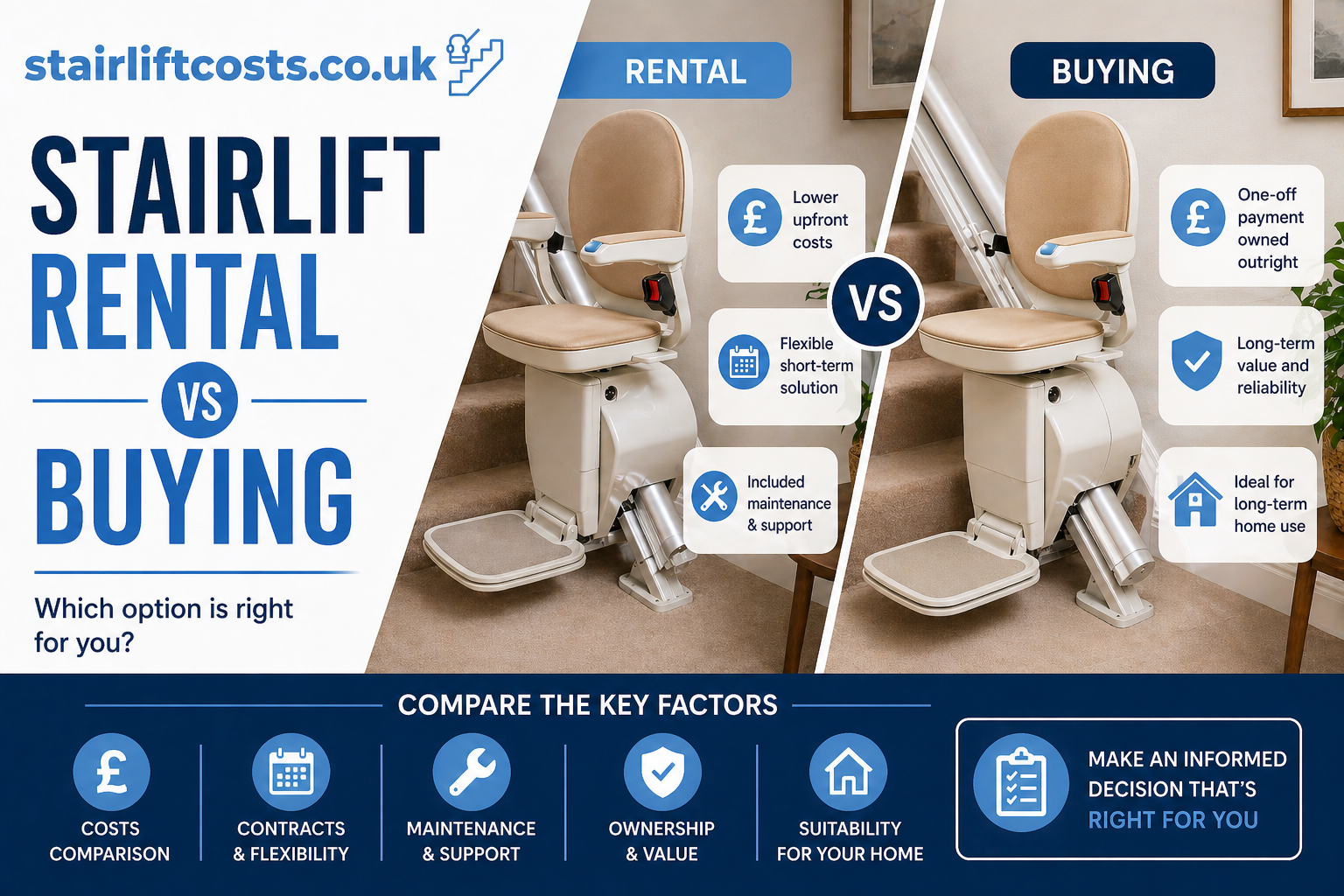
TL;DR:
Renting a stairlift keeps upfront costs low and is best suited to short-term or uncertain needs (typically under 1–2 years). Buying costs more initially but becomes a better value if you’ll use the stairlift long-term (around 2–3 years or more). You get ownership, customisation, and no ongoing fees. The right choice depends on how long you’ll need it, your budget, and whether you need a bespoke solution.
The Core Trade-Off: Upfront Cost vs Long-Term Value
- Renting a stairlift keeps upfront cost low; you pay a modest installation or deposit, then a monthly or weekly fee. Good if you only need the lift for a short time.
- Buying a stairlift requires a higher initial outlay, typically a few thousand pounds for a straight-rail model, but it becomes cheaper over time if you use the lift for several years.
If you need a stairlift long-term (many years or indefinitely), buying is usually more cost-effective overall.
Typical Costs, What You’ll Pay to Rent vs Buy (UK 2025)
Here’s a rough comparison based on current UK market rates:
When rental works out financially
- For short-term needs (e.g., post-surgery recovery, temporary mobility limitations, houseguests), if you only need a stairlift for a few months or up to 1–2 years, renting generally costs less than buying.
- When you don’t want to commitm, e.g., unsure how long mobility issues will last, a rental offers flexibility.
When buying becomes cheaper
- Suppose you expect to use the stairlift for several years or permanently. Over time, rental fees stack up, and you end up paying more than the cost of buying.
- If you want full customisation, features, or want to own the asset (e.g., for resale, reinstallation, or long-term usage).
Other Differences: Beyond Pure Cost
Advantages of Renting
- Low upfront cost, ideal for tight budgets or temporary needs.
- Maintenance & servicing included, you don’t need to worry about breakdowns, repairs, or servicing.
- Flexible commitment, you can stop renting if needs change (recovery, move house, stairs no longer an issue).
Advantages of Buying
- Better long-term value if needed long-term, no recurring monthly fees.
- Full customisation and choice, more freedom over model type (straight, curved, heavy-duty), seat type, and features. Rental units tend to be basic and “off the shelf.”
- Ownership and flexibility, once bought, you own it, can sell it, reuse it, or renovate around it without needing landlord permission.
Rental Limitations
- Limited model options, rental firms typically offer standard straight-lift models; curved, bespoke or heavy-duty lifts may not be available.
- Long-term cost may exceed buying, ongoing rental fees can eventually add up to more than a purchase.
- No asset at the end, when the rental ends, you don’t own anything, and there’s nothing to sell or re-use.
Rough Break-Even Estimates
A rough “break-even” horizon, when buying becomes cheaper than renting, often falls around 18–36 months for a straight stairlift, depending on rental rates and maintenance costs.
- If you expect to need the stairlift for less than ~2 years, renting is often the more economical and flexible option.
- If the stairlift will be needed for 3+ years, buying usually saves money and offers better long-term value.
Which Should You Choose? (Based on Your Situation)
| Situation / Priority | Likely Better Option |
| Temporary need (e.g., post-surgery, recovery, short stay) | Renting, low upfront cost, no long-term commitment |
| Long-term or permanent mobility needs (multiple years) | Buying, better long-term value, no ongoing payments |
| Budget constraints / limited savings | Start with renting, or consider a second-hand stairlift purchase |
| Need custom staircase solution (curved stairs, heavy-duty, special features) | Buying, rentals rarely offer bespoke stairlifts |
| Uncertain living duration, may move or change home | Renting offers flexibility; avoid being stuck with a fitted lift |
| Need included maintenance, no DIY upkeep | Renting might be easier (maintenance covered) |
Final Thoughts: There Isn’t a “One Size Fits All”
Renting vs buying a stairlift isn’t about one being strictly “better.” It’s about matching your mobility needs, finances, and plans.
- Rent if your need is temporary or uncertain, or if you want to avoid a high upfront cost.
- Buy if you expect long-term use, want full customisation or ownership, and enjoy the best value over time.
As a guideline, if you expect to need a stairlift for more than about 2–3 years, buying (new or reconditioned) is often the smarter financial decision.
Read More Comparative Guides
- Straight vs Curved Stairlifts: What’s the Real Difference in Cost?
- Standing Stairlifts vs Perch Stairlifts: What’s the Difference?
- Heavy Duty Stairlifts vs Standard Models: Key Differences
- Straight vs Curved Stairlifts: What is the Real Difference in Cost?
