
TL;DR:
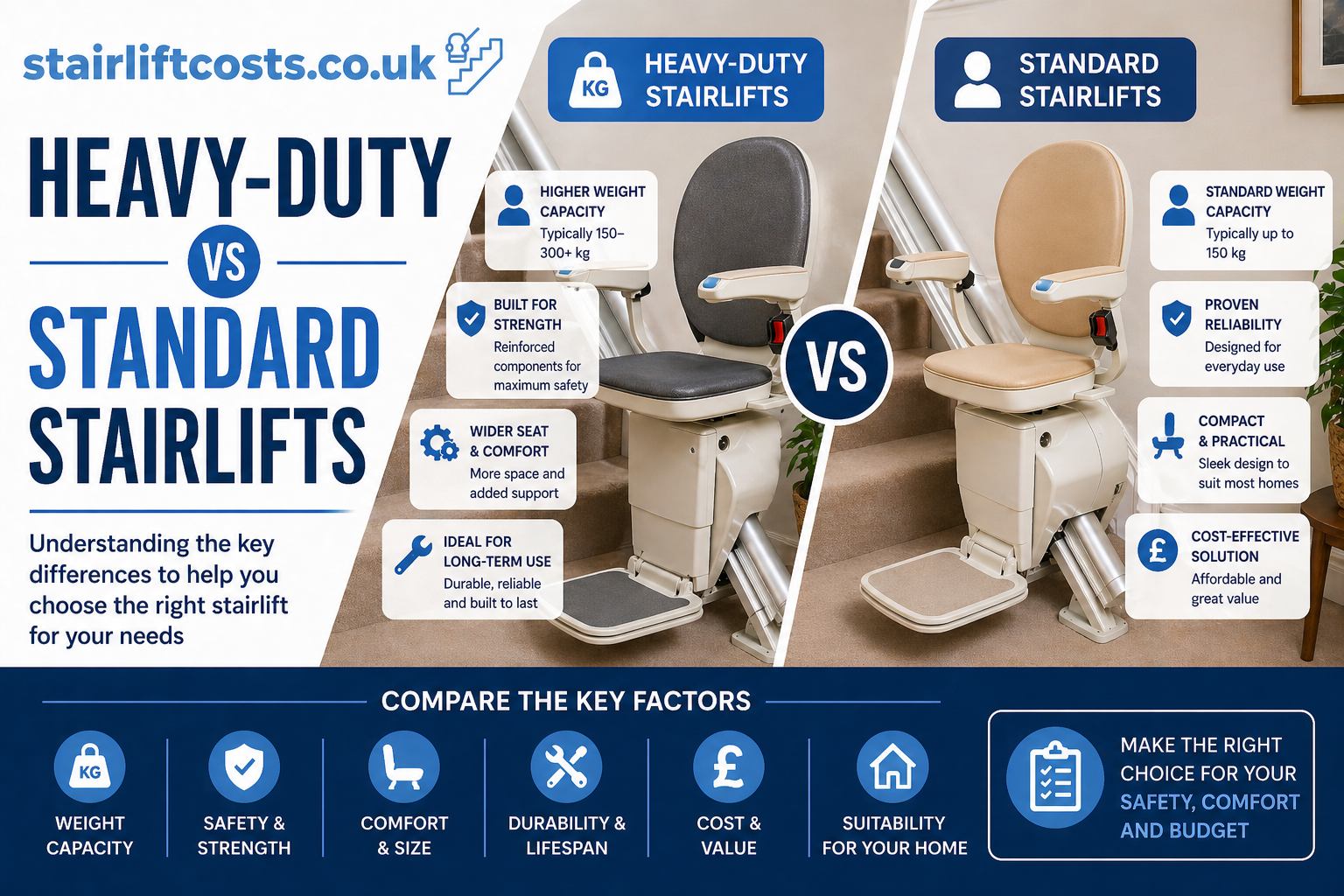
A standard stairlift suits most average-weight users, typically supporting up to around 18–22 stone, and fits most staircases at a lower cost. A heavy-duty stairlift is equipped with a stronger motor, stiffer rails, and a wider, deeper seat to safely support heavier loads (often 25–30 stone) and provide extra stability and comfort. Heavy-duty models cost more and need more space, but they’re the safer, longer-lasting option if weight limits are close to being exceeded, the seat feels cramped, or the lift will be used frequently.
What Are We Talking About?
- A standard (or “normal”) stairlift, the common stairlift many homes use, is designed for typical weight and mobility needs. Standard capacities tend to support average-weight users, typically up to around 18–22 stone (≈ 114–140 kg).
- A heavy-duty stairlift (sometimes called “bariatric” or “high-capacity”) is reinforced to support greater weight, with a stronger motor, reinforced rails/brackets, wider/deeper seating, and heavy-duty components. These are intended for users who exceed or are approaching the limits of standard lifts.
In short, both are “stairlifts,” but heavy-duty models are built for heavier users or more demanding use.
What Makes a Heavy-Duty Stairlift Different (vs Standard)
Heavy-duty stairlifts include several important hardware and specification upgrades compared with standard models to ensure safety, stability, and comfort when carrying heavier loads.
Key Upgrades and Features
- Higher Weight Capacity
- Reinforced Rail, Brackets and Motor
- Rails are stronger and more rigid, brackets are heavier-duty, and motors/gearboxes are built to handle greater loads without strain.
- Rails are stronger and more rigid, brackets are heavier-duty, and motors/gearboxes are built to handle greater loads without strain.
- Wider / Deeper Seats & Larger Footplates
- Enhanced Stability & Safety Features
- Potential for More Comfortable Ride & Longevity
- Because the stairlift isn’t working at its limit, wear and tear on the motor and rail are reduced, possibly extending its lifetime performance and reliability, especially if used frequently.
- Because the stairlift isn’t working at its limit, wear and tear on the motor and rail are reduced, possibly extending its lifetime performance and reliability, especially if used frequently.
- Suitability for Users with Mobility or Stability Needs
When Heavy-Duty Stairlifts Are a Better Fit: Who Needs Them
A heavy-duty stairlift is the right choice if any of the following apply:
- The user’s weight is close to or above the standard stairlift limit (~20+ stone / 125 kg).
- A standard seat feels too narrow or cramped, or the user needs extra stability/support due to mobility issues, joint pain, or difficulty shifting position.
- The stairlift will be used frequently by multiple users, or by people of different sizes. Heavy-duty lifts handle repeated loads better.
- You want long-term durability, and a heavy-duty design reduces the risk of motor strain or mechanical failures when under heavy load.
- There are medical, accessibility, or OT (occupational therapist) recommendations suggesting a sturdier, larger-capacity lift.
Trade-Offs & Limitations Compared to Standard Stairlifts
Heavy-duty stairlifts offer advantages, but there are some downsides or constraints vs standard models:
- Size & Fit Constraints
- Because seats are wider and rails/brackets are heavier, a heavy-duty stairlift may need more stair width or landing space. On narrow staircases, installation might be more challenging.
- Some heavy-duty models are bulkier overall, meaning clearance and manoeuvring at top/bottom landings must be checked carefully.
- Cost
- Heavy-duty stairlifts generally cost more than standard models due to their reinforced construction and premium components.
- Heavy-duty stairlifts generally cost more than standard models due to their reinforced construction and premium components.
- Potential Installation Limitations
- On very narrow, steep, or unusually shaped staircases, even some heavy-duty models may not fit or may require special assessment.
- On very narrow, steep, or unusually shaped staircases, even some heavy-duty models may not fit or may require special assessment.
- Less “Off-the-shelf” Flexibility for Reconditioned / Rental Options
Quick Comparison: Heavy-Duty vs Standard Stairlift
How to Decide: Standard or Heavy-Duty for You
When choosing between standard and heavy-duty stairlifts, consider the following questions:
- What is your weight? If it is near or exceeds standard limits, heavy-duty is safer.
- Do you feel cramped or uncomfortable in a standard stairlift seat?
- Does anyone else share the stairlift and might exceed standard limits?
- Will the stairlift be used frequently, or by multiple people?
- Is the staircase width/clearance sufficient to install a wider/heavier lift safely?
- Do you need extra stability, support, or comfort, for example, due to joint pain, mobility issues, or other limitations?
- Are you willing to pay more for stronger construction and long-term reliability?
If the answer to several of these is “yes,” a heavy-duty stairlift is likely the better long-term investment.
Final Thoughts
Heavy-duty stairlifts are not just “stronger stairlifts.” They’re engineered for users who need more support, stability, and weight capacity than standard models provide. The reinforced rail, upgraded motor, wider seat, and stronger components together make them safer and more reliable for heavier users or those with special needs.
For many households, especially when standard stairlift limits are reached or exceeded, a heavy-duty stairlift offers peace of mind, comfort, and long-term durability. But it’s important to check staircase dimensions, clearances, and available space carefully before committing, and to compare costs vs. benefits.
Read More Comparative Guides
- Straight vs Curved Stairlifts: What’s the Real Difference in Cost?
- Standing Stairlifts vs Perch Stairlifts: What’s the Difference?
- Straight vs Curved Stairlifts: What is the Real Difference in Cost?
- Stairlift Rental vs Buying: Which Saves More Money?