

Reconditioned Stairlift
A reconditioned stairlift is a used lift that has been taken back to a workshop, stripped, rebuilt with new batteries and worn parts replaced, safety tested and re-warranted. A reconditioned straight lift costs £1,000 to £2,000 fully installed, roughly half the price of a new one. That is a different thing entirely from a second-hand lift bought off a marketplace, and the difference is where most of the money is lost.
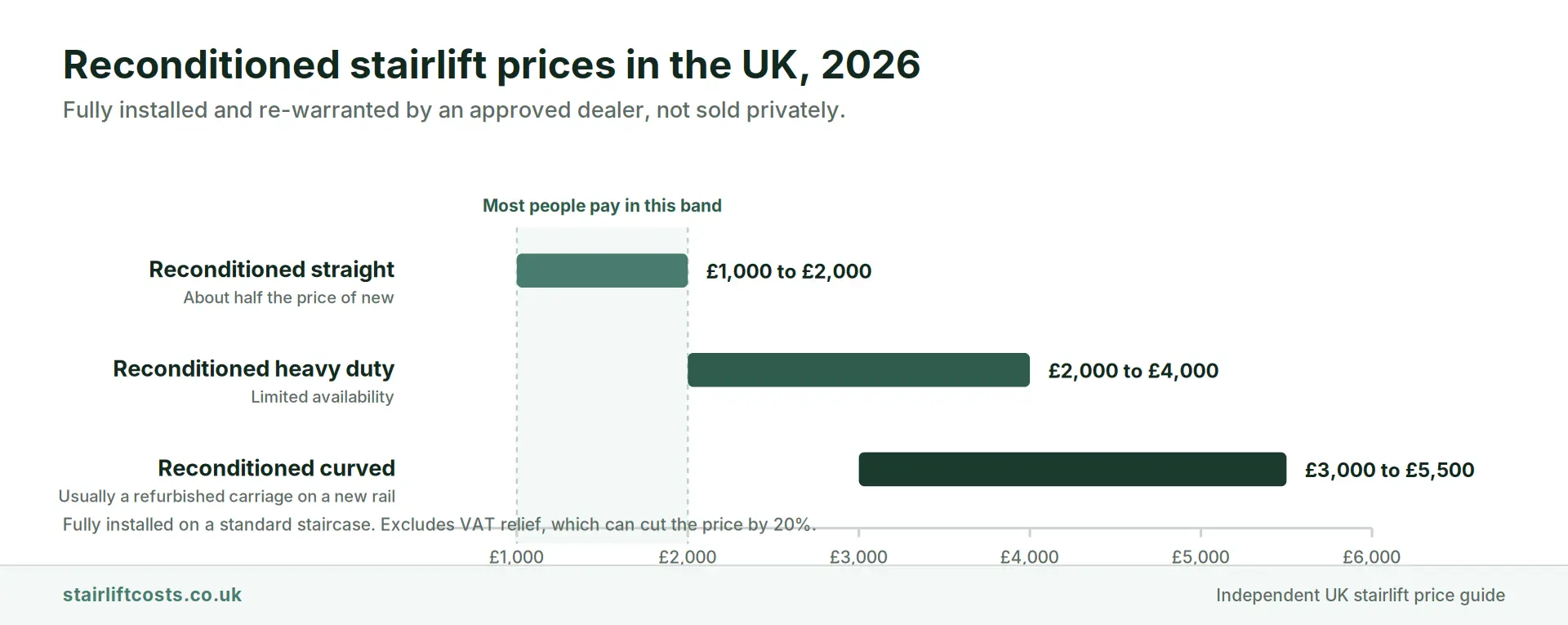
How much does a reconditioned stairlift cost? A reconditioned straight stairlift costs £1,000 to £2,000 fully installed in the UK in 2026, about half the £2,000 to £3,500 a new one costs. Reconditioned curved lifts run £3,000 to £5,500 and heavy-duty units £2,000 to £4,000. Every figure on this page comes from our Pricing Index, which we review quarterly against real installer quotes.
What is a reconditioned stairlift?
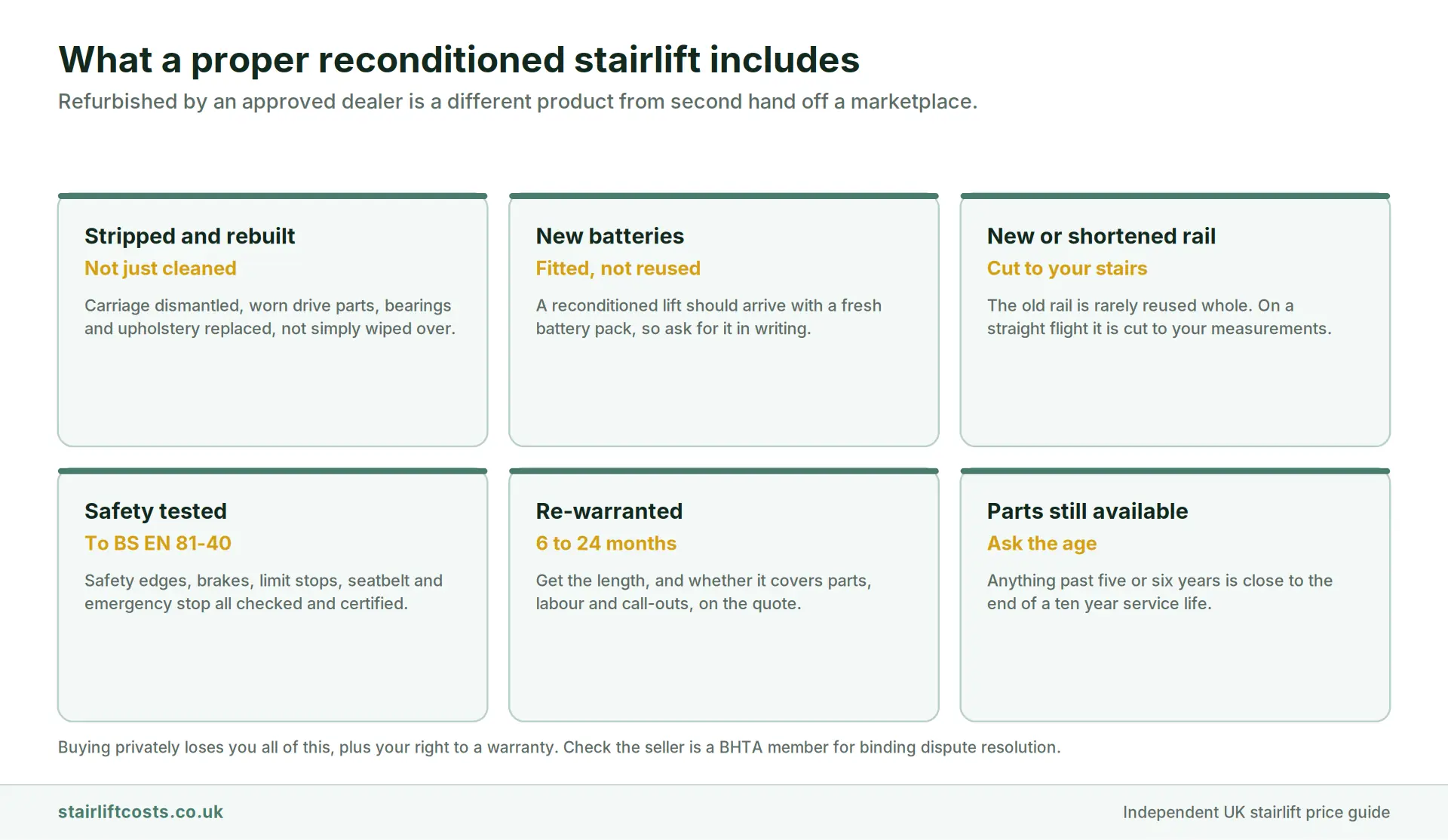
A reconditioned stairlift has been installed in someone’s home, removed, and taken back to a workshop where it is stripped, checked against a formal inspection list, rebuilt with worn parts replaced, fitted with new batteries and safety tested before being sold again with a fresh warranty. It is then installed on a rail cut or bent to fit your staircase, exactly as a new lift would be, and you should be handed a test certificate.
That is the version worth buying. The word is also used loosely, and sometimes deliberately, for a lift that has been wiped down and re-advertised, and for private sales where a machine is pulled out of one house and offered to whoever collects it. Telling those apart is the whole point, because the price difference is often small and the difference in what you get is enormous.
Is a reconditioned stairlift right for you?
Reconditioned works well if
- Your staircase is straight, where the saving is largest and the rail can be cut from stock
- The budget is the binding constraint and a new lift would mean going without
- The need is medium term, five years or so, rather than twenty
- You are buying from an established installer who services what they sell
- You want a lift quickly, since refurbished straight units are often in stock
Buy new instead if
- Your staircase curves. The bespoke rail is made new either way, so the saving is much smaller
- You need a specific weight rating. Refurbished units are sometimes re-rated lower than when new, so check the plate against heavy-duty requirements
- You qualify for a Disabled Facilities Grant that would cover a new lift anyway
- The stairs are unusually narrow and only one or two current models fit, which rules out most of the used pool
- You want the longest service life and a two year manufacturer warranty
Two words that mean nothing on their own. “Reconditioned” and “refurbished” are used interchangeably by the trade and neither is protected. There is no UK standard for reconditioning a stairlift: BS EN 81-40:2020 governs how the lift was built, not how it was rebuilt. The advert tells you nothing, and what the seller puts in writing tells you everything.
How much does a reconditioned stairlift cost in 2026?
A reconditioned straight stairlift costs £1,000 to £2,000 fully installed, against £2,000 to £3,500 new. Reconditioned curved lifts run £3,000 to £5,500 against £5,000 to £10,000 new, and heavy-duty units £2,000 to £4,000. All are supplied and installed prices, the only basis worth comparing.
| Type | Reconditioned, installed | New, installed | Typical saving |
|---|---|---|---|
| Straight | £1,000 to £2,000 | £2,000 to £3,500 | 40% to 60% |
| Heavy duty | £2,000 to £4,000 | £3,000 to £6,000 | 30% to 40% |
| Curved | £3,000 to £5,500 | £5,000 to £10,000 | 20% to 35% |
Last verified: August 2026
Treat any advertised saving of 60% or more on a curved lift with suspicion: it is almost always a reconditioned carriage priced against a top-of-range new quote. Watch the VAT basis too, because relief is worth about 17% of a VAT-inclusive price. Our page on reconditioned prices breaks the bands down further, and reconditioned against new sets the two side by side.
What a quoted price usually includes, and what it does not
| Usually included | Usually extra, or missing |
|---|---|
| Free home survey and measurement | Annual servicing once the warranty ends |
| New batteries fitted as part of the rebuild | Any warranty beyond the first 6 to 12 months |
| A rail cut, shortened or bent to your staircase | A hinged rail to clear a doorway at the bottom |
| Installation, commissioning and safety testing | Adding a socket if there is not one in reach |
| A written test certificate at handover | Powered swivel or footrest, if the donor lift lacked them |
| Handover and tuition | Removal of an old lift, and removal at end of life |
Why the saving is smaller on a curved staircase
A curved rail is measured, designed and manufactured for one specific staircase, and cannot be reused on yours unless the two are near enough identical, which almost never happens. So on a reconditioned curved job the rail is made new at full price, and only the carriage, seat and drive unit are second hand. You pay the whole cost of the most expensive component and save on the smaller part, while accepting a used drive train, a shorter warranty and less remaining life.
That is why the honest curved saving is 20% to 35% rather than half, and why a reconditioned curved quote above about £4,000 deserves a new-lift quote alongside it, because the gap can close to almost nothing at the top of the band.
Ask one question in writing. On any reconditioned curved quote, ask whether the rail is newly manufactured for your staircase or reused from another installation. A few sellers still imply that curved rails are refurbished and refitted. If the rail is reused, walk away, because a rail bent to different angles cannot be made to follow yours safely.
How to pay less, and what still applies
VAT relief applies to reconditioned lifts too
The VAT rules turn on what the goods are, who the customer is and how they are supplied, and say nothing about whether the goods are new. Buy from a VAT-registered supplier and both reliefs are available on a reconditioned unit.
- Zero rate, 0% VAT. Where the lift is supplied and installed for a chronically sick or disabled person in their own home. HMRC defines that as a physical or mental impairment with a long-term and substantial adverse effect on everyday activities. Later servicing, repairs and spare parts can be zero-rated as well.
- Reduced rate, 5% VAT. Available on age alone where the customer is 60 or over and the lift is supplied and installed in their own home. It does not apply to goods without installation, and it does not cover repairs or replacement of an existing installation.
A private seller cannot give you VAT relief. They are not VAT registered, so there is no VAT to zero-rate. Against a VAT-relieved trade purchase that wipes out about 17% of the apparent saving, before you count the missing warranty, installation and consumer rights. It is the most overlooked number in the used stairlift market.
Grants, rental and finance
A Disabled Facilities Grant can fund a stairlift after an occupational therapy assessment, and nothing in the rules excludes a reconditioned unit. In practice councils often specify equipment supplied with an extended warranty and servicing agreement, so ask your council’s home improvement team whether a refurbished lift is acceptable before choosing a supplier.
| Nation | Maximum | Means tested? |
|---|---|---|
| England | £30,000 | Yes, on the disabled person and partner. Not means tested for a disabled child. Adaptations costing £1,000 or less must be provided free |
| Wales | £36,000 | Yes, with small adaptations usually fitted free regardless of means |
| Scotland | No DFG. Scheme of Assistance instead | Councils fund at least 80% of approved costs, and up to 100% on qualifying benefits |
| Northern Ireland | £25,000 | Yes, administered by the Housing Executive. Confirm the current cap with NIHE before you rely on it |
Last verified: August 2026 against gov.uk
A grant cannot pay for work already done, so apply before you order, and councils have six months to decide. Where the wait is the problem, a rented lift covers a temporary need, and most installers offer instalments or finance, where the total repayable matters more than the monthly figure. Charities including Independence at Home, the ACT Foundation and SSAFA make small grants towards adaptations.
What a reconditioned stairlift costs to run
Running costs are the same as a new lift, with one qualification: an older machine is closer to the point where wear items need attention, so budget for a repair sooner rather than later.
| Running cost | Typical UK figure | How often |
|---|---|---|
| Electricity | About £12 a year | Continuous |
| Annual service | £100 to £200 | Yearly, once the warranty ends |
| Out of warranty repair | Call-out £75 to £200, plus parts | Which? found 37% of owners needed one repair over ten years, averaging £257 |
| Battery replacement | £50 to £120 fitted | Every 3 to 5 years from the date fitted, not the date the lift was built |
| Extended warranty or cover plan | £150 to £300 a year | Optional, and not offered by every reconditioned supplier |
| Removal at end of life | £150 to £300 | Once |
Last verified: August 2026
How to check the lift you are being offered
The advert will not tell you what you need to know. These checks separate a genuine refurbishment from a cleaned-up used lift, and every one can be asked over the phone before you book a survey.
- Ask for the manufacture date on the rating plate, not the date it was reconditioned. Those are different numbers and only one of them tells you how much life is left.
- Check the age against the five year rule. The trade’s own guidance is that reconditioned units should be no more than five years old, and Which? Trusted Traders reports stock generally at five to six years. A stairlift lasts seven to ten years, so a five-year-old lift has two to five years left, not a decade.
- Ask whether the model is still in production and still supported. No UK manufacturer publishes a parts-availability commitment, so this is a question about the specific model rather than a policy you can look up.
- Ask what was replaced during the rebuild. New batteries should be fitted as standard rather than tested and passed. Rollers, cabling, worn gears and bearings, upholstery and the belt are the usual items.
- Ask for the rail arrangement. On a straight lift the rail should be new or shortened and drilled for your treads. On a curved lift it should be newly manufactured for your staircase.
- Ask for the rated load as supplied, in kilograms. Some units are re-rated below the model’s original figure, and one popular straight lift is rated 159kg new but 115kg reconditioned.
- Ask for the service history of the donor lift, and for a written record of the workshop inspection.
- Ask for a test certificate at handover, confirming the lift was load and safety tested after installation.
The most useful single question. Ask who will service the lift in year three. A refurbisher who sells lifts but does not maintain them is a one-shot seller, and you will be hunting for an independent engineer willing to work on a discontinued model at exactly the wrong moment. An installer who answers “we will, and here is the annual price” is worth a few hundred pounds more.
Safety, standards and the test certificate
UK stairlifts are built to BS EN 81-40:2020, and a reconditioned lift was built to whichever version applied when it was made. There is no separate British standard for reconditioning, and whether a rebuilt lift needs re-marking is not settled anywhere public, so your practical protection is the supplier’s testing and the paperwork they hand over.
A properly refurbished lift should have every safety feature working and individually tested: obstruction sensors on the carriage, footrest and both ends of the rail, a retractable seatbelt, a lockable 90 degree swivel seat, constant-pressure controls, a key switch to isolate it, an overspeed governor and a fail-safe brake, plus manual lowering if power and battery fail. Ask the engineer to demonstrate each one at handover rather than describe it, and keep the test certificate with the manual.
Buying privately: what you give up
Second-hand stairlifts appear constantly on auction sites and local ads, often for a few hundred pounds, and the price looks unanswerable until you list what is missing. Buying from a trader, new or reconditioned, gives you rights under the Consumer Rights Act 2015: goods must be of satisfactory quality, fit for purpose and as described, with repair, replacement or a refund if they are not. Those rights apply to second-hand goods from a trader exactly as to new ones, judged against the price paid, the description and the age of the item. A private seller strips almost all of that away, because the goods only have to match their description.
| What you get | Reconditioned from a dealer | Private or marketplace sale |
|---|---|---|
| Installation by a trained engineer | Included | Your problem, on a powered machine bolted to your stairs |
| Rail cut or made for your staircase | Yes | No. The rail came off someone else’s stairs |
| New batteries | Fitted as standard | Usually original, often flat |
| Warranty | 6 to 24 months, 12 months is the norm | None |
| Consumer Rights Act protection | Full, including satisfactory quality | Description only |
| VAT relief if eligible | Yes, 0% or 5% | No, the seller is not VAT registered |
| Test certificate and tuition | Yes | No |
The other red flags are a discontinued model with no parts, no service history, a seller who will not say why the lift was removed, and any suggestion that you can fit it yourself. If the machine turns out not to suit your staircase, and most do not, you have bought a heavy piece of scrap that you now have to pay to dispose of.
Installation and permissions
Fitting is no different from a new lift. A reconditioned straight lift takes two to four hours and a curved one four to six, and because straight units are usually in stock, survey to installation is often days. The engineer cuts and levels the rail, bolts the brackets to the treads, mounts the carriage, connects to a socket and commissions the lift. The stairlift installation guide covers the day itself.
- Planning permission is not required for an internal stairlift, and building regulations approval is not required for the lift itself.
- Listed buildings need listed building consent for significant work, which catches people out because planning permission is not needed.
- Rented homes need the landlord’s written permission. Under the Equality Act 2010 a landlord should not unreasonably refuse a disability-related adaptation. Agree reinstatement terms and photograph the stairs first.
- Leasehold flats need the freeholder’s consent where the lease restricts alterations.
Warranty, lifespan and what happens later
Twelve months is the market norm on a reconditioned lift. Some suppliers offer as little as three to six months, a few offer two years as a selling point, and extended cover can usually be bought on top. New lifts come with 12 to 24 months. Check whether the guarantee is insurance-backed, because if it is not and the supplier stops trading it may be worthless.
On lifespan, be realistic. Seven to ten years is the figure quoted for stairlifts generally, refurbished ones included, and the clock started at manufacture rather than at rebuild. A five-year-old unit with a fresh warranty is a sensible purchase at £1,500 and a poor one at £2,400. Resale at the end is close to nil, and beyond a few years the realistic outcome is free removal rather than a cheque. Our guide to selling a stairlift covers the options honestly.
Reconditioned compared with the alternatives
| Option | Installed cost | Best for |
|---|---|---|
| Reconditioned straight | £1,000 to £2,000 | Tight budgets on a straight flight, where the saving is largest |
| New straight | £2,000 to £3,500 | Long-term need, longest warranty, full service life |
| Reconditioned curved | £3,000 to £5,500 | Curved stairs on a budget, with a used carriage on a new rail |
| Reconditioned heavy duty | £2,000 to £4,000 | Higher weight ratings on a budget, if the plate rating is confirmed in writing |
| Rented lift | Monthly fee plus an installation charge | Recovery from surgery, or a need under about 18 months |
| Private second-hand sale | A few hundred pounds, plus fitting | Almost nobody. No installation, warranty, rights or VAT relief |
| A lift for very tight stairs | See narrow stairs | Staircases under about 70cm, where the used pool rarely fits |
Last verified: August 2026
What to ask before you sign
Get three quotes and include at least one for a new lift, so you can see the real gap. Take these questions to each survey and write down the answers.
- What is the manufacture date on the rating plate of the actual lift I am buying?
- Is that model still in production, and are spare parts still available for it?
- What exactly was replaced during the refurbishment, item by item?
- Are new batteries fitted as part of the price, or tested and reused?
- Is the rail new, shortened from stock, or reused from another installation?
- What is the rated load as supplied, and does it differ from the model’s original rating?
- Will I get a written test certificate after installation?
- How long is the warranty, what does it cover, and is it insurance-backed?
- Who services the lift from year two, and what does an annual visit cost?
- Is this price at 0%, 5% or 20% VAT, and will you supply the eligibility declaration form?
- What is your response time for a breakdown call, including weekends?
- Are you a member of the British Healthcare Trades Association, which offers binding dispute resolution?
Your rights, and the red flags
Stairlifts are usually sold in your home, which makes them an off-premises contract with a 14 day right to cancel under the Consumer Contracts Regulations 2013. Goods made to measure for you are excluded, and that exclusion bites hardest on a curved rail, so settle cancellation terms in writing before the rail goes into manufacture. It is a much weaker argument for a reconditioned straight lift on a stock rail cut to length. If the trader did not give you cancellation information in writing, the cancellation period extends by twelve months.
Walk away from: a seller who will not give the age of the lift, one who describes a curved rail as reconditioned, a “cancelled order going cheap” pitch, a price that only holds today, or anyone quoting a unit price and adding fitting later. The BHTA code of practice bans pressurised selling and false claims of limited availability, requires suppliers to bring VAT relief to your attention, sets a three working day response standard for service calls and a three month minimum guarantee on repair work, and provides free mediation and binding arbitration at no cost to you. It is approved by the Chartered Trading Standards Institute. To get quotes from installers working to it, compare prices here.
Frequently asked questions
How much does a reconditioned stairlift cost?
A reconditioned straight stairlift costs £1,000 to £2,000 fully installed in the UK in 2026, roughly half the £2,000 to £3,500 a new one costs. Reconditioned curved lifts run £3,000 to £5,500 and heavy-duty units £2,000 to £4,000. Those are supplied and installed figures, the only fair basis for comparison.
What does reconditioned actually mean?
A reconditioned stairlift has been removed from a previous home, returned to a workshop, stripped, inspected against a formal checklist, rebuilt with worn parts replaced, fitted with new batteries and safety tested before resale with a fresh warranty. The word is not protected, so ask the seller to confirm each step in writing.
Are reconditioned stairlifts any good?
A properly refurbished lift from an established installer is a sound purchase, particularly on a straight staircase, where the saving is 40% to 60%. The risks are age, parts availability for discontinued models and a shorter warranty. The quality of the refurbisher matters more than the age of the machine.
How much do you save buying reconditioned?
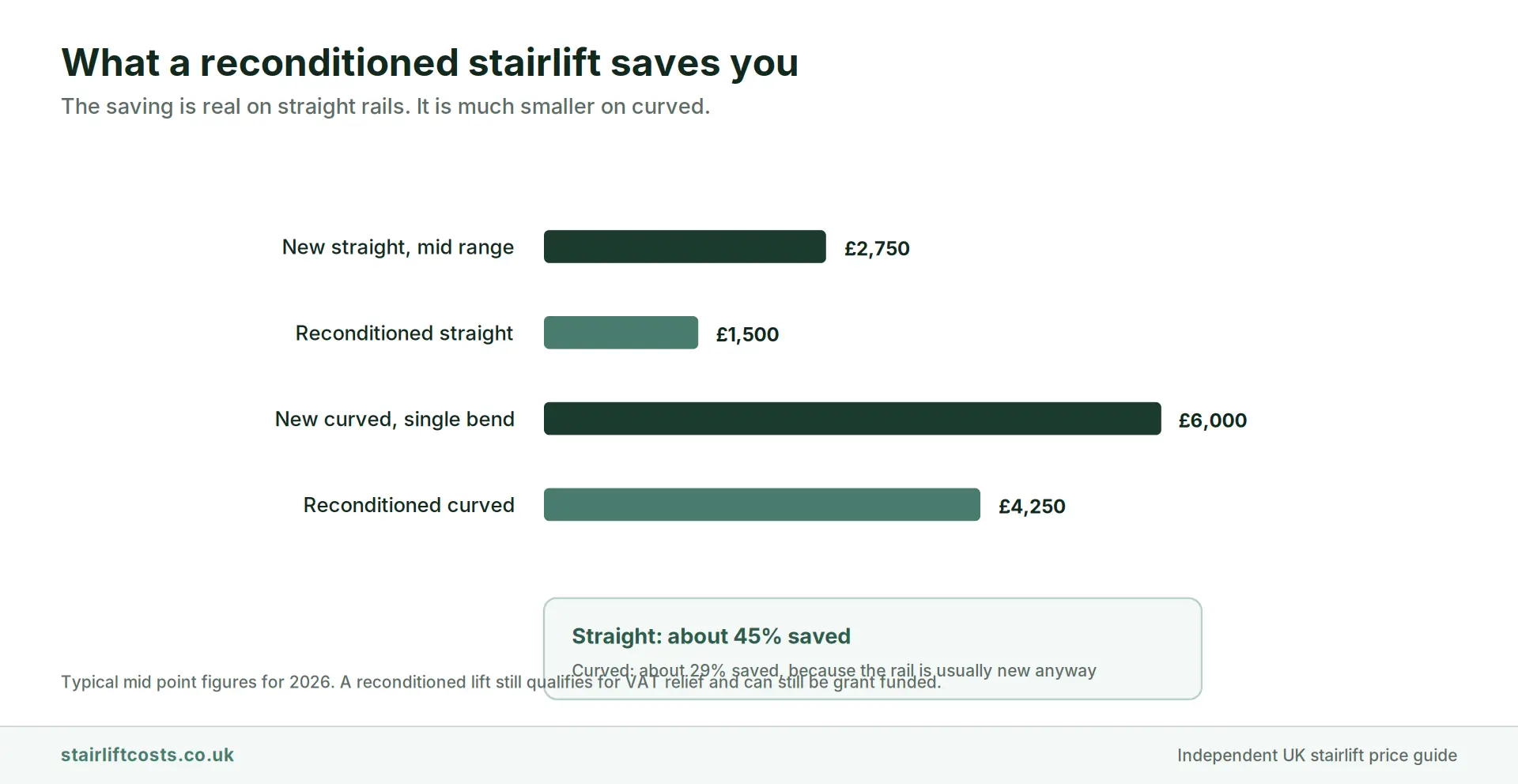
Expect 40% to 60% off on a straight staircase and 20% to 35% on a curved one. A mid-band straight lift works out at about £1,500 reconditioned against £2,750 new, and a curved lift at about £4,250 against £6,000. Advertised savings of 60% or more on curved lifts compare a used carriage against a premium new quote.
Why is a reconditioned curved stairlift not much cheaper?
Because the rail is normally made new. Curved rails are bent for one specific staircase and cannot be transferred, so only the carriage, seat and drive unit are second hand. You pay full price for the most expensive component and save on the smaller one, which is why the honest saving is 20% to 35%.
How old is a reconditioned stairlift?
Usually five years or less. The trade’s own guidance is a five year ceiling, and Which? Trusted Traders reports stock generally at five to six years old. Since a stairlift lasts seven to ten years, a five-year-old unit has two to five years of design life left. Ask for the manufacture date on the rating plate, not the reconditioning date.
Can you get VAT relief on a reconditioned stairlift?
Yes. The rules turn on what the goods are, who the customer is and whether the lift is supplied and installed together, not on whether the goods are new. A chronically sick or disabled person buying for their own home pays 0%, and a customer aged 60 or over pays 5%. A private seller cannot offer relief, because they are not VAT registered.
Can a Disabled Facilities Grant pay for a reconditioned stairlift?
Nothing in the grant rules excludes a reconditioned unit, and stairlifts are an eligible adaptation up to £30,000 in England, £36,000 in Wales and £25,000 in Northern Ireland. In practice some councils specify equipment supplied with an extended warranty and servicing agreement, so ask your council’s home improvement team before choosing a supplier.
What warranty comes with a reconditioned stairlift?
Twelve months is the market norm. Some suppliers offer only three to six months and a few offer two years as a differentiator, with extended cover available to buy on top. New lifts carry 12 to 24 months. Ask whether the guarantee is insurance-backed, because an uninsured guarantee is worth nothing if the supplier stops trading.
Is it safe to buy a second-hand stairlift privately?
It is rarely worth it. A private sale comes with no installation, no warranty, no VAT relief and almost no legal protection, since goods from a private seller only have to match their description. The rail was cut for someone else’s staircase. Buying from a trader keeps your Consumer Rights Act protection in full.
Will a reconditioned stairlift fit my stairs?
On a straight staircase, yes, because the rail is new or shortened from stock and cut to your treads. On a curved staircase the rail is newly manufactured to a drawing of your stairs. The constraint is the carriage: refurbished stock is whatever has come back in, so narrow flights or high weight ratings limit the choice.