
Stairlifts for Narrow Stairs
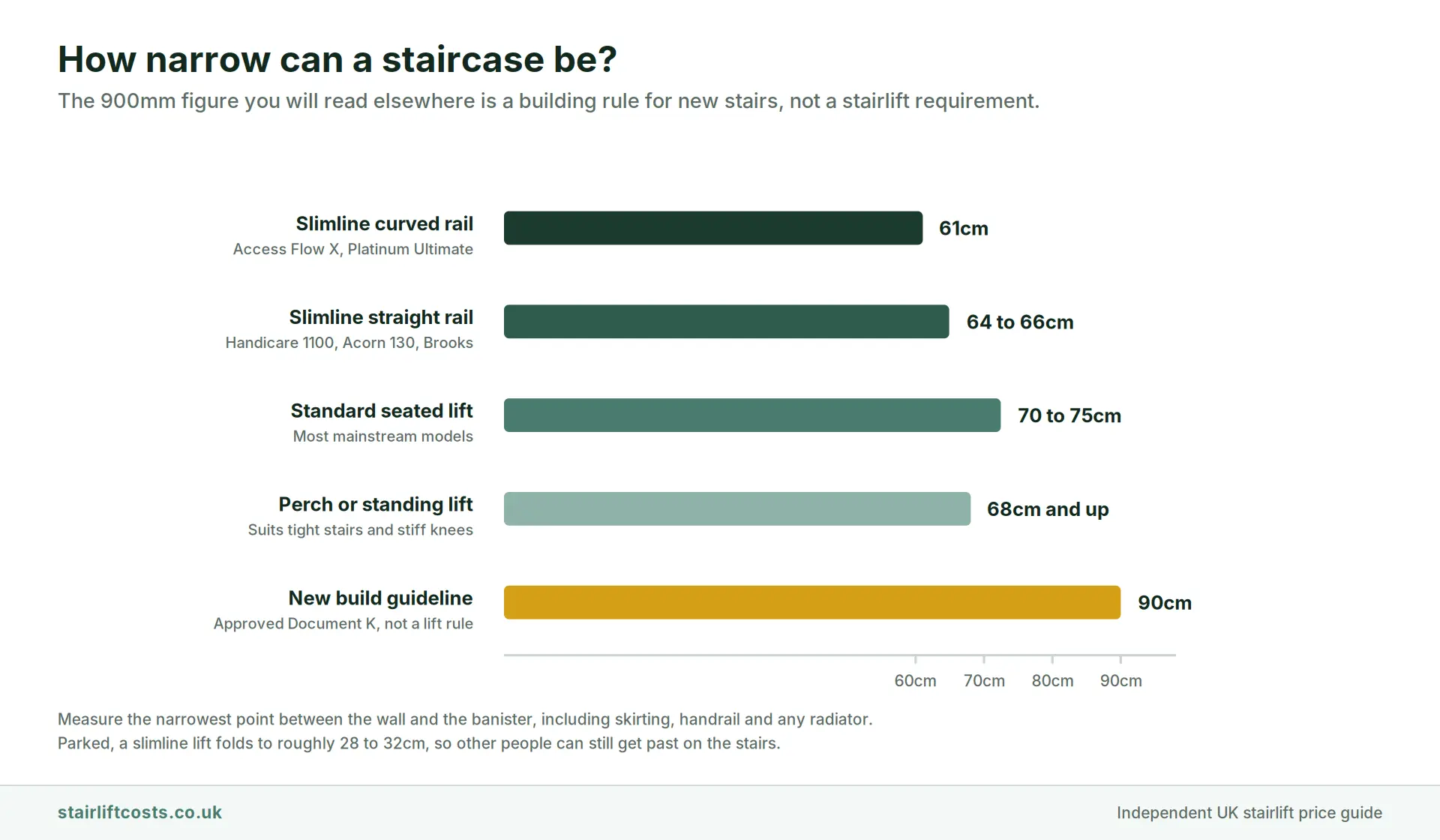
Most standard stairlifts need 70 to 75cm of clear stair width. Slimline models fit staircases from about 61cm, and a slimline straight lift costs £2,000 to £3,500 fully installed, the same as a standard one. The 900mm figure repeated all over the internet is a new-build design guideline, not a stairlift rule, and it does not apply to the stairs you already have.
How narrow can stairs be for a stairlift? A slimline stairlift fits a staircase from about 61cm of clear width, against 70 to 75cm for a standard seated model, and it costs £2,000 to £3,500 installed on a straight flight, the same price as a standard lift. Slimline curved rails run £5,000 to £7,000. Every figure on this page comes from our Pricing Index, which we review quarterly against real installer quotes.
What counts as a narrow staircase?
There is no legal minimum, and this is where most advice goes wrong. Approved Document K, the part of the building regulations covering stairs, sets no general minimum width for private stairs inside a home. The 900mm figure quoted on dozens of stairlift sites comes from paragraph 1.16, which applies only to flights within the entrance storey of a new dwelling on a severely sloping plot. It is a guideline for people building houses, and it says nothing about whether a lift can go on the staircase you already own.
What decides it is the clearance each manufacturer states for each model, and those numbers are far smaller. The narrowest verified seated lifts in the UK fit from 610mm; standard seated models want 700 to 750mm. The rail takes 136 to 160mm off the usable tread, so the figure that counts is not the width of your stairs but what is left once the rail, the seat and the person are on them.
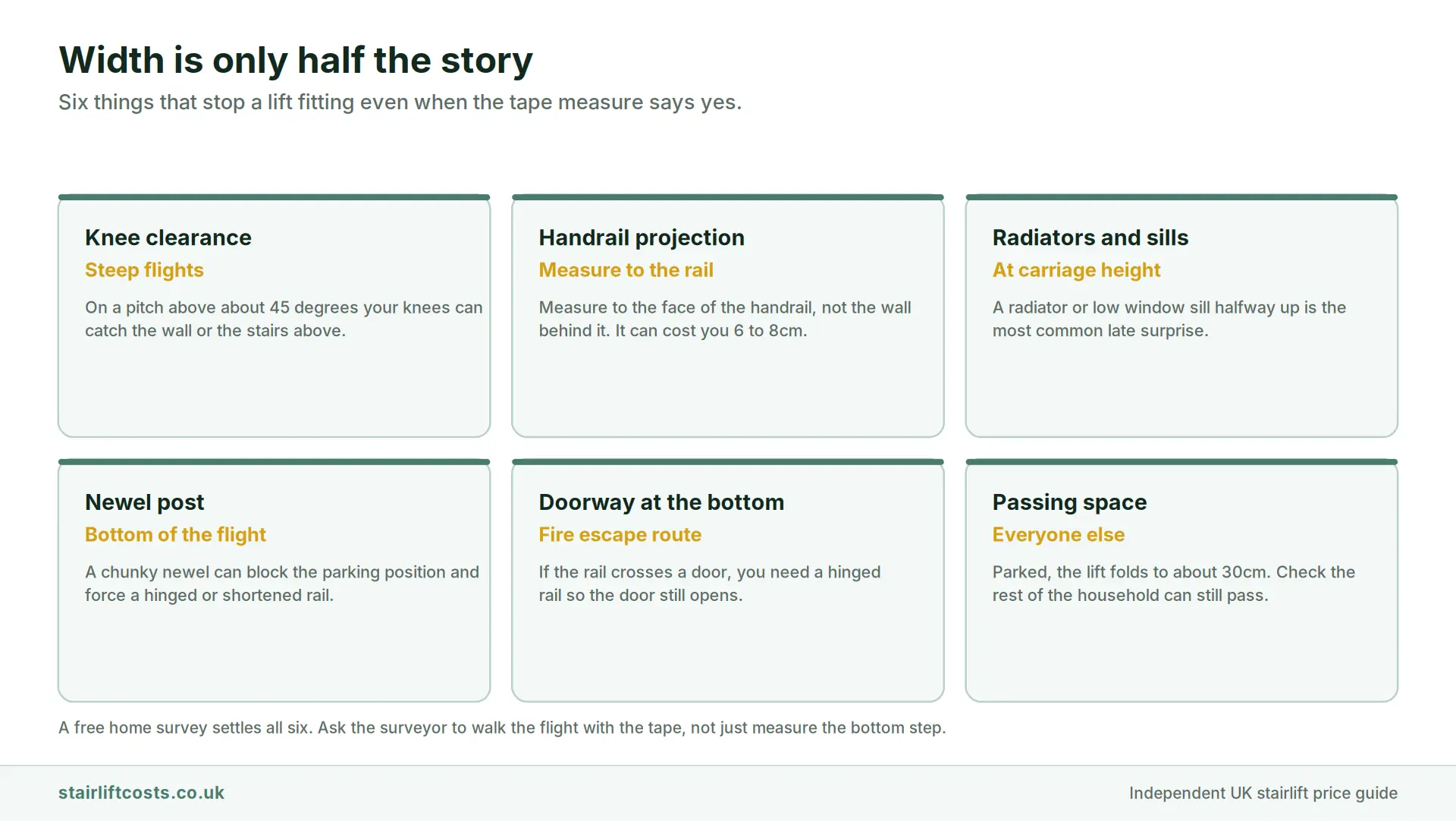
Width is a filter, not a verdict. Clearing the stated width gets a model onto the shortlist and no further. Knee clearance on a steep flight, handrail projection, a radiator halfway up and the user’s own shoulder and knee dimensions all rule out lifts that pass the tape measure easily. A surveyor measures the user as carefully as the staircase.
Is a slimline stairlift right for your stairs?
A slimline stairlift usually works if
- The narrowest point measures about 61cm or more, skirting board to skirting board
- The pitch is inside 25 to 50 degrees, which covers almost every domestic staircase
- The user can sit and bend the knees enough to keep their feet on the footplate
- There is 45 to 60cm of clear floor at the bottom, or room for a hinged rail
- Others in the house can manage a gap of about 40cm to get past the parked lift
Look at something else if
- The flight is under about 60cm clear. Almost nothing seated fits, and a standing or perch lift is the next thing to price
- Knees hit the opposite wall on a steep flight. Under 35mm of knee clearance no seated lift is safe at any width
- Headroom is tight on the top bend of a curve, where the rail climbs and can put the user’s head into a sloping ceiling
- The user needs a wide seat or a high weight rating. Heavy-duty models are bigger and need more room, not less
- The user cannot leave a wheelchair, in which case a through-floor lift carries chair and person together
How much does a stairlift for narrow stairs cost in 2026?
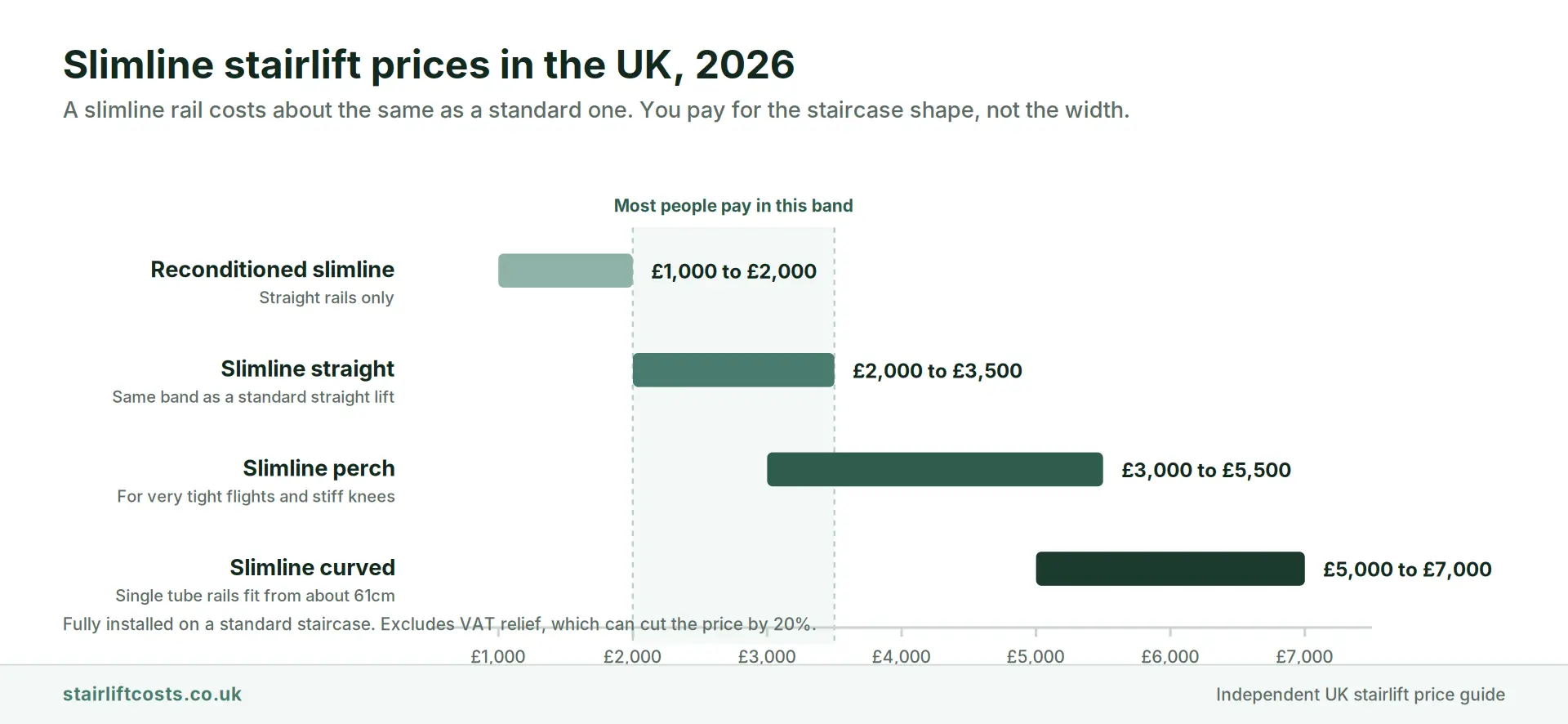
A slimline straight stairlift costs £2,000 to £3,500 fully installed, the same band as a standard straight stairlift. That is the most useful thing to know before you start ringing round: narrow stairs do not by themselves put the job into a higher price bracket. Slim rail designs are mainstream products now, and several are simply the manufacturer’s ordinary straight lift.
| Option | Installed price | What you get |
|---|---|---|
| Reconditioned slimline | £1,000 to £2,000 | Refurbished carriage on a rail cut for your stairs, safety tested, 6 to 12 months warranty |
| Slimline straight, new | £2,000 to £3,500 | A narrow-body carriage on a stock rail, folding to 28 to 34cm when parked |
| Slimline perch or standing | £3,000 to £5,500 | A padded perch instead of a seat, for users who cannot bend the knees or whose stairs are too tight to sit on |
| Slimline curved | £5,000 to £7,000 | A bespoke rail bent to your staircase, single tube or slim twin rail |
Last verified: August 2026
Inside those bands the number moves for the usual reasons: rail length, a hinged section to clear a door, a powered swivel, extra call stations, and whether you buy from the manufacturer or a dealer. On a curved job the bespoke rail dominates, so a slim curved rail costs much the same as a conventional one. On straight rails the slim models sit in the upper half of the band, which is worth a few hundred pounds rather than a different price class.
What a quoted price usually includes, and what it does not
| Usually included | Usually extra |
|---|---|
| Free home survey | Annual servicing once the warranty ends |
| Delivery, rail assembly and fitting | Moving a radiator or newel cap to clear the rail |
| Connection to a nearby 13 amp socket | Adding a socket if there is not one within reach |
| Two remote call stations | A hinged rail to clear a doorway at the bottom |
| 12 to 24 months parts, labour and call-outs | Powered swivel and powered footrest |
| Handover and tuition | Removing an old lift, and making good at end of life |
How to pay less for a narrow stair stairlift
VAT relief is the biggest single saving
There are two reliefs and most buyers qualify for one. They are worth more than any discount an installer will offer, so settle VAT before you talk about price.
- Zero rate, 0% VAT. Where the lift is supplied and installed for a chronically sick or disabled person in their own home. HMRC defines that as a physical or mental impairment with a long-term and substantial adverse effect on everyday activities. Being frail or elderly does not qualify on its own.
- Reduced rate, 5% VAT. Available on age alone where the customer is 60 or over and the lift is supplied and installed in their own home. It does not apply to goods without installation, and it does not cover later repairs or replacement of an existing installation.
You do not claim it back. There is nothing to reclaim from HMRC, no doctor’s letter and no proof of benefits. You sign a short eligibility declaration, separate from the order form, and the supplier does not charge the VAT. If you qualify on disability grounds, servicing, repairs and spare parts can be zero-rated too, which almost nobody mentions at the survey.
Grants and council help
A Disabled Facilities Grant can cover all or part of a stairlift after an occupational therapy assessment. Ask for the OT visit to coincide with the supplier’s survey, because the two measuring together on a tight staircase saves argument later.
| Nation | Maximum | Means tested? |
|---|---|---|
| England | £30,000 | Yes, on the disabled person and partner. Not means tested for a disabled child. Adaptations costing £1,000 or less must be provided free |
| Wales | £36,000 | Yes, with small adaptations usually fitted free regardless of means |
| Scotland | No DFG. Scheme of Assistance instead | Councils fund at least 80% of approved costs, and up to 100% on qualifying benefits |
| Northern Ireland | £35,000 | Yes, administered by the Housing Executive. Confirm the current cap with NIHE before you rely on it |
Last verified: August 2026 against the grant legislation. GOV.UK still shows the superseded £25,000 figure for Northern Ireland.
A grant cannot pay for work already done, so apply before you order, and councils have six months to decide. Tenants should ask the landlord first, because councils and housing associations often fund and fit directly. The full stairlift grants guide covers the application.
Reconditioned, rental and finance
- Reconditioned. A refurbished slimline straight lift runs £1,000 to £2,000 installed. Slim models turn up second hand less often, so expect a short list and wait for the right carriage rather than accept a wider one.
- Rental. Sensible for a temporary need such as recovery from surgery. Beyond about 18 months the cumulative cost overtakes buying outright.
- Finance. Most installers offer instalments. Compare the total repayable rather than the monthly figure, and check whether the agreement is regulated.
- Charities. Independence at Home, the ACT Foundation, SSAFA, the Royal British Legion and trusts listed on Turn2us make small grants towards adaptations.
What a slimline stairlift costs to run
Running costs do not change because the lift is narrow. The carriage is lighter, so the electricity is marginally lower, but the difference is pennies.
| Running cost | Typical UK figure | How often |
|---|---|---|
| Electricity | About £12 a year | Continuous |
| Annual service | £100 to £200 | Yearly, once the warranty ends |
| Out of warranty repair | Call-out £75 to £200, plus parts | Which? found 37% of owners needed one repair over ten years, averaging £257 |
| Battery replacement | £50 to £120 fitted | Every 3 to 5 years |
| Extended warranty or cover plan | £150 to £300 a year | Optional |
| Removal at end of life | £150 to £300 | Once |
Last verified: August 2026
How to measure a narrow staircase
A surveyor does this free and their measurement is the one that counts. Doing it yourself first tells you whether you are in ordinary territory or a special case.
- Measure skirting board to skirting board, not wall to wall. A 20mm skirting each side removes 40mm, enough to fail a 610mm lift on a staircase measuring 650mm between the plaster.
- Measure at the narrowest point, not the average and not the bottom step. The tight spot is usually a newel post, a radiator, a window reveal or the handrail bracket.
- Subtract the rail. It intrudes 136 to 160mm into the tread on common models. Take that off your narrowest figure to see what is genuinely left for a foot.
- Measure the run properly. Lay the tape on each tread rather than pulling it taut across the nosings, which under-reads badly, then carry on to the floor for the rail overrun.
- Measure the parking space from the riser of the bottom step to the nearest door, wall or radiator. You want 45 to 60cm; less than that means a hinged rail, which adds cost.
- Check headroom top to bottom, and take the user’s seated height if the ceiling slopes. On curved rails the tightest point is the top bend.
The dining chair test. Put a dining chair at the bottom of the stairs, roughly where the parked lift would sit, and check three things: can you get past it, can the user get onto it, and can they swing their legs clear. Then measure them seated, spine to knee and elbow to elbow. Those two body measurements decide more narrow-stair cases than the staircase does.
Minimum widths by model
These are manufacturer figures published between 2024 and 2026. Treat them as a shortlist tool rather than a promise, because several add wording such as “may vary” and the swivel at the top can need more room than the ride.
| Type and example models | Minimum clear width | Notes |
|---|---|---|
| Slimline curved, single tube or slim twin rail | From 61cm | The narrowest verified seated lifts sold in the UK |
| Slimline straight | 64 to 66cm | One popular 66cm lift needs 67cm to swivel at the top |
| Mid-range straight and curved | 66 to 68cm | Often quoted as “may vary”, so confirm against your narrowest point |
| Standard seated straight | 70 to 75cm | The default assumption in most quotes |
| Standard curved | 75 to 80cm | A wider rail package plus more swing on the bends |
| Perch or standing | From about 68cm | No manufacturer publishes a hard minimum. Headroom binds before width does |
Folded width and getting past the lift
A lift that fits is not the same as a lift that leaves the stairs usable by everyone else. Folded, the carriage still projects from the wall, and on a 66cm staircase a 36cm folded lift leaves about 30cm, below comfortable adult walking width.
| Model | Folded depth from wall | Gap left on a 76cm staircase |
|---|---|---|
| Narrowest slim straight models | 28 to 31cm | About 45 to 48cm |
| Common slim straight models | 32 to 34cm | About 42 to 44cm |
| Slim curved models | 33 to 36cm | About 40 to 43cm |
| Standard curved models | 40 to 44cm | About 32 to 36cm |
Brochure and retailer figures for the same model often differ by 4 to 8cm, because a brochure may quote the seat alone while a retailer includes the footrest and armrests. Ask which is which. Our page on minimum stair width has the model-by-model numbers.
What to do when no seated lift will fit
A genuinely unfittable staircase is rare. Below about 60cm clear, or where knees meet the opposite wall on a steep flight, the seated options run out and the choice becomes a different kind of lift, or a different way of living in the house.
| Option | Installed cost | Best for |
|---|---|---|
| Slimline seated stairlift | £2,000 to £3,500 straight | From about 61cm clear, where the user can sit and bend the knees |
| Perch or standing lift | £3,000 to £5,500 | Limited hip or knee flexion, or a flight too tight to sit on. Needs balance, and is unsuitable with dizziness |
| Two straight lifts with a landing transfer | Two straight prices, often below one curved | Split-level homes where the user can walk a few steps at the half landing |
| Slimline curved lift | £5,000 to £7,000 | Tight staircases with a bend or half landing |
| Through-floor lift | £12,000 upwards | Wheelchair users and progressive conditions. Needs a landing footprint upstairs |
| Downstairs living | Varies, often grant funded | Where a bedroom and wet room can be created below |
Last verified: August 2026
Installation, step by step
Fitting a slimline straight lift takes two to four hours and a curved one four to six. Straight rails are stock lengths cut to size, so survey to installation is usually one to five working days, while curved rails are bent to a drawing and take two to six weeks. The engineer levels and joins the rail, bolts brackets to the treads, mounts the carriage, connects a plug, then tests the safety edges, seatbelt, limit stops and emergency stop. Nothing structural is touched and carpets are not lifted. The stairlift installation guide covers the day itself.
Permissions
- Planning permission is not required for an internal stairlift, nor building regulations approval for the lift itself. The product must meet BS EN 81-40.
- Listed buildings do need listed building consent for significant work. Listed cottages are exactly the housing stock with the narrowest stairs, so this catches people out.
- Rented homes need the landlord’s written permission. Under the Equality Act 2010 a landlord should not unreasonably refuse a disability-related adaptation. Agree reinstatement terms and photograph the stairs first.
- Leasehold flats need the freeholder’s consent where the lease restricts alterations, and communal stairs are usually impossible under means of escape rules.
Safety features and standards
UK stairlifts are built to BS EN 81-40:2020, the standard for stairlifts and inclined lifting platforms. A slim carriage is not a stripped-down one, and every mainstream slimline model includes the following as standard:
- Obstruction sensors on the carriage, footrest and both ends of the rail, which matter more on a narrow flight where a shoe left on a tread sits close to the track
- A retractable seatbelt, with a full harness available where needed
- A lockable 90 degree swivel seat, and a powered swivel option worth taking on a narrow landing
- Constant-pressure controls, so the lift stops the moment you let go
- A key switch to isolate the lift, useful with children or dementia in the house
- An overspeed governor and a fail-safe brake, plus manual lowering if power and battery fail
Warranty, lifespan and resale
New slimline lifts come with 12 to 24 months of parts, labour and call-outs, and reconditioned units 6 to 12 months. A well serviced lift should give around ten years. Slim straight models hold their value slightly better on buy-back because demand for a narrow carriage outstrips supply, but beyond a few years the realistic outcome is free removal rather than a cheque. Curved lifts of any width have almost no resale value. Our guide to selling a stairlift sets out the options.
What to ask before you sign
Get three quotes and say you are comparing. Two installers can measure the same flight and reach opposite conclusions, depending on which models they sell.
- What is the manufacturer’s stated minimum width for this exact model, in writing?
- Where did you measure, and was it skirting board to skirting board at the narrowest point?
- How far does the rail intrude into the tread, and what usable tread is left?
- What is the knee clearance for this user on this pitch, and what is your minimum?
- How wide is the carriage folded, and what gap does that leave for everyone else?
- Does the swivel at the top need more width or landing space than the ride does?
- Is a hinged or folding rail needed to clear the door at the bottom, and is it in this price?
- Is this price at 0%, 5% or 20% VAT, and will you supply the eligibility declaration form?
- How long is the warranty, does it cover parts, labour and call-outs, and are batteries included?
- Are you the manufacturer or a dealer, who services the lift, and what happens if you cease trading?
- Will you bring a demonstration unit so the user can try it before ordering?
- Are you a member of the British Healthcare Trades Association, which offers binding dispute resolution?
Your rights, and the red flags
Stairlifts are usually sold in your home, which makes them an off-premises contract with a 14 day right to cancel under the Consumer Contracts Regulations 2013. Goods made to measure are excluded, and suppliers routinely apply that to stairlifts. The claim is much weaker for a slimline straight lift on a stock rail than for a bespoke curved rail, so push back, and settle cancellation terms in writing before a curved rail goes into manufacture. If the trader gave you no cancellation information in writing, the period extends by twelve months.
Walk away from: an installer who quotes 900mm as a legal requirement, one who measures wall to wall rather than from the skirting, a price that only holds if you sign today, or a refusal to put the model’s minimum width in writing. The BHTA code of practice bans price-dropping and pressurised selling, requires a suitability assessment in the home before the sale, and is approved by the Chartered Trading Standards Institute. For quotes from installers who work to it, compare local prices here.
Frequently asked questions
What is the minimum stair width for a stairlift?
Slimline stairlifts fit staircases from about 61cm of clear width, measured skirting board to skirting board at the narrowest point. Standard seated models need 70 to 75cm and standard curved models 75 to 80cm. There is no legal minimum in the UK, so the figure that matters is the clearance the manufacturer publishes for the model you are quoted.
Is 900mm the legal minimum stair width for a stairlift?
No. Approved Document K sets no general minimum width for private stairs inside a home. The 900mm figure comes from paragraph 1.16, which applies only to entrance-storey flights in new dwellings built on severely sloping plots. It is a design guideline for builders and has no bearing on whether a stairlift can be fitted to an existing staircase.
How much does a stairlift for narrow stairs cost?
A slimline straight stairlift costs £2,000 to £3,500 fully installed, the same band as a standard straight lift. Reconditioned slimline models run £1,000 to £2,000, perch and standing lifts £3,000 to £5,500, and slimline curved rails £5,000 to £7,000. Narrow stairs alone do not push a straight installation into a higher bracket.
Do slimline stairlifts cost more than standard ones?
Only slightly, and often not at all. Slim straight models sit in the same £2,000 to £3,500 band as standard ones, though they tend towards the upper half of it, so the practical difference is a few hundred pounds. On curved staircases any slimline premium disappears, because the bespoke rail dominates the cost regardless of how slim the carriage is.
How much space does a stairlift take up when it is folded?
Between 28 and 44cm measured from the wall with the seat, arms and footplate folded. The narrowest slim straight models fold to about 28 to 31cm and standard curved models to 40 to 44cm. Brochure figures sometimes quote the seat alone, so ask whether the number includes the footrest and armrests.
Can two people still use the stairs once a stairlift is fitted?
Usually yes, but check the arithmetic first. Subtract the folded depth of the lift from the clear width of the stairs. A 76cm staircase with a 32cm folded lift leaves about 44cm, which most people manage. A 66cm staircase with a 36cm lift leaves about 30cm, below comfortable adult walking width.
How do I measure my stairs for a stairlift?
Measure from skirting board to skirting board, not wall to wall, at the narrowest point of the flight, which is usually at a newel post, radiator or window reveal. Subtract 136 to 160mm for the rail to see what tread is left. Measure the run by laying the tape on each tread rather than across the nosings.
What if my stairs are too narrow for any stairlift?
Below about 60cm of clear width the seated options run out, but a genuinely unfittable staircase is rare. A perch or standing lift needs less depth and costs £3,000 to £5,500. Other routes are two straight lifts with a transfer at a half landing, a through-floor lift from £12,000, or a ground-floor bedroom and wet room.
Can a curved stairlift fit narrow stairs?
Yes. Several single-tube and slim twin-rail curved systems fit from 61cm, narrower than many standard straight lifts need. The catch is headroom rather than width, because a curved rail climbs as it turns and the tightest point is usually the top bend. A slimline curved lift costs £5,000 to £7,000 installed.
Why do two installers give different answers about whether a lift will fit?
Because each is measuring against the models they sell. An installer whose narrowest lift needs 70cm will say a 65cm staircase is impossible, and they are right about their own range. Get three surveys, ask each for the manufacturer’s stated minimum width in writing, and treat anyone quoting a legal minimum with caution.