

Outdoor Stairlifts
An outdoor stairlift carries you up the steps outside the house, on a rail bolted into the steps themselves rather than the wall. It is an ordinary stairlift built to live outside: sealed electrics, a weather-treated rail and a waterproof cover for the seat. Expect £3,000 to £5,000 installed on straight steps, and £5,500 to £9,000 for a curved outdoor rail.
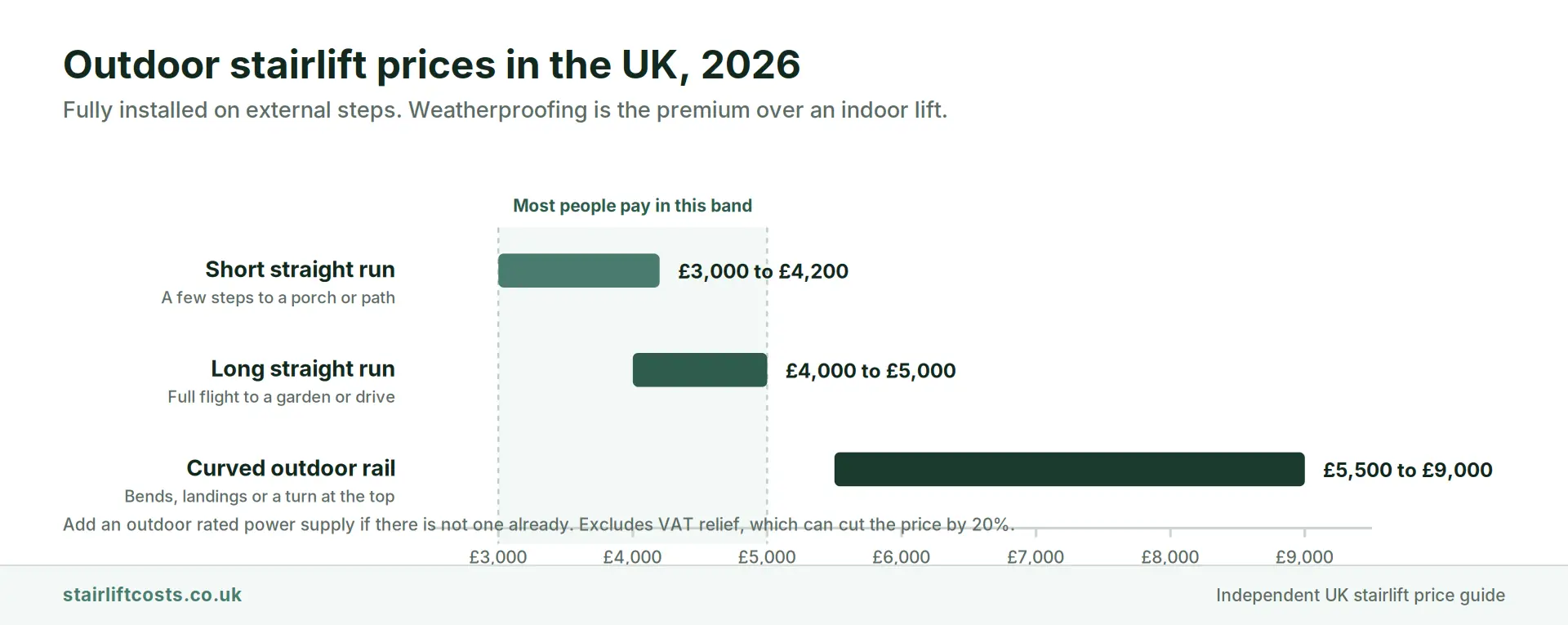
How much does an outdoor stairlift cost? An outdoor stairlift costs £3,000 to £5,000 fully installed in the UK in 2026 on straight steps, and £5,500 to £9,000 where the rail has to follow a curve. A short run of a few steps sits at £3,000 to £4,200, a long run down a garden or bank at £4,000 to £5,000. Every figure here comes from our Pricing Index, reviewed quarterly against real installer quotes.
What is an outdoor stairlift?
An outdoor stairlift is a powered seat on a rail fixed to external steps: a front path, a back door approach, a terrace or the steps down to a driveway. Mechanically it is the same machine as an indoor lift. What differs is the protection: sealed motor, control board and battery, upholstery chosen to survive sunlight, weatherproof housings on the call buttons at each end of the flight, and a full-length waterproof cover for the seat between journeys.
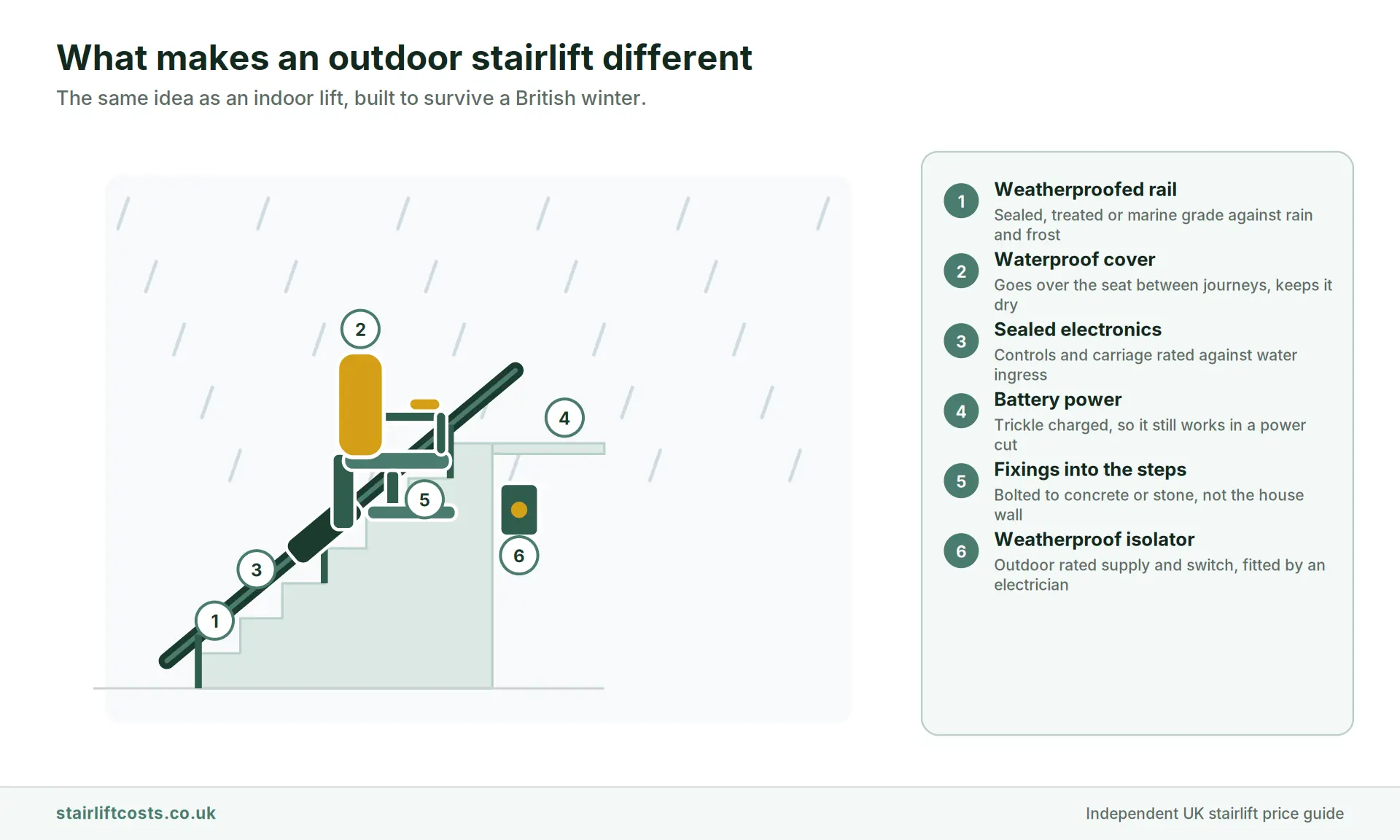
Two things follow. The steps have to be solid and reasonably even, because they are the structure the lift hangs on, so crumbling concrete, loose slabs and timber decking usually need making good first, at your cost. And the lift needs power outside, which normally means an outdoor rated, RCD protected socket fitted by an electrician, with a weatherproof isolator. The lift itself runs on trickle-charged batteries, so it still works in a power cut.
Is an outdoor stairlift right for your steps?
An outdoor stairlift usually works if
- External steps are the barrier between the door and the street, or the house and the garden
- There are more than about three steps, so a ramp at a usable gradient will not fit
- The steps are concrete, stone or brick, solid enough to take fixings and even enough for a rail
- An electrician can reach the position with an outdoor supply, or there is an indoor socket close by
- The user can walk to the lift, transfer onto the seat and sit for the ride in bad weather
Look at something else if
- There are only one or two steps. A short ramp or a half step is cheaper and needs no servicing
- The user cannot leave a wheelchair. A step lift or platform lift carries the chair, and so does a through-floor lift indoors
- The steps are decking, loose slabs or badly worn, and rebuilding them costs more than the lift
- Hips or knees will not bend enough to sit. Ask whether a perch seat is offered outdoors, because not all suppliers do it
- The steps are communal, or the building is listed. Consent comes first, and it is not always given
The cover is not optional. What separates an outdoor lift that lasts from one that does not is whether the waterproof cover actually goes on after every journey. It is fabric, not a hard canopy, and it is the one part of the weather protection that depends on a person rather than on engineering. If the user will not manage it in the wet or the cold, somebody else has to, and that belongs in the decision.
How much does an outdoor stairlift cost in 2026?
Most households pay £3,000 to £5,000 for a new outdoor stairlift on straight steps, supplied and installed. The rail is the variable that matters. A short run to a front door sits at the bottom of the band, a long run down a garden at the top, and any bend moves you to a bespoke rail at £5,500 to £9,000. That jump is the difference between a stock extrusion cut to length and a rail bent to your steps.
| Option | Installed price | What you get |
|---|---|---|
| Short straight run | £3,000 to £4,200 | Stock rail cut to length, weatherproofed carriage, cover, two weatherproof call stations |
| Long straight run | £4,000 to £5,000 | Extended rail down a path, terrace or bank, usually with extra intermediate fixings |
| Curved outdoor rail | £5,500 to £9,000 | Bespoke rail bent to the flight, made to measure after survey, longer lead time |
| Reconditioned outdoor | Limited stock, ask locally | Few installers hold refurbished outdoor units, and a used rail rarely suits another flight |
| Rental | Rarely offered | We could not find a UK supplier publicly advertising an outdoor stairlift for hire |
Last verified: August 2026
Inside those bands the movers are rail length, the number of bends, the work the steps need first, the outdoor power supply and how far the nearest engineer travels. A straight indoor stairlift on the same run costs considerably less, so ask any supplier what the outdoor specification actually adds. If the route bends, our curved stairlift guide explains the manufacturing that sets both the price and the wait.
What a quoted price usually includes, and what it does not
| Usually included | Usually extra |
|---|---|
| Free site survey, no obligation | The outdoor rated socket, isolator and any new circuit |
| Delivery, rail assembly and fixing to the steps | Repairing, levelling or rebuilding the steps first |
| Weatherproof call stations top and bottom | Drainage work where water pools at the park position |
| The waterproof seat cover, supplied once | Replacement covers, which almost nobody prices up front |
| Commissioning, safety tests and handover | Servicing after the warranty, at two visits a year |
| Warranty on parts, labour and call-outs | Handrail changes or a new landing at the top |
| Making good the fixing holes on removal | Planning drawings or listed building consent work |
How to pay less for an outdoor stairlift
VAT relief is the biggest single saving
There are two reliefs and most buyers qualify for one. Settle the VAT question before you negotiate on price, because it is worth more than any discount offered.
- Zero rate, 0% VAT. Where the lift is supplied and installed for a chronically sick or disabled person in their own home. HMRC treats that as an impairment with a long-term and substantial adverse effect on everyday activities, or a condition the medical profession treats as chronic sickness. Being elderly on its own does not qualify.
- Reduced rate, 5% VAT. On age alone, where the customer is 60 or over and the lift is supplied and installed in their own home. It does not cover goods without installation, care homes, or repairs once the lift is in.
Get the outdoor VAT position in writing. You reclaim nothing from HMRC and you need no doctor’s letter. You sign a short eligibility declaration, separate from the order form, and the supplier does not charge the VAT. HMRC’s guidance names stair lifts and chair lifts without saying anything about indoor or outdoor, so the treatment of an external lift is not spelled out. Ask for the rate and the reason on the quotation. Where the zero rate applies, servicing and repairs are zero-rated too.
Grants and council help
A Disabled Facilities Grant can pay for all or part of an outdoor lift after an occupational therapy assessment. External access is squarely in scope: the legislation covers works facilitating access to and from the dwelling, not only inside it, which is why councils routinely fund ramps, widened approaches and step lifts.
| Nation | Maximum | Means tested? |
|---|---|---|
| England | £30,000 | Yes, on the disabled person and partner. Not means tested for a disabled child. Adaptations costing £1,000 or less must be provided free |
| Wales | £36,000 | Yes, with small adaptations usually fitted free regardless of means |
| Scotland | No DFG. Scheme of Assistance instead | Councils fund at least 80% of approved costs, and up to 100% on qualifying benefits |
| Northern Ireland | £25,000 | Yes, administered by the Housing Executive. Confirm the current cap with NIHE before you rely on it |
Last verified: August 2026 against gov.uk
Two things shape the outdoor answer. Councils fund the least expensive solution that meets the assessed need, so expect a ramp to be offered first wherever one will physically fit. And servicing after the warranty falls to the householder in most schemes, which bites harder outdoors. Apply before you order, because a grant cannot pay for work already done, and read the full stairlift grants guide.
Reconditioned, rental and finance
- Reconditioned. Outdoor stock is limited. Far fewer outdoor units come back onto the market than indoor ones, and a rail cut to one external flight rarely suits another. Ask how old the carriage is and whether the seals and cover are new.
- Rental. Rarely offered outdoors. Hire fleets are built around stock indoor straight rails, and we found no UK supplier publicly advertising an outdoor lift for hire. For a few months of need, price a temporary modular ramp instead.
- Finance. Most installers offer instalments. Compare the total repayable rather than the monthly figure, and check whether the agreement is regulated.
- Charities. Independence at Home, the ACT Foundation, SSAFA and condition-specific charities make small grants towards adaptations, usually in the hundreds rather than the thousands, and several need a referral from a professional.
What an outdoor stairlift costs to run
Electricity is trivial. Servicing is not, and it is where outdoor differs from indoor: outdoor lifts are commonly put on a six monthly interval rather than an annual one, because rain, salt, grit and sunlight all work on the rail, seals and upholstery. Budget two visits a year once the warranty ends, and ask for the per visit price in writing.
| Running cost | Typical UK figure | How often |
|---|---|---|
| Electricity | About £12 a year | Continuous, on typical daily use |
| Service visit | £100 to £200 | Commonly twice a year outdoors, so budget two |
| Out of warranty call-out | £75 to £200, plus parts | As needed. A failed motor or control board is the expensive case |
| Battery replacement | £50 to £120 fitted | Every 3 to 5 years, and cold is hard on batteries |
| Extended warranty or cover plan | £150 to £300 a year | Optional. Check whether batteries and weather damage are in or out |
| Removal at end of life | £150 to £300 | Once. Assume no buy-back on a rail cut to your steps |
Last verified: August 2026
Never switch it off for the winter. Isolating an outdoor lift for months flattens the batteries, and a flat pair in cold weather is the commonest reason one will not start in February. Leave it powered, keep the cover on between journeys, and if the lift is only used in summer, say so at the service visit so the batteries are checked before you need them.
What weatherproof actually covers, and what it does not
Weatherproof has a narrow and specific meaning on a stairlift. It is worth knowing which parts of the machine it applies to before you rely on it.
- What it covers. Sealed motor, control board and battery compartment. Corrosion-resistant, weather-treated components on the carriage and rail. Upholstery chosen to resist fading and cracking in sunlight. Weatherproof housings on the call buttons. A key switch or lock so passers-by cannot use the lift. And a full-length waterproof cover for the seat.
- What it does not. The cover only works if somebody puts it on, and being fabric it is a consumable that will need replacing, at a price almost nobody publishes. Manufacturers do not generally describe marine grade stainless, galvanising or powder coating on domestic outdoor lifts, so do not assume that level of protection. And no UK manufacturer publishes an ingress protection rating for the lift itself, so ask any supplier quoting an IP number where it comes from.
Operating temperature ranges are published per model and they differ: one widely fitted outdoor lift is rated from minus 10C to plus 40C, another from minus 10C to plus 50C. Ask for the rated range and the weight limit of the model you are being sold. Outdoor models are often rated lower than indoor heavy-duty lifts, so a user near the limit can be sold a lift they will outgrow.
The warranty question nobody answers. No UK supplier we could find publishes whether corrosion, water ingress or storm damage is excluded from an outdoor stairlift warranty. That is a genuine gap rather than a trick question, and it is the single most useful thing to get in writing. Ask for the exclusions list, not a verbal reassurance.
Will an outdoor stairlift fit outside? What to measure
The surveyor does this properly and for free, but these are the points that decide whether you are in ordinary territory or a special case.
| What to check | Why it matters |
|---|---|
| Rise | Total height from bottom level to top level. This is the number that decides whether a ramp is even possible |
| Run | Rail length along the steps. Long garden runs need extra intermediate fixings and push you up the price band |
| Step material | Concrete, stone and brick take fixings well. Decking, loose slabs and crumbling edges need making good first |
| Straightness | A rail needs consistent, reasonably straight steps. A dogleg or a mid-flight landing means a bespoke curved rail |
| Obstructions | Gates, bin stores, downpipes, meter boxes, bay windows and the swing of the front door all want the same space |
| Park position | The parked carriage must not block the steps, the door or an escape route, and should not sit where water collects |
| Weight limit | Typically 135 to 160kg outdoors, lower than an indoor heavy-duty lift. Confirm it for the specific model |
Drainage deserves its own sentence because no supplier raises it. If the bottom of the flight is where rainwater collects, the parked carriage sits in standing water every time it rains. Look at the steps during heavy rain before the survey, say what you saw, and ask whether the park position can be moved to the top.
Installation, step by step
A straight outdoor rail is usually fitted in two to four hours and most outdoor jobs are finished within a day. The engineer sets out the rail, bolts the brackets into the steps, joins and levels the sections, mounts the carriage, fits the call stations, connects the charger and commissions the lift by running it and testing the safety edges, seatbelt, limit stops and emergency stop. Straight rails are stock lengths, so the wait is short. A bespoke curved external rail has to be measured and manufactured, and no supplier publishes an outdoor curved lead time, so get one in writing before paying a deposit. Our installation guide covers the day itself.
Power, the isolator and the electrician
The lift plugs into a charger and the charger needs a supply. In practice that means an outdoor rated, RCD protected socket in a weatherproof enclosure, fitted by a qualified electrician, with an isolator so the lift can be switched off safely for servicing. A new dedicated outdoor circuit is notifiable electrical work in England, so it must be signed off by building control or self-certified by an electrician registered with a competent person scheme such as NICEIC or NAPIT. Ask who does that work, whether it is in the price and who issues the certificate. An extension lead from indoors is not an answer.
Permissions, and the mistake nearly every guide makes
- An indoor stairlift needs no planning permission. An outdoor one might. There is no permitted development right covering stairlifts or disabled access, so the test is whether the work materially affects the external appearance of the building. A slim rail on rear steps often does not. A rail and carriage on the front elevation, visible from the street, is far more likely to count as development.
- The disabled access provision is a fee exemption, not a permission. Works in the curtilage of a house providing access for a disabled person are exempt from the application fee. That is not the same as permission being unnecessary, and supplier websites conflate the two constantly.
- Conservation areas and Article 4 directions tighten what is allowed without permission, so anything visible from a public road is worth a free pre-application conversation with the council.
- Listed buildings need listed building consent for alterations affecting character, and bolting a rail into historic steps is an alteration. Consent is free to apply for, unauthorised work is a criminal offence, and national guidance treats stairlifts as visually intrusive, so expect the conversation to start with ramps.
- Rented and leasehold homes need the landlord’s or freeholder’s written consent, which should not be unreasonably withheld. Photograph the steps first and agree reinstatement in writing.
- Communal steps are the hard case. Escape routes must be kept clear, and a parked carriage on a shared flight can put the responsible person in breach of the building’s fire risk assessment. Any mitigation has to be signed off in that assessment.
- Boundaries. A rail or footplate overhanging a neighbour’s land is a trespass even in mid-air, and fixing into a party wall may need a party structure notice in England and Wales.
Safety features and standards
Outdoor stairlifts are built to BS EN 81-40:2020, the standard for stairlifts and inclined lifting platforms. A brochure still citing the 2008 version tells you how current the rest of the document is. Stairlifts travel below 0.15 metres a second, which puts them outside the Lifts Regulations 2016 and under machinery safety rules, and in a private home there is no legal thorough-examination duty, whatever an installer implies. A lift in a care home or workplace is a different matter.
- Obstruction sensors on the carriage, footrest and both ends of the rail, which stop the lift on contact with a bin, a pot or a pet
- A retractable seatbelt, with a harness available where more support is needed
- Constant-pressure controls, so the lift stops the moment the user lets go
- An overspeed governor and dual braking, plus manual lowering if power and battery both fail
- A key switch, which outdoors is as much about strangers and children as about isolation
- Battery drive with trickle charging, so a power cut does not strand anybody outside
Outdoors adds hazards an indoor assessment ignores: a wet or icy footplate, glare on the display in low sun, wind, cold-stiffened joints, and a transfer that happens in the open. Grit the steps, light the flight, and think about how the user reaches the lift in bad weather as well as how they ride it.
Warranty, lifespan and resale
New outdoor lifts typically carry 12 to 24 months of parts, labour and call-outs, and some suppliers advertise an extended two year warranty on outdoor models specifically. Ask what a cover plan costs afterwards, because it is priced against twice yearly servicing rather than annual.
Exposure shortens working life. Indoor lifts are commonly quoted at 10 to 15 years and outdoor ones at 7 to 12, which matters when you compare against a ramp that needs no servicing and lasts as long as the concrete. On resale, expect nothing. Buy-back firms take working straight indoor lifts because the rail can be shortened and reused, but a rail cut to your external steps is effectively bespoke, so the realistic end-of-life outcome is paying £150 to £300 for removal.
Outdoor stairlift compared with a ramp and the other options
The ramp comparison decides most outdoor cases, and it is arithmetic rather than preference. At 1 in 12, the steepest gradient normally accepted on a domestic approach, a ramp needs twelve times the height in horizontal run, plus landings.
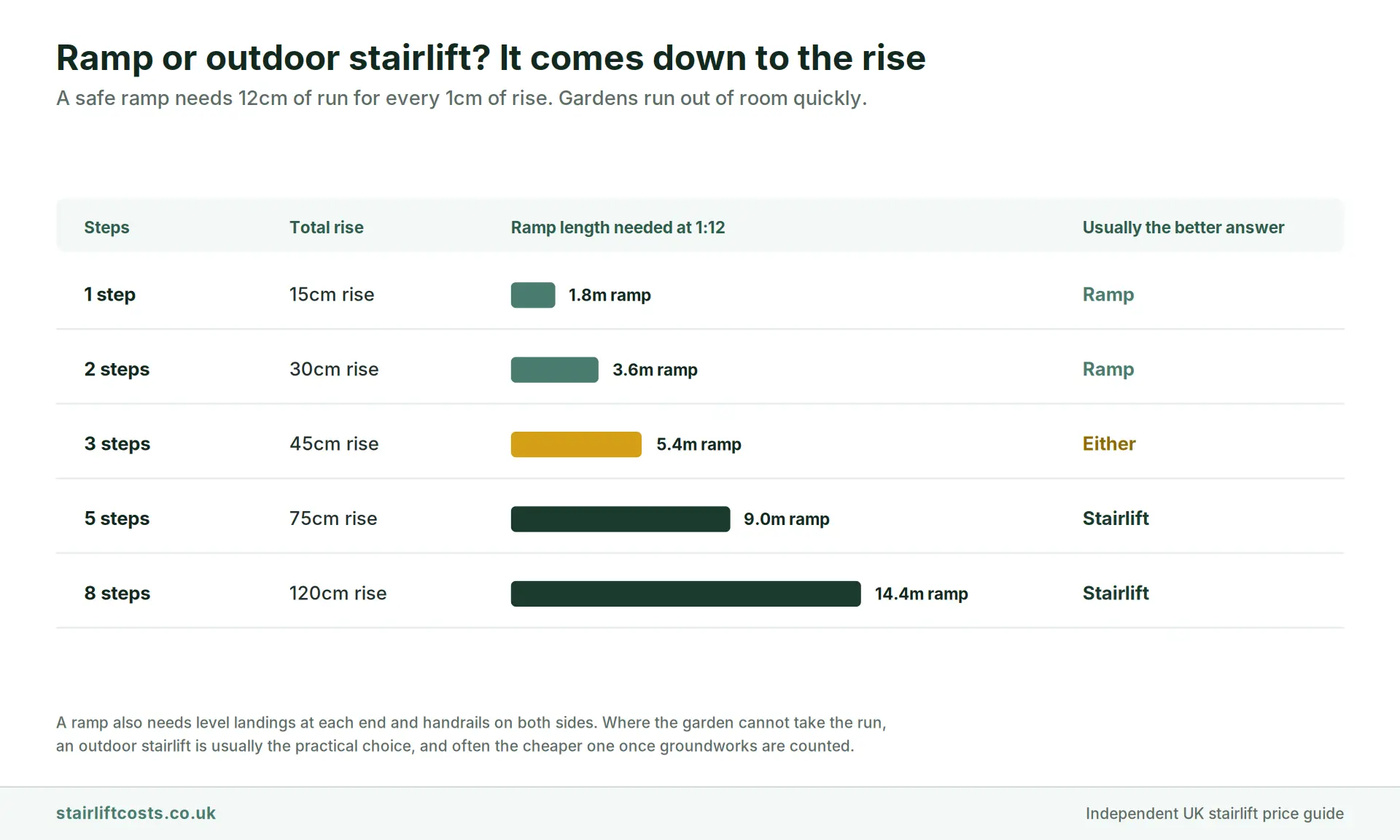
One step needs about 1.8 metres of run, two need 3.6 metres, three need 5.4 metres, five need 9.0 metres and eight need 14.4 metres. Add level landings top and bottom, handrails both sides and a minimum width, and the verdict flips at about three steps: below that a ramp is cheaper, simpler and maintenance free, and above it a compliant ramp rarely fits a domestic frontage. That is the point where an outdoor lift starts to make sense, and it is why councils offer a ramp first and then reconsider.
| Option | Typical installed cost | Best for |
|---|---|---|
| Outdoor stairlift, straight | £3,000 to £5,000 | Four or more steps where a ramp will not fit, and the user can walk to the lift and sit |
| Outdoor stairlift, curved | £5,500 to £9,000 | External flights that turn, dogleg or break at a landing |
| Ramp | Varies with length, material and landings | A rise of one to three steps with room for the run. No power, no servicing |
| Step lift or short-rise platform lift | Considerably more than a stairlift | Wheelchair users over a short rise. Outdoor rated models exist and do publish ingress protection ratings |
| Through-floor lift | Substantially more again | Moving between floors indoors rather than solving an external approach |
| Handrails, half steps or re-grading the path | Modest | Users who mainly need something to hold, or where one awkward step is the problem |
| Relocating the entrance | Varies | Homes with a level approach at the side or rear that nobody has thought to use |
Last verified: August 2026
What to ask before you sign
Get three quotes and say you are comparing. On an outdoor lift the differences hide in the aftercare and the groundworks, not the headline price.
- Is this price fully installed, or is installation itemised separately anywhere on the quotation?
- Is this at 0%, 5% or 20% VAT, will you supply the declaration, and does the zero rate cover servicing?
- Is the outdoor socket and isolator included, who certifies the electrical work, and is it notified under Part P?
- How many service visits a year do you recommend outdoors, and what is the per visit price after the warranty?
- How long is the warranty on this outdoor model, and can I see the exclusions in writing?
- Are corrosion, water ingress and storm damage covered or excluded?
- What is the rated operating temperature range, and the ingress protection rating of the controls and call stations?
- What is the rated weight limit of the outdoor model, not the indoor equivalent?
- What work do the steps need first, and is it priced here rather than left to be assessed?
- Where does the carriage park, does it block the steps or the door, and does water collect there?
- What cover is supplied, fabric or hard, and what does a replacement cost?
- What is the removal cost at end of life, is making good included, and who handles any consent application?
Your rights, and the red flags
Stairlifts are usually sold in your home, which makes them an off-premises contract with a 14 day right to cancel under the Consumer Contracts Regulations 2013. Goods made to measure or personalised are excluded, and suppliers apply that to stairlifts routinely. The claim is much stronger for a bespoke curved external rail than for a stock straight rail cut to length, so push back if you are told a straight outdoor lift cannot be cancelled. Where the cancellation information was not given in writing, the period extends by twelve months.
Walk away from: a price that only holds if you sign today, the cancelled order going cheap pitch, groundworks left as to be assessed with no figure, or a refusal to put warranty exclusions in writing. The British Healthcare Trades Association code bans price-dropping and pressurised selling by its members, offers binding dispute resolution and is approved by the Chartered Trading Standards Institute.
Frequently asked questions
How much does an outdoor stairlift cost in the UK?
An outdoor stairlift costs £3,000 to £5,000 fully installed on straight external steps in 2026. A short run of a few steps sits at £3,000 to £4,200 and a long run down a garden or bank at £4,000 to £5,000. A curved outdoor rail, made to measure for a flight that turns, costs £5,500 to £9,000.
Are outdoor stairlifts really weatherproof?
Outdoor stairlifts have sealed motors, control boards and batteries, weather-treated components, sunlight-resistant upholstery and weatherproof housings on the call buttons. They also come with a full-length waterproof cover that has to be put on after every journey to do its job. No UK manufacturer publishes an ingress protection rating for the lift itself, so ask what any quoted rating covers.
Do I need planning permission for an outdoor stairlift?
Possibly. There is no permitted development right for stairlifts or disabled access, so the test is whether the installation materially affects the external appearance of the building. A slim rail on rear steps often does not, while a rail on the front elevation visible from the street is more likely to need permission. Applications for disabled access are exempt from the fee, but permission is still required.
Does an outdoor stairlift work in a power cut?
Yes. Outdoor stairlifts run on batteries that trickle charge from the outdoor supply, so the lift keeps working when the mains fails, usually for several return journeys. That is one reason not to switch the lift off at the isolator for long periods: the batteries need to stay on charge, and a flat pair in cold weather is a common winter failure.
Will an outdoor stairlift work in freezing weather?
Outdoor models publish an operating temperature range and it varies. One widely fitted lift is rated from minus 10C to plus 40C and another from minus 10C to plus 50C, so ask for the figure for the model quoted. Cold also shortens battery life, which makes winter charging and using the cover the two things that decide reliability.
How often does an outdoor stairlift need servicing?
Outdoor lifts are commonly serviced twice a year rather than annually, because rain, salt, grit and sunlight act on the rail, seals and upholstery. Each visit costs £100 to £200 once the warranty ends, so budget for two. Ask for the per visit price in writing rather than accepting a generic annual figure quoted for indoor lifts.
Is a ramp cheaper than an outdoor stairlift?
For one or two steps, almost always. At a 1 in 12 gradient a ramp needs 1.8 metres of run per step, so one step needs 1.8 metres, two need 3.6 metres and three need 5.4 metres, plus landings. By five steps the run is 9.0 metres and by eight it is 14.4 metres, which rarely fits a domestic frontage. The verdict usually flips towards a stairlift at about three steps.
Can I get a grant for an outdoor stairlift?
Yes, in principle. A Disabled Facilities Grant covers works facilitating access to and from the dwelling, not only works inside it, so external access is in scope after an occupational therapy assessment. Councils fund the least expensive adaptation that meets the assessed need, so a ramp is usually offered first where one fits. Apply before ordering, because a grant cannot pay for work already done.
Can I rent an outdoor stairlift?
Rarely. UK rental fleets are built around stock indoor straight rails, and we could not find a supplier publicly advertising an outdoor stairlift for hire. That is an absence of any published offer rather than a refusal, so it is still worth asking locally. For a short-term need outdoors, a temporary modular ramp system is the more realistic option.
Can an outdoor stairlift be fitted to timber decking or garden steps?
Not without preparation. The rail bolts into the steps rather than the house wall, so the steps carry the load and must be solid and reasonably even. Concrete, stone and brick take fixings well. Timber decking, loose paving slabs and crumbling edges usually need repairing or rebuilding first, and that work is normally quoted separately from the lift.
How long does an outdoor stairlift last?
Expect roughly 7 to 12 years outdoors against 10 to 15 for the same machine indoors, provided it is serviced twice a year and the cover is used. Exposure is what shortens it. Because the rail is cut to one specific flight, assume no resale or buy-back value and budget £150 to £300 for removal at the end.
Is an outdoor stairlift more expensive than an indoor one?
Yes. An outdoor straight stairlift at £3,000 to £5,000 costs meaningfully more than an equivalent indoor straight lift, because of the sealing, the weatherproofed components and the outdoor power supply. Running costs are higher too, mainly through twice yearly servicing. Ask any supplier quoting only a small premium exactly what the outdoor specification adds.
When an outdoor stairlift may not be the right choice
An outdoor stairlift solves a specific problem, but it is not always the best answer. Consider these alternatives before committing.
A permanent ramp may be better if: the steps are few (typically six or fewer), the gradient allows it, and the user is a wheelchair user or finds a stairlift seat difficult. A concrete or aluminium ramp costs less to install and has no ongoing maintenance, servicing or battery costs. Your local council can assess whether a ramp is feasible as part of a Disabled Facilities Grant application.
A platform lift (vertical or inclined) may be better if: the user is a full-time wheelchair user, the height change is significant, or the outdoor steps are too steep or narrow for a rail-mounted stairlift. Platform lifts are more expensive but provide direct wheelchair access without transferring to a seat.
Relocating the entrance may be worth considering if: the property has a secondary access point (a side door, patio, or garage) that avoids the steps entirely. A simple path and threshold adaptation can sometimes eliminate the need for any lifting equipment. An occupational therapist can assess all access routes during a home visit.
Watch: Outdoor Stairlift Costs

From our YouTube channel.